
Close Menu
    Facebook X (Twitter) Instagram
    SciTechDaily
    • Biology
    • Chemistry
    • Earth
    • Health
    • Physics
    • Science
    • Space
    • Technology
    Facebook X (Twitter) Pinterest YouTube RSS
    SciTechDaily
    Home»Space»Cassini Reveals the Diverse Hemisphere of Enceladus
    Space

    Cassini Reveals the Diverse Hemisphere of Enceladus

    By SciTechDailyOctober 26, 2015No Comments1 Min Read
    Facebook Twitter Pinterest Telegram LinkedIn WhatsApp Email Reddit
    Share
    Facebook Twitter LinkedIn Pinterest Telegram Email Reddit
    New Cassini Image of Saturn's Moon Enceladus
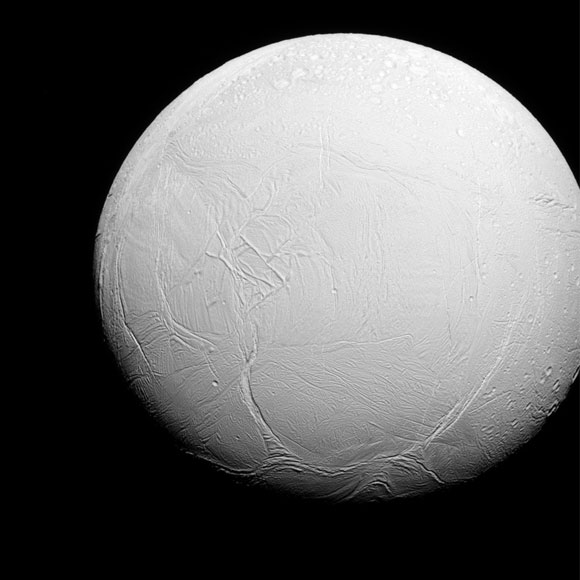
    Saturn’s moon Enceladus. Credit: NASA/JPL-Caltech/Space Science Institute

    This new Cassini image helps reveal the different features of Saturn’s moon Enceladus.

    Enceladus is a world divided. To the north, the terrain is covered in impact craters, much like other icy moons. But to the south, the record of impact cratering is much more sparse, and instead, the land is covered in fractures, ropy or hummocky terrain, and long, linear features.

    Lit terrain seen here is on the leading side of Enceladus. North on Enceladus is up. The image was taken in visible green light with the Cassini spacecraft narrow-angle camera on July 27, 2015.

    The view was obtained at a distance of approximately 70,000 miles (112,000 kilometers) from Enceladus and at a Sun-Enceladus-spacecraft, or phase, angle of 25 degrees. Image scale is 0.4 miles (0.7 kilometers) per pixel.

    Never miss a breakthrough: Join the SciTechDaily newsletter.
    Follow us on Google and Google News.

    Cassini-Huygens Mission Enceladus European Space Agency NASA Planetary Science
    Share. Facebook Twitter Pinterest LinkedIn Email Reddit

    Related Articles

    Cassini Flyby Provides New Close-Up of Saturn’s Moon Enceladus

    Cassini Completes Deepest-Ever Dive Through the Icy Plume of Enceladus

    ScienceCasts Video: Close Encounter with Enceladus

    Cassini’s Deepest-Ever Dive Through the Enceladus Plume

    NASA Prepares for Historic Flyby of Icy Saturn Moon Enceladus

    NASA’s Cassini Reveals New Views of Saturn’s Moon Enceladus

    Cassini Spacecraft to Begin Flyby of Saturn’s Moon Enceladus

    Cassini Reveals Global Ocean in Saturn’s Moon Enceladus

    NASA Detects Ocean Inside Saturn’s Moon Enceladus

    Leave A Reply Cancel Reply

    • Facebook
    • Twitter
    • Pinterest
    • YouTube

    Don't Miss a Discovery

    Subscribe for the Latest in Science & Tech!

    Trending News

    A Star Near the Milky Way’s Black Hole Is Losing Mass at an Astonishing Rate

    Scientists Solve a Vitamin B12 Mystery With an Unexpected Culprit

    Has the Autism Spectrum Become Too Broad? Leading Scientist Warns of Hidden Consequences

    Rewriting History: Researchers Uncover a Forgotten Amazon Civilization That May Have Housed 3 Million People

    New Research May Change How We Think About Weight Loss Drugs Like Ozempic

    Coffee Drinkers Show Surprising Differences in Fat, Muscle, and Hormones

    New Treatment Targets Gum Disease Without Killing Good Bacteria

    Scientists Discover a 245-Million-Year-Old Reptile With Its Organs Still Preserved

    Follow SciTechDaily
    • Facebook
    • Twitter
    • YouTube
    • Pinterest
    • Newsletter
    • RSS
    SciTech News
    • Biology News
    • Chemistry News
    • Earth News
    • Health News
    • Physics News
    • Science News
    • Space News
    • Technology News
    Recent Posts
    • Scientists Reveal How ADHD Could Fuel Creative Thinking
    • Scientists Find a Surprising Diabetes-Fighting Compound in Turmeric
    • Archaeologists Discover a 10,000-Year Human History Hidden in the Pyrenees
    • Scientists Discover a Surprising Link Between Human Genes and Language
    • Archaeologists Discover a Forgotten 3,000-Year-Old Egyptian Tomb – Now They’re Racing To Save It
    Copyright © 1998 - 2026 SciTechDaily. All Rights Reserved.
    • Science News
    • About
    • Contact
    • Editorial Board
    • Privacy Policy
    • Terms of Use

    Type above and press Enter to search. Press Esc to cancel.