
Close Menu
    Facebook X (Twitter) Instagram
    SciTechDaily
    • Biology
    • Chemistry
    • Earth
    • Health
    • Physics
    • Science
    • Space
    • Technology
    Facebook X (Twitter) Pinterest YouTube RSS
    SciTechDaily
    Home»Space»NASA’s Solar Dynamics Observatory Views a Trio of Solar Flares
    Space

    NASA’s Solar Dynamics Observatory Views a Trio of Solar Flares

    By Sarah Frazier, NASA's Goddard Space Flight CenterApril 3, 2017No Comments3 Mins Read
    Facebook Twitter Pinterest Telegram LinkedIn WhatsApp Email Reddit
    Share
    Facebook Twitter LinkedIn Pinterest Telegram Email Reddit
    NASA’s Solar Dynamics Observatory Captured Trio of Solar Flares
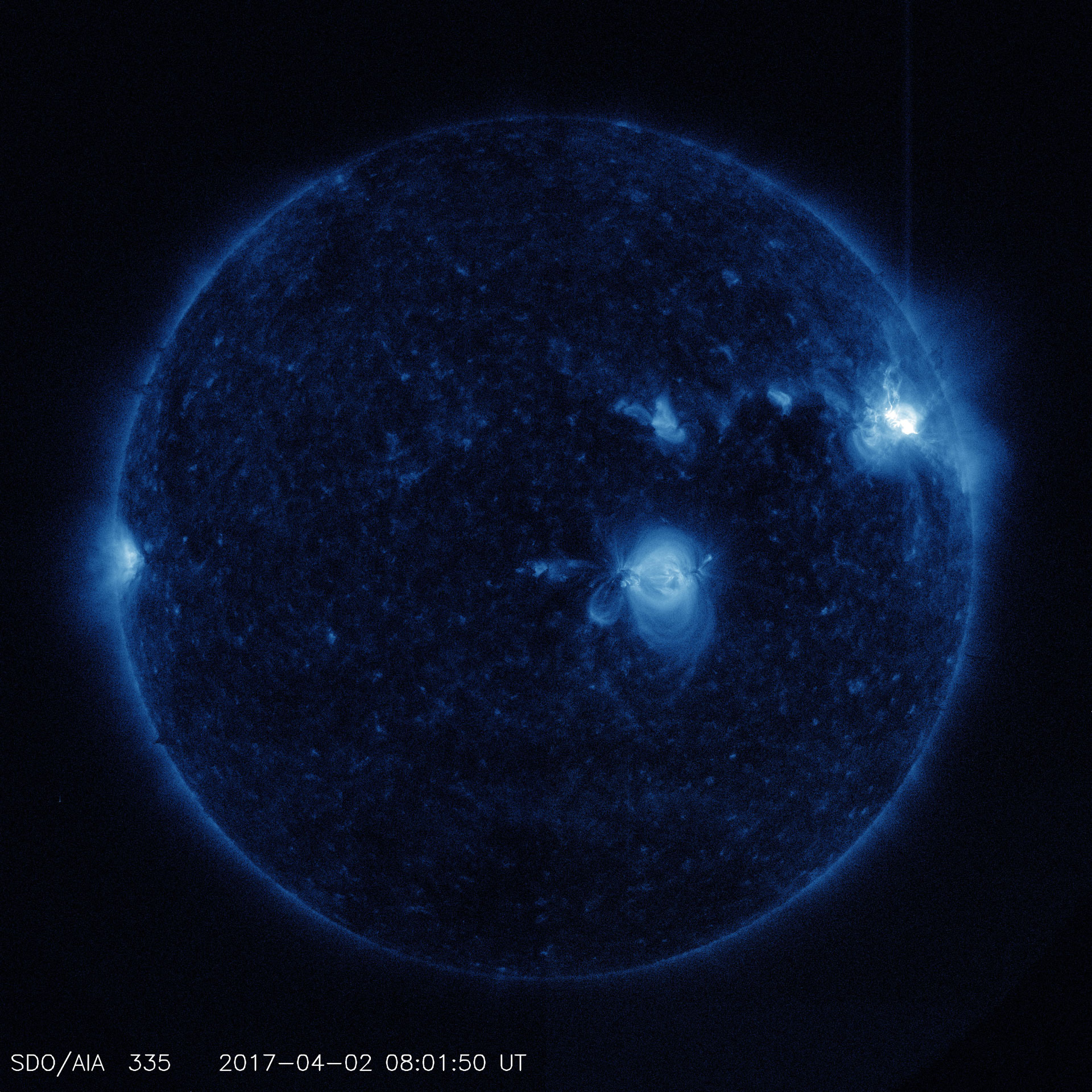
    NASA’s Solar Dynamics Observatory captured this image of a solar flare peaking at 4:02 a.m. EDT on April 2, 2017, as seen in the bright flash near the sun’s upper right edge. The image shows a subset of extreme ultraviolet light that highlights the extremely hot material in flares and which is typically colorized in blue.

    NASA’s Solar Dynamics Observatory captured the new images of the three solar flares.

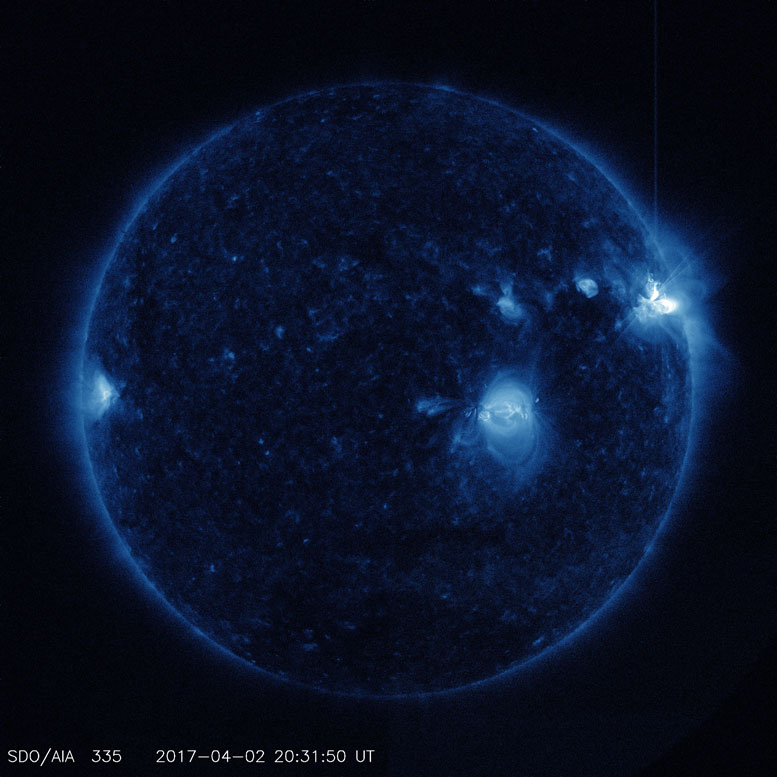
    The sun emitted a trio of mid-level solar flares on April 2-3, 2017. The first peaked at 4:02 a.m. EDT on April 2, the second peaked at 4:33 p.m. EDT on April 2, and the third peaked at 10:29 a.m. EDT on April 3. NASA’s Solar Dynamics Observatory, which watches the sun constantly, captured images of the three events. Solar flares are powerful bursts of radiation. Harmful radiation from a flare cannot pass through Earth’s atmosphere to physically affect humans on the ground, however — when intense enough — they can disturb the atmosphere in the layer where GPS and communications signals travel.
    Solar Dynamics Observatory Captured Trio of Solar Flares
    NASA’s Solar Dynamics Observatory captured this image of a solar flare peaking at 4:33 p.m. EDT on April 2, 2017, as seen in the bright flash near the sun’s upper right edge. The image shows a subset of extreme ultraviolet light that highlights the extremely hot material in flares and which is typically colorized in blue.
    NASA’s SDO Captured Trio of Solar Flares
    NASA’s Solar Dynamics Observatory captured this image of a solar flare peaking at 10:29 a.m. EDT on April 3, 2017, as seen in the bright flash near the sun’s upper right edge. The image shows a subset of extreme ultraviolet light that highlights the extremely hot material in flares and which is typically colorized in teal.

    To see how this event may affect Earth, please visit NOAA’s Space Weather Prediction Center at http://spaceweather.gov, the U.S. government’s official source for space weather forecasts, alerts, watches and warnings.

    The first April 2 flare was classified as an M5.3 flare, while the second April 2 was an M5.7 flare. The April 3 flare was classified as an M5.8 flare. M-class flares are a tenth the size of the most intense flares, the X-class flares. The number provides more information about its strength. An M2 is twice as intense as an M1, an M3 is three times as intense, etc.  

    Related Link

    • NASA’s SDO website

    Never miss a breakthrough: Join the SciTechDaily newsletter.
    Follow us on Google and Google News.

    Astronomy Solar Dynamics Observatory Solar Flares
    Share. Facebook Twitter Pinterest LinkedIn Email Reddit

    Related Articles

    Sun’s Fury Unleashed: NASA’s Solar Dynamics Observatory Captures Intense X1.6 Solar Flare

    Intensely Powerful X1.0 Solar Flare Witnessed by NASA’s Solar Dynamics Observatory

    Radiant Fury: Sun Unleashes Powerful X1.0 Class Solar Flare

    Breathtaking X-Class Solar Flare Bursts From the Sun

    Powerful X1 Solar Flare Erupts From Sun

    Powerful X-Class Solar Flare Erupts From Sun – Captured by NASA’s Solar Dynamics Observatory

    Moderate Solar Flare Erupts From Sun – Captured by NASA’s Solar Dynamics Observatory

    In 1999 Mysterious Finger-Like Features Were Spotted on the Sun – Now Scientists Have an Explanation

    NASA’s Solar Dynamics Observatory Captures Mid-Level Flare Erupting From the Sun

    Leave A Reply Cancel Reply

    • Facebook
    • Twitter
    • Pinterest
    • YouTube

    Don't Miss a Discovery

    Subscribe for the Latest in Science & Tech!

    Trending News

    Dark Matter May Be Leaving a Signal in Earth’s Atmosphere

    Scientists Discover a 300-Million-Year-Old Geological Time Capsule Inside Fossilized Wood

    Oral Weight Loss Pill Helps Patients Lose up to 12% of Body Weight

    Scientists Find Two New Ways To Break Down “Forever Chemicals” in Water

    Pesticide Exposure May Carry a Serious Neurological Risk Years Later

    Ozempic Could Fight Addiction Too – Scientists Finally Know How

    Two Mysterious ‘Ghost’ Ancestors Are Hiding in Our DNA

    This Widely Used Plastic Could Be Harming Your Liver

    Follow SciTechDaily
    • Facebook
    • Twitter
    • YouTube
    • Pinterest
    • Newsletter
    • RSS
    SciTech News
    • Biology News
    • Chemistry News
    • Earth News
    • Health News
    • Physics News
    • Science News
    • Space News
    • Technology News
    Recent Posts
    • This AI Can Find the Missing Atoms That X-Rays Cannot See
    • Scientists Catch a Hidden Electronic State Forming Almost Instantly
    • Starlink Satellites Reveal a Hidden Atmosphere 300 Miles Above Earth
    • Cancer Cells Exploit a Hidden Immune “Off Switch”
    • Rare Human Brain Study Reveals How an Alzheimer’s Drug May Protect the Brain
    Copyright © 1998 - 2026 SciTechDaily. All Rights Reserved.
    • Science News
    • About
    • Contact
    • Editorial Board
    • Privacy Policy
    • Terms of Use

    Type above and press Enter to search. Press Esc to cancel.