
Close Menu
    Facebook X (Twitter) Instagram
    SciTechDaily
    • Biology
    • Chemistry
    • Earth
    • Health
    • Physics
    • Science
    • Space
    • Technology
    Facebook X (Twitter) Pinterest YouTube RSS
    SciTechDaily
    Home»Space»ESO Astronomers View a Great Cold Spot on Jupiter
    Space

    ESO Astronomers View a Great Cold Spot on Jupiter

    By ESO/T. StallardApril 17, 2017No Comments2 Mins Read
    Facebook Twitter Pinterest Telegram LinkedIn WhatsApp Email Reddit
    Share
    Facebook Twitter LinkedIn Pinterest Telegram Email Reddit
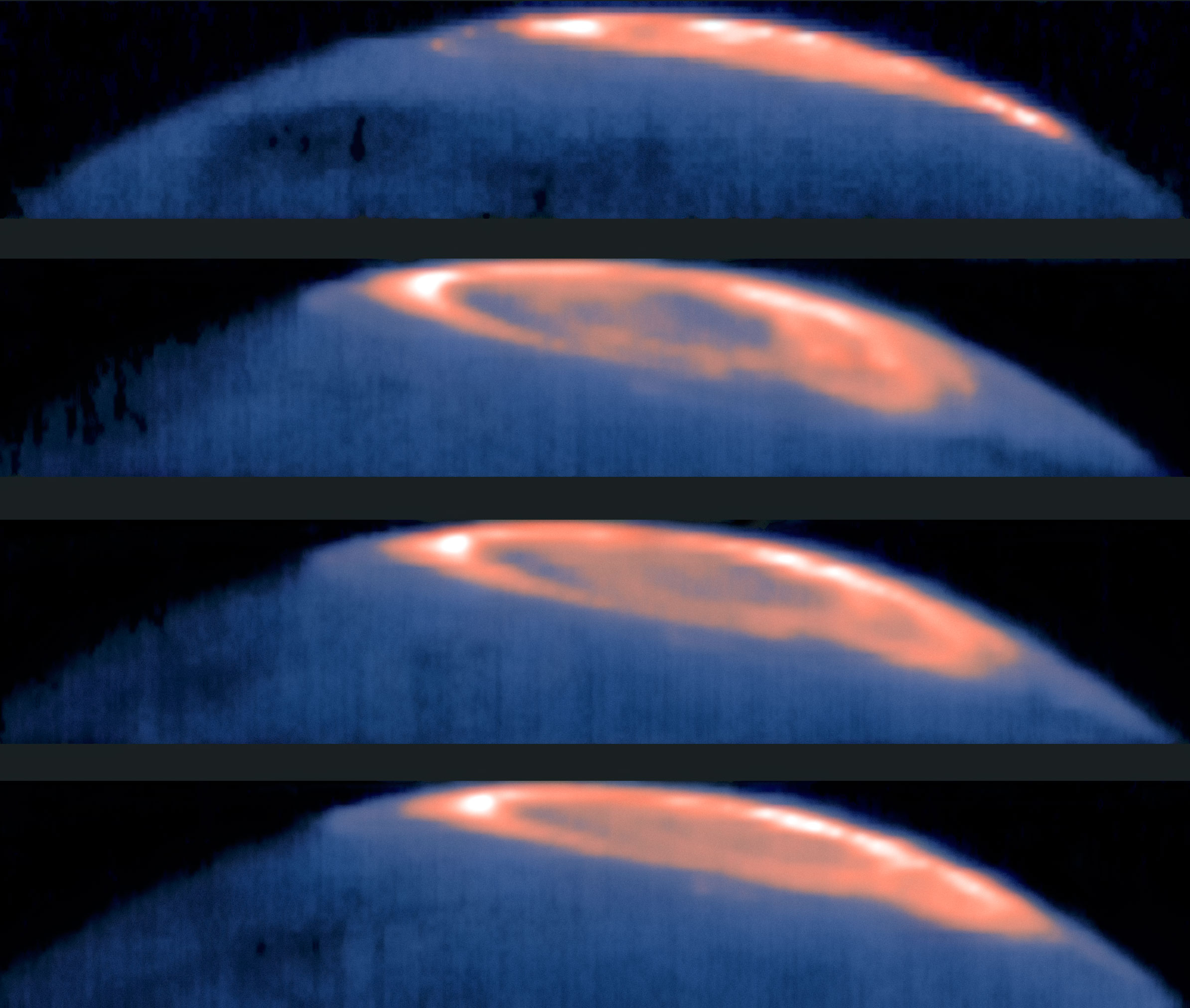
    ESO Views a Great Cold Spot Discovered on Jupiter
    A giant cold spot on Jupiter, which is believed to be caused by the planet’s powerful aurorae.

    This newly released image from the CRIRES instrument on ESO’s Very Large Telescope shows a giant cold spot on Jupiter, which is believed to be caused by the planet’s powerful aurorae.

    Jupiter’s Great Red Spot is a gigantic storm (so big it could engulf several Earths) that has been raging for centuries with winds blasting at over 600 kilometers (370 miles) per hour. But it has a rival: astronomers have discovered that Jupiter has a second Great Spot, this time a cold one.

    In the polar regions of Jupiter, astronomers using the CRIRES instrument on ESO’s Very Large Telescope have found a dark spot in the upper atmosphere (below the aurora to the left) about 200 °C (390 °F)cooler than its surroundings. Aptly nicknamed the “Great Cold Spot,” this intriguing feature is comparable in size to the Great Red Spot — 24,000 km (15,000 mi) across and 12,000 km (7,500 mi) tall. But data taken over 15 years show that the Great Cold Spot is much more volatile than its slowly-changing cousin. It changes dramatically in shape and size over days and weeks — but never disappears, and always stays roughly in the same location.

    The Great Cold Spot is thought to be caused by the planet’s powerful aurorae, which drive energy into the atmosphere in the form of heat that flows around the planet. This creates a cooler region in the upper atmosphere, making the Great Cold Spot the first weather system ever observed to be generated by aurorae.

    Never miss a breakthrough: Join the SciTechDaily newsletter.
    Follow us on Google and Google News.

    Astronomy European Southern Observatory Jupiter Planetary Science Very Large Telescope
    Share. Facebook Twitter Pinterest LinkedIn Email Reddit

    Related Articles

    ESO’s VLT Captures Remarkably Sharp Test Images of Neptune

    ESO Detects Titanium Oxide in Atmosphere of Exoplanet WASP-19b

    Astronomers Measure the Length of an Exoplanet Day

    ESO’s Very Large Telescope Views Planetary Nebula Abell 33

    Planetary Nebula Fleming 1 Likely Has Two White Dwarfs Circling Each Other at Its Center

    Jupiter’s Atmosphere Experiencing Large Scale Changes

    ESO’s New Image of Spiral Galaxy NGC 1187

    VLT Reveals That O Stars, Which Drive the Evolution of Galaxies, Don’t Live Alone

    Scientists Detect Dark Galaxies for the First Time

    Leave A Reply Cancel Reply

    • Facebook
    • Twitter
    • Pinterest
    • YouTube

    Don't Miss a Discovery

    Subscribe for the Latest in Science & Tech!

    Trending News

    The Strange “Spacetime Crystal” That Can Suddenly Turn Into a Black Hole

    The Surprising Way Asteroids May Have Helped Life Begin on Earth

    Vast Hidden Structure Discovered Under Miles of Ice in East Antarctica

    A Surprising Discovery Suggests Autism Is Not One Condition

    New Alzheimer’s Discovery Could Change How Scientists Fight the Disease

    Yale Discovery Overturns Long-Held “Evolutionary Dead End” Theory

    UCLA Scientists Uncover a “Hidden Weakness” in Some of the World’s Deadliest Cancers

    Humpback Whale Stuns Scientists With 15,000 Kilometer Journey Across Oceans

    Follow SciTechDaily
    • Facebook
    • Twitter
    • YouTube
    • Pinterest
    • Newsletter
    • RSS
    SciTech News
    • Biology News
    • Chemistry News
    • Earth News
    • Health News
    • Physics News
    • Science News
    • Space News
    • Technology News
    Recent Posts
    • Food Waste Becomes a Powerful Carbon Trap in Climate Breakthrough
    • Battery-Free Artificial Photosynthesis Turns Sunlight, Water, and CO2 Into Fuel
    • How Ancient People Moved a 6-Ton Stone 700 Kilometers to Stonehenge
    • Scientists Finally See How Antibodies Really Attack Viruses
    • The Unexpected Gut Health Risk of Cutting Out Sugar
    Copyright © 1998 - 2026 SciTechDaily. All Rights Reserved.
    • Science News
    • About
    • Contact
    • Editorial Board
    • Privacy Policy
    • Terms of Use

    Type above and press Enter to search. Press Esc to cancel.