
Close Menu
    Facebook X (Twitter) Instagram
    SciTechDaily
    • Biology
    • Chemistry
    • Earth
    • Health
    • Physics
    • Science
    • Space
    • Technology
    Facebook X (Twitter) Pinterest YouTube RSS
    SciTechDaily
    Home»Space»ALMA Captures Highest-Resolution Image of Nearby Star Betelgeuse
    Space

    ALMA Captures Highest-Resolution Image of Nearby Star Betelgeuse

    By SciTechDailyJune 26, 2017No Comments2 Mins Read
    Facebook Twitter Pinterest Telegram LinkedIn WhatsApp Email Reddit
    Share
    Facebook Twitter LinkedIn Pinterest Telegram Email Reddit
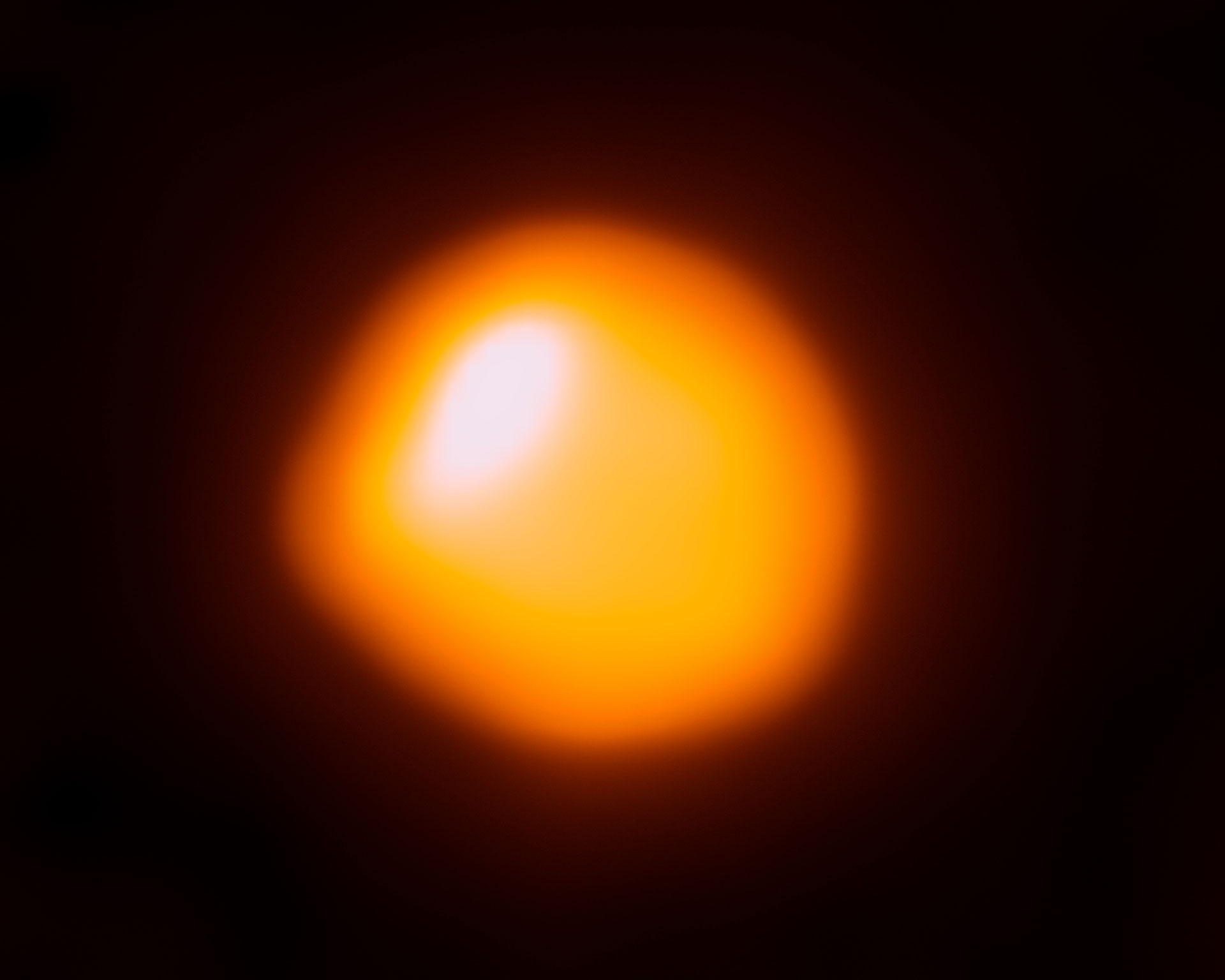
    ALMA Image of Nearby Star Betelgeuse
    Betelgeuse is a giant star in the Orion constellation, located about 600 light-years away from Earth. It has a radius 1400 times larger than the Sun. Credit: ALMA (ESO/NAOJ/NRAO)/E. O’Gorman/P. Kervella

    This new image from the Atacama Large Millimeter/submillimeter Array (ALMA) shows the nearby star Betelgeuse. This is the first time that ALMA has ever observed the surface of a star and this first attempt has resulted in the highest-resolution image of Betelgeuse available.

    Betelgeuse is one of the largest stars currently known — with a radius around 1400 times larger than the Sun’s in the millimeter continuum. About 600 light-years away in the constellation of Orion (The Hunter), the red supergiant burns brightly, causing it to have only a short life expectancy. The star is just about eight million years old, but is already on the verge of becoming a supernova. When that happens, the resulting explosion will be visible from Earth, even in broad daylight.

    The star has been observed in many other wavelengths, particularly in the visible, infrared, and ultraviolet. Using ESO’s Very Large Telescope astronomers discovered a vast plume of gas almost as large as our Solar System. Astronomers have also found a gigantic bubble that boils away on Betelgeuse’s surface. These features help to explain how the star is shedding gas and dust at tremendous rates. In this picture, ALMA observes the hot gas of the lower chromosphere of Betelgeuse at sub-millimeter wavelengths — where localized increased temperatures explain why it is not symmetric. Scientifically, ALMA can help us to understand the extended atmospheres of these hot, blazing stars.

    Reference: “The inhomogeneous sub-millimeter atmosphere of Betelgeuse” by E. O’Gorman, P. Kervella, G. M. Harper, A. M. S. Richards, L. Decin, M. Montargès and I. McDonald, 20 June 2017, Astronomy & Astrophysics.
    DOI: 10.1051/0004-6361/201731171
    arXiv


    Never miss a breakthrough: Join the SciTechDaily newsletter.
    Follow us on Google and Google News.

    ALMA Astronomy Betelgeuse
    Share. Facebook Twitter Pinterest LinkedIn Email Reddit

    Related Articles

    Surprising Insights Into Star Formation From Unprecedented Survey of the “Nurseries” Where Stars Are Born

    Mind the Gap: Direct Link Uncovered Between Protoplanetary Disk Structures and Giant Exoplanets

    Young Chaotic Star System Reveals Secrets of Planet Formation

    Astronomers Were Puzzled by “Great Dimming” of Betelgeuse – Now the Mystery Is Solved

    Earliest Gigantic Black Hole Storm Ever Discovered – Supermassive Black Hole a Telltale Sign About Very Early History of the Universe

    Map of the Nearby Universe Created by Cosmic Cartographers Reveals the Diversity of Star-Forming Galaxies

    Massive Stars Are Formed Not From Dust Disk but From Debris – “A Chaotic Mess”

    Spinning Disks, Oddball Stars, and Strange Planets Help Astronomers Test Theories About Planetary System Formation

    ALMA Peers Back 12.4 Billion Years and Discovers the Most Ancient Galaxy of Its Kind Ever Observed

    Leave A Reply Cancel Reply

    • Facebook
    • Twitter
    • Pinterest
    • YouTube

    Don't Miss a Discovery

    Subscribe for the Latest in Science & Tech!

    Trending News

    Monster Storms on Jupiter Unleash Lightning Beyond Anything on Earth

    Scientists Create “Liquid Gears” That Spin Without Touching

    The Simple Habit That Could Help Prevent Cancer

    Millions Take These IBS Drugs, But a New Study Finds Serious Risks

    Scientists Unlock Hidden Secrets of 2,300-Year-Old Mummies Using Cutting-Edge CT Scanner

    Bread Might Be Making You Gain Weight Even Without Eating More Calories

    Scientists Discover Massive Magma Reservoir Beneath Tuscany

    Europe’s Most Active Volcano Just Got Stranger – Here’s Why Scientists Are Rethinking It

    Follow SciTechDaily
    • Facebook
    • Twitter
    • YouTube
    • Pinterest
    • Newsletter
    • RSS
    SciTech News
    • Biology News
    • Chemistry News
    • Earth News
    • Health News
    • Physics News
    • Science News
    • Space News
    • Technology News
    Recent Posts
    • 25-Year Study Uncovers Hidden Paths and Early Warning Signs of Blood Cancer
    • Not Just Snoring – New Research Reveals Sleep Apnea May Be Damaging Your Muscles
    • Scientists Discover a Surprising Reason Intermittent Fasting Extends Life
    • Scientists Discover a New Meteor Shower From a Mysterious Crumbling Asteroid
    • This Simple Fruit Wash Could Make Produce Safer and Last Days Longer
    Copyright © 1998 - 2026 SciTechDaily. All Rights Reserved.
    • Science News
    • About
    • Contact
    • Editorial Board
    • Privacy Policy
    • Terms of Use

    Type above and press Enter to search. Press Esc to cancel.