
Close Menu
    Facebook X (Twitter) Instagram
    SciTechDaily
    • Biology
    • Chemistry
    • Earth
    • Health
    • Physics
    • Science
    • Space
    • Technology
    Facebook X (Twitter) Pinterest YouTube RSS
    SciTechDaily
    Home»Space»Massive Stars Are Formed Not From Dust Disk but From Debris – “A Chaotic Mess”
    Space

    Massive Stars Are Formed Not From Dust Disk but From Debris – “A Chaotic Mess”

    By Leiden UniversityJune 3, 20212 Comments3 Mins Read
    Facebook Twitter Pinterest Telegram LinkedIn WhatsApp Email Reddit
    Share
    Facebook Twitter LinkedIn Pinterest Telegram Email Reddit
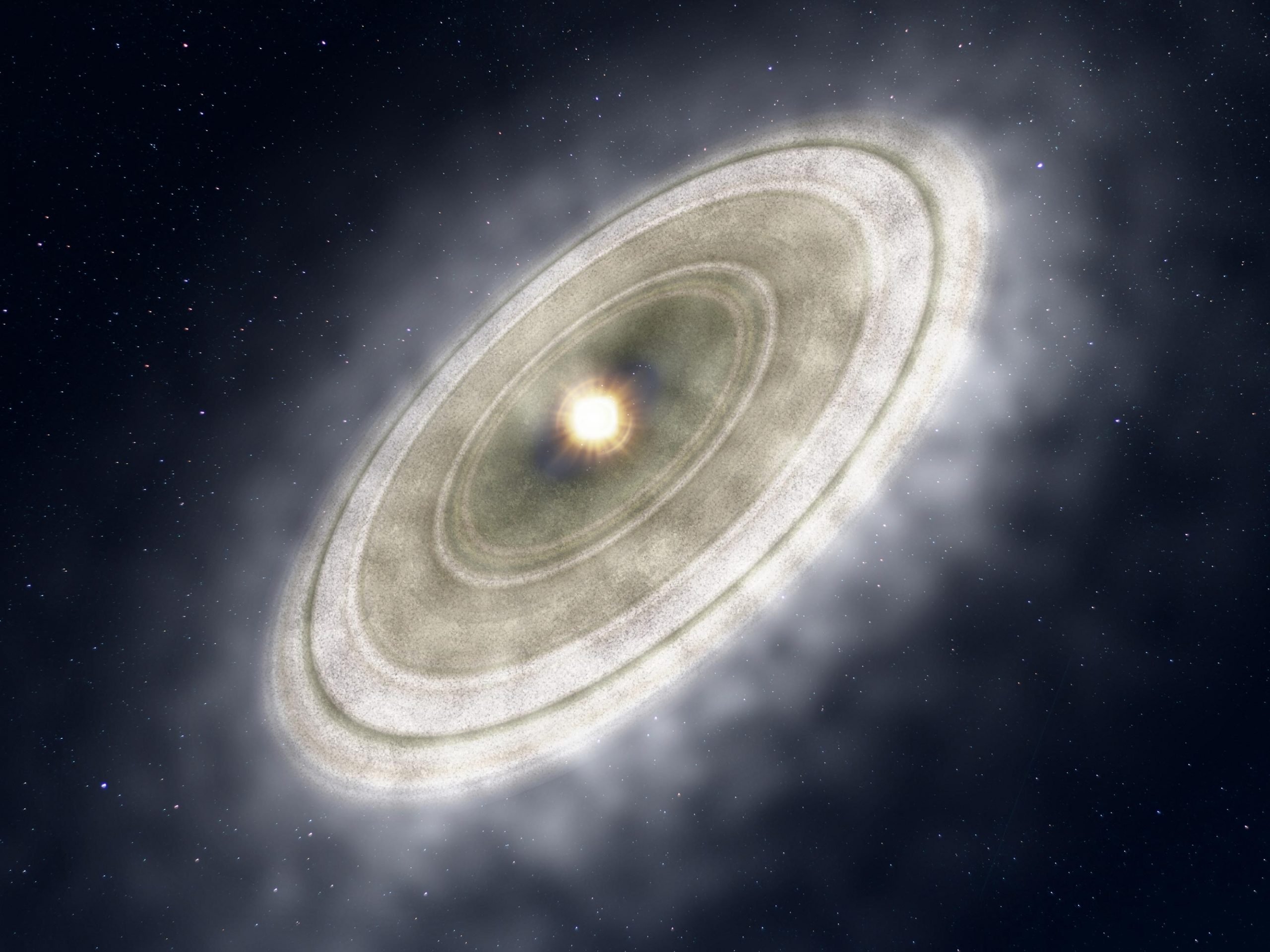
    Gas Rich Debris Disk Around 49 Ceti
    Artist’s impression of the gas-rich debris disk. Credit: NAOJ

    Unlike small stars, large stars form through chaotic matter inflows, not stable disks.

    A Dutch-led team of astronomers has discovered that high-mass stars are formed differently from their smaller siblings. Whereas small stars are often surrounded by an orderly disk of dust and matter, the supply of matter to large stars is a chaotic mess. The researchers used the Atacama Large Millimeter/submillimeter Array (ALMA) telescope for their observations, and recently published their findings in the Astrophysical Journal.

    It is well known how small, young stars are created. They accrete matter from a disk of gas and dust in a relatively orderly fashion. Astronomers have already seen many of these disks of dust around young, low-mass stars but never around young, high-mass stars. This raised the question of whether large stars come into existence in the same way as small ones.

    Large Stars Are Formed in a Different Way

    “Our findings now provide convincing evidence to show that the answer is ‘No,'” according to Ciriaco Goddi, affiliated with the ALMA expertise center Allegro at Leiden University and with Radboud University in Nijmegen.

    Goddi led a team that studied three young, high-mass stars in star-forming region W51, roughly 17,000 light-years from Earth. The researchers were looking in particular for large, stable disks expelling jets of matter perpendicular to the surface of the disk. Such disks should be visible with the high resolution ALMA telescopes.

    Not Stable Disks but Chaos

    Goddi: “But instead of stable disks, we discovered that the accretion zone of young, high-mass stars looks like a chaotic mess.”

    The observation showed strands of gas coming at the young, high-mass stars from all directions. In addition, the researchers saw jets which indicate that there may be small disks, invisible to the telescope. Also, it would appear that some hundred years ago the disk around one of three stars studied rotated. In short: chaos.

    Matter From Multiple Directions

    The researchers concluded that these young, high-mass stars, in their early years at least, are formed by matter coming from multiple directions and at an irregular speed. This is different for small stars, where there is a stable influx of matter. The astronomers suspect that that multiple supply of matter is probably the reason that no large, stable disks can be created.

    “Such an unstructured influx model had previously been proposed, on the basis of computer simulations. We now have the first observational evidence to support the model”, says Goddi.

    Reference: “Multidirectional Mass Accretion and Collimated Outflows on Scales of 100–2000 au in Early Stages of High-mass Protostars” by C. Goddi, A. Ginsburg, L. T. Maud, Q. Zhang and Luis A. Zapata, 9 December 2020, The Astrophysical Journal.
    DOI: 10.3847/1538-4357/abc88e

    Never miss a breakthrough: Join the SciTechDaily newsletter.
    Follow us on Google and Google News.

    ALMA Astronomy Astrophysics Leiden University Stars
    Share. Facebook Twitter Pinterest LinkedIn Email Reddit

    Related Articles

    Astronomers Just Uncovered the Secret Fuel Behind Giant Stars

    A Strange Discovery Just Changed What We Know About the First Stars

    Astronomers Solve the 1936 Mystery of FU Orionis’ Dramatic Outburst

    Mysterious Death of Carbon-Rich Star Plays Out Like Six-Ring Circus

    Surprising Insights Into Star Formation From Unprecedented Survey of the “Nurseries” Where Stars Are Born

    Mind the Gap: Direct Link Uncovered Between Protoplanetary Disk Structures and Giant Exoplanets

    Young Chaotic Star System Reveals Secrets of Planet Formation

    Growing up Stardust: Astronomers Discover That Stars and Planets May Be Siblings

    Distant Colliding Galaxy Dying Out As It Loses the Ability to Form Stars – Ejecting 10,000 Suns-Worth of Gas a Year

    2 Comments

    1. Ed Stauffer on June 4, 2021 9:32 am

      If there is less condensed dark matter it will begin to condense resulting in a higher rate of inflow as well as more uneven inflow.

      Reply
    2. xABBAAA on June 19, 2021 10:35 am

      … hgmh, this is bit odd, it looks like not only the Saturn rings look like that old music flat disc is it similar to the atoms… like that thing is there, but also in that scale too…

      Reply
    Leave A Reply Cancel Reply

    • Facebook
    • Twitter
    • Pinterest
    • YouTube

    Don't Miss a Discovery

    Subscribe for the Latest in Science & Tech!

    Trending News

    The Universe Is Expanding Too Fast and Scientists Can’t Explain Why

    “Like Liquid Metal”: Scientists Create Strange Shape-Shifting Material

    Early Warning Signals of Esophageal Cancer May Be Hiding in Plain Sight

    Common Blood Pressure Drug Shows Surprising Power Against Deadly Antibiotic-Resistant Superbug

    Scientists Uncover Dangerous Connection Between Serotonin and Heart Valve Disease

    Scientists Discover a “Protector” Protein That Could Help Reverse Hair Loss

    Bone-Strengthening Discovery Could Reverse Osteoporosis

    Scientists Uncover Hidden Trigger Behind Stem Cell Aging

    Follow SciTechDaily
    • Facebook
    • Twitter
    • YouTube
    • Pinterest
    • Newsletter
    • RSS
    SciTech News
    • Biology News
    • Chemistry News
    • Earth News
    • Health News
    • Physics News
    • Science News
    • Space News
    • Technology News
    Recent Posts
    • Scientists Create Improved Insulin Cells That Reverse Diabetes in Mice
    • Scientists Stunned After Finding Plant Thought Extinct for 60 Years
    • A Common Diabetes Drug May Hold the Key to Stopping HIV From Coming Back
    • Ancient “Syphilis-Like” Disease in Vietnam Challenges Key Scientific Assumptions
    • Drinking Alcohol To Cope in Your 20s Could Damage Your Brain for Life
    Copyright © 1998 - 2026 SciTechDaily. All Rights Reserved.
    • Science News
    • About
    • Contact
    • Editorial Board
    • Privacy Policy
    • Terms of Use

    Type above and press Enter to search. Press Esc to cancel.