
Close Menu
    Facebook X (Twitter) Instagram
    SciTechDaily
    • Biology
    • Chemistry
    • Earth
    • Health
    • Physics
    • Science
    • Space
    • Technology
    Facebook X (Twitter) Pinterest YouTube RSS
    SciTechDaily
    Home»Space»Hubble Image of the Week – A Distorted Duo
    Space

    Hubble Image of the Week – A Distorted Duo

    By NASAAugust 14, 20171 Comment2 Mins Read
    Facebook Twitter Pinterest Telegram LinkedIn WhatsApp Email Reddit
    Share
    Facebook Twitter LinkedIn Pinterest Telegram Email Reddit
    Hubble Views IC 1727 and NGC 672
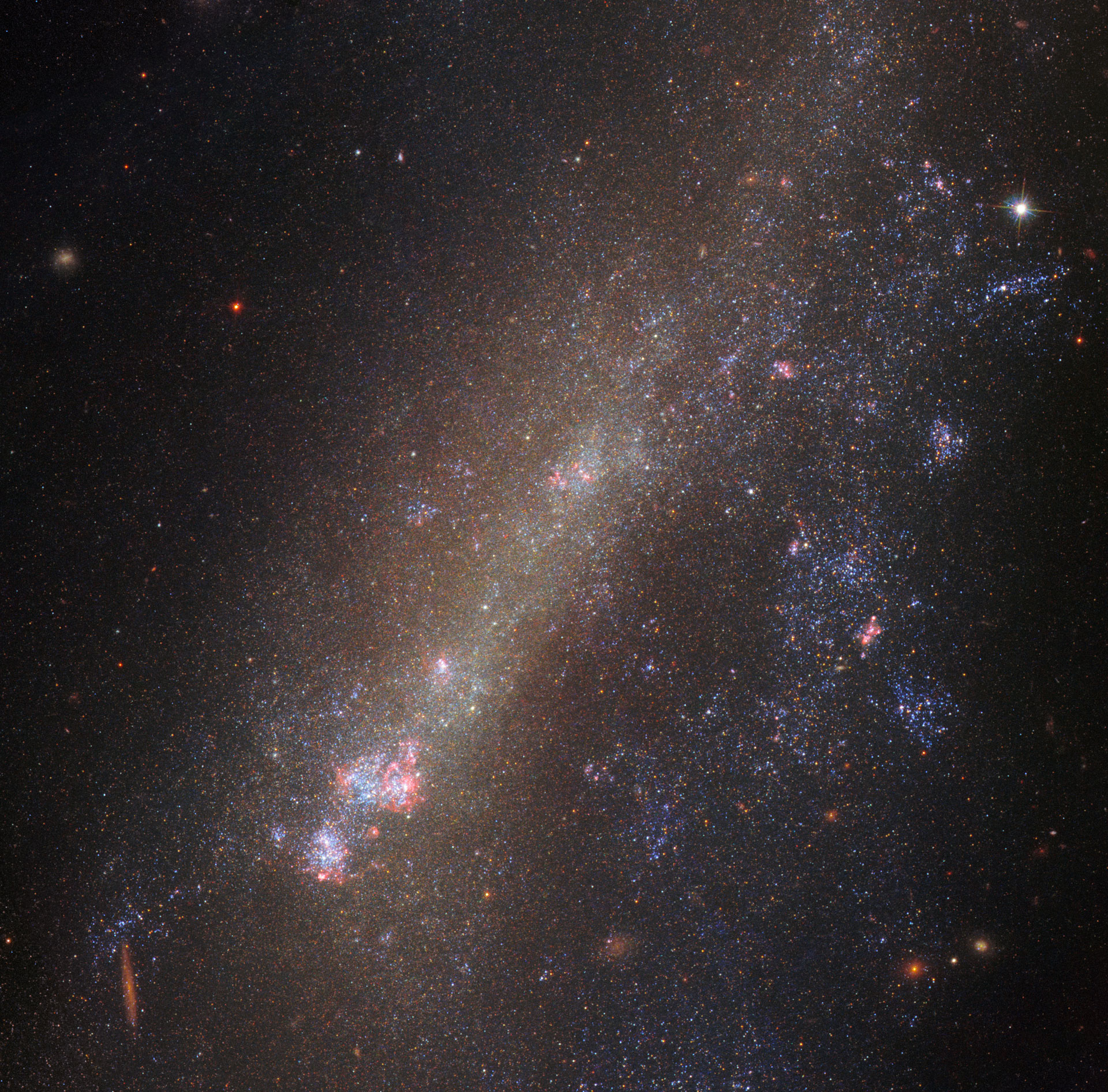
    Hubble image of galaxy IC 1727. It is being twisted and distorted by its nearby neighbor NGC 672. Credit: ESA/Hubble & NASA

    This Hubble Space Telescope image of the week shows galaxy IC 1727, which is currently being twisted and pulled by its near neighbor NGC 672.

    Gravity governs the movements of the cosmos. It attracts flocks of galaxies together to form small groups and more massive galaxy clusters, and brings duos so close that they begin to tug at one another. This latter scenario can have extreme consequences, with members of interacting pairs of galaxies often being dramatically distorted, torn apart, or driven to smash into one another, abandoning their former identities and merging to form a single accumulation of gas, dust, and stars.

    The subject of this NASA/ESA Hubble Space Telescope image, IC 1727, is currently interacting with its near neighbor, NGC 672 (which is just out of frame). The pair’s interactions have triggered peculiar and intriguing phenomena within both objects — most noticeably in IC 1727. The galaxy’s structure is visibly twisted and asymmetric, and its bright nucleus has been dragged off-center.

    In interacting galaxies such as these, astronomers often see signs of intense star formation (in episodic flurries known as starbursts) and spot newly-formed star clusters. They are thought to be caused by gravity churning, redistributing, and compacting the gas and dust. In fact, astronomers have analyzed the star formation within IC 1727 and NGC 672 and discovered something interesting — observations show that simultaneous bursts of star formation occurred in both galaxies some 20 to 30 and 450 to 750 million years ago. The most likely explanation for this is that the galaxies are indeed an interacting pair, approaching each other every so often and swirling up gas and dust as they pass close by.

    Never miss a breakthrough: Join the SciTechDaily newsletter.
    Follow us on Google and Google News.

    Astronomy Hubble Space Telescope NASA
    Share. Facebook Twitter Pinterest LinkedIn Email Reddit

    Related Articles

    Hubble Reveals a Star Disk Three Times Hotter Than the Sun’s Surface

    A Star’s Unexpected Heatwave: FU Orionis Challenges Astrophysics Models

    NASA’s Hubble Reveals How the LMC Defied Galactic Destruction

    Legendary Star’s Smooth Disk Mystifies Astronomers, Challenges Planet Formation Theories

    Cosmic Horror Unveiled: NASA Reveals “Blood-Soaked Eyes” Staring From Deep Space [Video]

    Spanning 248 Billion Miles: Stunning Hubble Timelapse Captures a Star’s Violent Eruptions

    Jupiter’s Great Red Spot Enigma: Unexplained Oscillations Baffle Astronomers

    Unlocking Uranus: NASA’s Dual Observations Pave the Way to Discovering New Worlds

    Astronomers Baffled by Black Hole Jets Igniting Star Explosions

    1 Comment

    1. Valeriy on August 15, 2017 7:23 am

      There are some very complicated issues of galaxy formation. Unfortunately, here is the same problem as with the stars. The origin of galaxies remains unclear, in spite of huge activity in the field. What the “formation” means? It means that we have the material that is assembling into galaxies.

      Reply
    Leave A Reply Cancel Reply

    • Facebook
    • Twitter
    • Pinterest
    • YouTube

    Don't Miss a Discovery

    Subscribe for the Latest in Science & Tech!

    Trending News

    Scientists Say Love Follows Mathematical Patterns

    “Zombie Cells” Reveal a Hidden Weakness That Could Help Fight Aging

    Alien Signals May Be Hiding in a Radio Band SETI Has Barely Explored

    Earth’s Hidden Thermostat Has Regulated Climate for 60 Million Years

    This 518-Million-Year-Old Creature Reveals How Spiders Got Their Bite

    Scientists Built a Programmable Chip That Can Slow Light on Command

    The Backyard “Silly Sprinkler” That Cracked One of Physics’ Biggest Puzzles

    This Common Sleep Habit Could Be Making You Gain Weight

    Follow SciTechDaily
    • Facebook
    • Twitter
    • YouTube
    • Pinterest
    • Newsletter
    • RSS
    SciTech News
    • Biology News
    • Chemistry News
    • Earth News
    • Health News
    • Physics News
    • Science News
    • Space News
    • Technology News
    Recent Posts
    • Where on Earth Was This Fossil 200 Million Years Ago?
    • A 25,000-Year-Old Ritual Tradition Was Hidden Beneath This Cave Floor
    • A Hidden Source of Metal-Mining Emissions Could Be 10x Larger Than Estimated
    • Plant Compounds in Berries, Tea, and Cocoa May Support Healthy Brain Aging
    • Scientists Find a Way To Keep Cancer-Fighting T Cells From Burning Out
    Copyright © 1998 - 2026 SciTechDaily. All Rights Reserved.
    • Science News
    • About
    • Contact
    • Editorial Board
    • Privacy Policy
    • Terms of Use

    Type above and press Enter to search. Press Esc to cancel.