
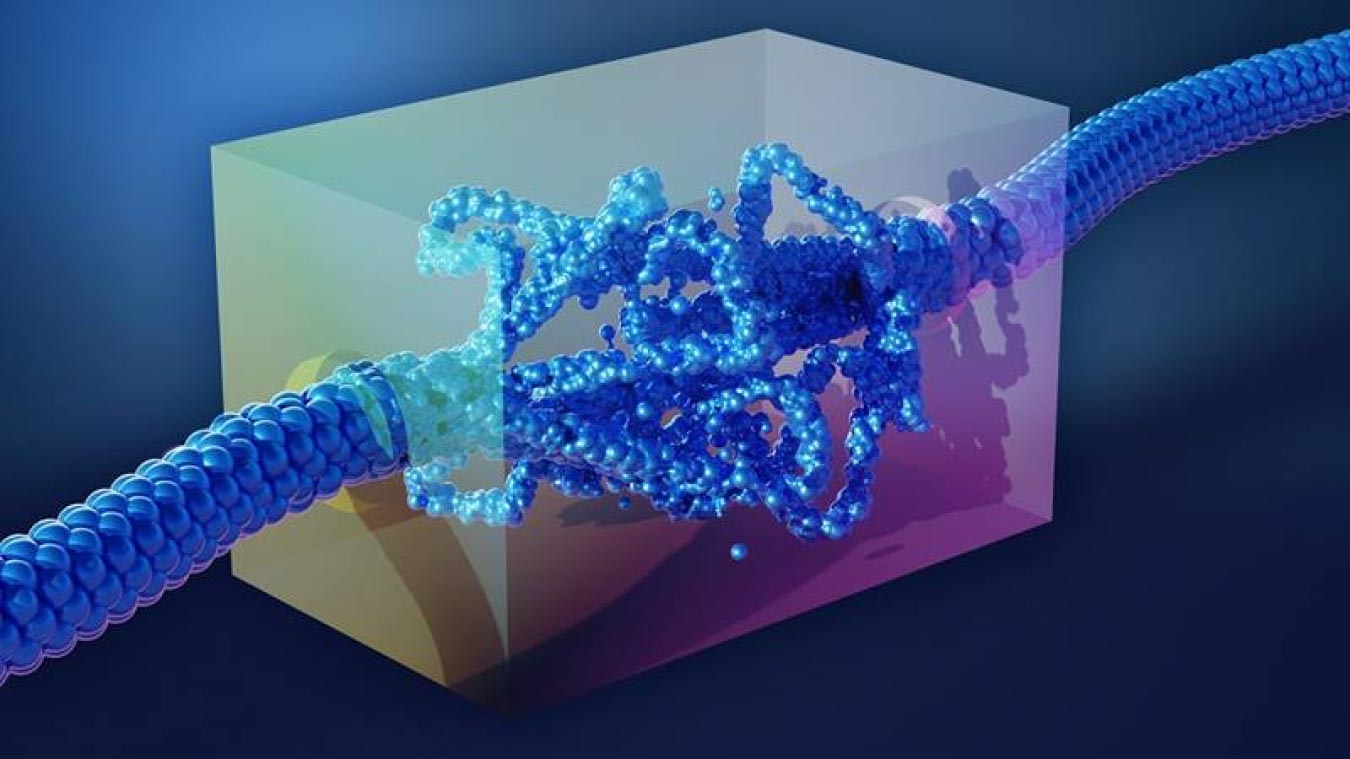
Strange metals challenge the 60-year-old theory that electric current consists of a flow of discrete charges.
Strange metals show electricity carried by a quantum fluid rather than discrete electrons, challenging the long-standing Fermi liquid theory and prompting new research into electrical transport and superconductivity.
We often learn that electricity arises from the movement of electrons through a metal. Each electron carries a discrete, quantized charge. However, this simple picture becomes more complex because electrons naturally repel one another. When a single electron moves, it can disturb the surrounding cloud of neighboring electrons.
When these disturbances are relatively small, electrons no longer move individually but instead behave collectively, forming groups known as electron quasiparticles. Despite this grouping, electrical current is still carried by discrete charges. However, these charges are no longer isolated “free” electrons but are manifestations of collective electron motion. This behavior is described by Fermi liquid theory, which has served as the standard framework for understanding metals for more than sixty years.
Surprisingly, many newly discovered materials, referred to as “strange metals,” do not conform to this traditional model. In these materials, electrical conduction is not carried by discrete electron-like charges. Using a technique called shot noise measurement, researchers have observed that electrons in strange metals blur into a continuous, featureless quantum fluid.
This raises a profound question: if individual electrons are not carrying the current, what is? Fermi liquid theory represents one of the major achievements of condensed matter physics, which is the branch of physics devoted to the study of solid materials. The discovery of strange metals challenges a cornerstone of our understanding. Developing a new theory to explain electrical transport in these unusual materials could lead to transformative insights across physics and materials science.
Connections to High-Temperature Superconductivity
For example, understanding the departure from Fermi liquid behavior might reveal the hidden workings of high temperature superconductors, which in their normal, non-superconducting state behave like strange metals.
Strange metals defy the orthodox understanding of electric transport via discrete charges. In these materials, the resistance changes linearly at low temperature. In contrast, typical metals carriers have a quadratic behavior in resistance change.
To determine whether electricity is transported in discrete chunks, researchers used a technique called shot noise. Shot noise measures random fluctuations in a direct electrical current. These random fluctuations occur because the current is a flow of discrete charges and each charge’s arrival varies statistically. It’s like when a small number of large drops of rain hit a roof.
They do not all hit the roof at the same time, but rather their arrival is distributed. In this case, the shot noise is high. At the other extreme, if the rain is hard enough, there are no drops – the flow of rain is continuous and featureless. In this case, the shot noise is zero. This is what seems to happen in strange metals!
Overcoming Experimental Challenges
Measuring shot noise without external influences is not easy. In a metal, the vibration of the atoms’ lattice can push electrons around and obscure the shot noise. Researchers had to fabricate nanoscale wires so small that electrons pass through them faster than it takes to feel the ripples of the lattice vibrations.
The experiments provided strong evidence that in the strange metal YbRh2Si2 there are no quasiparticles, and the current is not carried by discrete chunks. It’s like electrons lose their identity and meld into a quantum soup. The claim of an absence of quasiparticles is a very strong one, and not all physicists are ready to accept it. These results will spark a flurry of high-profile investigations and contribute to the development of new theories of strange metals.
Reference: “Shot noise in a strange metal” by Liyang Chen, Dale T. Lowder, Emine Bakali, Aaron Maxwell Andrews, Werner Schrenk, Monika Waas, Robert Svagera, Gaku Eguchi, Lukas Prochaska, Yiming Wang, Chandan Setty, Shouvik Sur, Qimiao Si, Silke Paschen and Douglas Natelson, 23 November 2023, Science.
DOI: 10.1126/science.abq6100
This work was funded by the Department of Energy Office of Science, Basic Energy Sciences program’s Experimental Condensed Matter Physics research area. Additional support was provided by the National Science Foundation, the European Research Council, the Austrian Science Fund, the Austrian Research Promotion Agency, a European Union Horizon 2020 grant, the U.S. Air Force Office of Scientific Research, a Robert A. Welch Foundation Grant, and a Vannevar Bush Faculty Fellowship.
Never miss a breakthrough: Join the SciTechDaily newsletter.
Follow us on Google and Google News.
7 Comments
Electricity flows through metals but it also flows on the outside around the metals in a field. If you could visually measure the waves on these electrical towers that you see it would look like a magnetic field all the way down the line
Defying 60 Years of Physics – “Strange Metals” Break the Rules of Electricity。
VERY GOOD!
Ask the researchers:
1. If your researches are scientific, are the Rules you believe in scientific?
2. Is there a difference between science and pseudoscience?
Many pseudo scientific theories in physics are classics and dogmas of so-called peer-reviewed publications.
Many pseudo scientific Rules in physics are classics and dogmas of so-called peer-reviewed publications.
What about “skin effect”? How this theory explains that?
Very thin wire has a huge resistance? Compound with silicone (Si) is it a “metal”?
As I understand this article, electrons melt to flow, or perhaps combine to flow? Could this partially explain electrons acting as both particles and also waves? My understanding is not that good.