
Close Menu
    Facebook X (Twitter) Instagram
    SciTechDaily
    • Biology
    • Chemistry
    • Earth
    • Health
    • Physics
    • Science
    • Space
    • Technology
    Facebook X (Twitter) Pinterest YouTube RSS
    SciTechDaily
    Home»Space»RCS2 J2327 – A Cluster With the Mass of Two Quadrillion Suns
    Space

    RCS2 J2327 – A Cluster With the Mass of Two Quadrillion Suns

    By ESO & ESA/Hubble & NASADecember 26, 2017No Comments2 Mins Read
    Facebook Twitter Pinterest Telegram LinkedIn WhatsApp Email Reddit
    Share
    Facebook Twitter LinkedIn Pinterest Telegram Email Reddit
    Hubble and HAWK-I Explore a Cluster with the Mass of Two Quadrillion Suns
    RCS2 J2327 is one of the most massive clusters known at its distance or beyond.

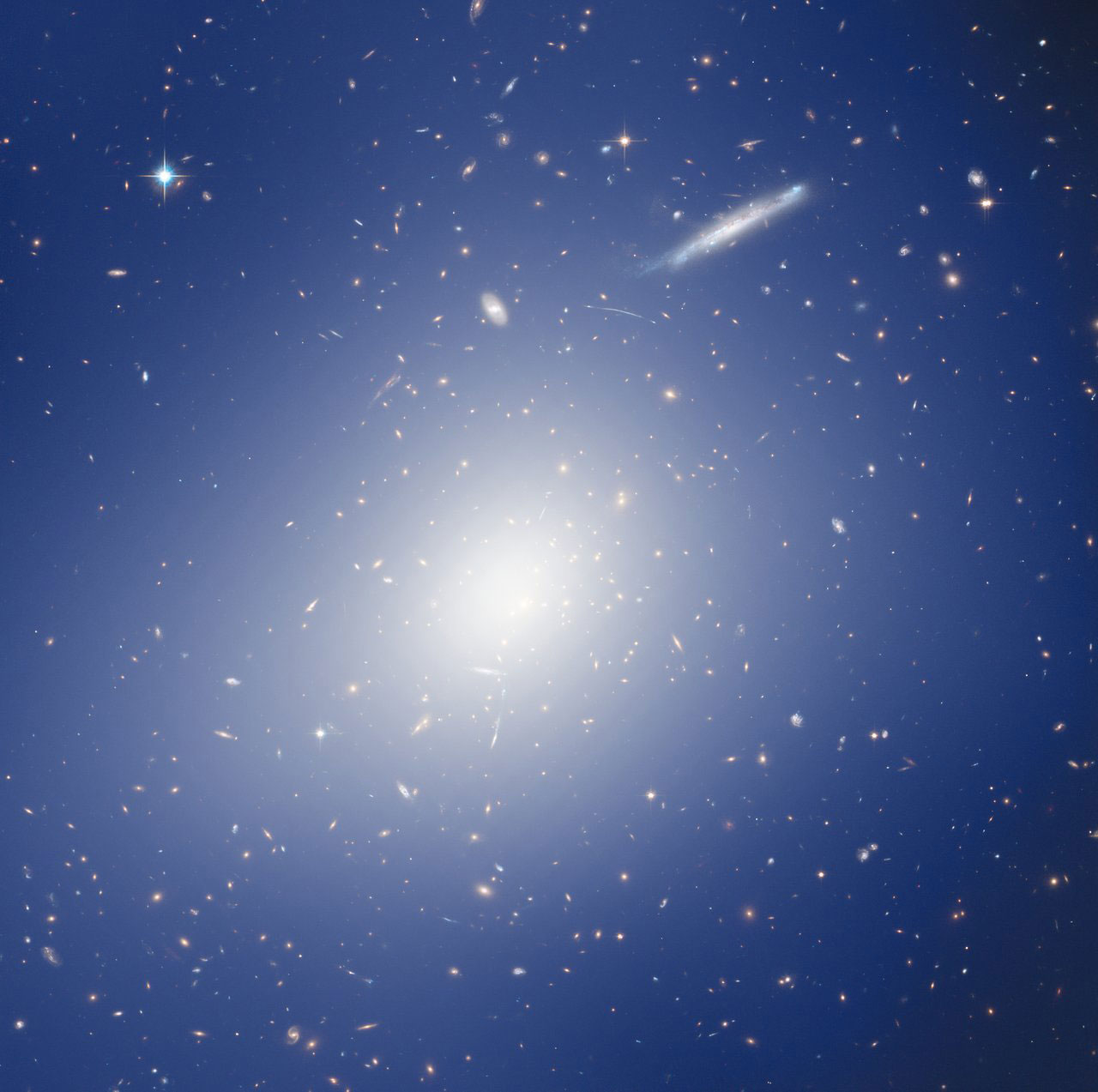
    This image shows something spectacular: a massive galaxy cluster that it is warping the space around it! The cluster, whose heart is at the center of the frame, is named RCS2 J2327, and is one of the most massive clusters known at its distance or beyond.

    Massive objects such as RCS2 J2327 have such a strong influence on their surroundings that they visibly warp the space around them. This effect is known as gravitational lensing. In this way, they cause the light from more distant objects to be bent, distorted, and magnified, allowing us to see galaxies that would otherwise be far too distant to detect. Gravitational lensing is one of the predictions of Einstein’s theory of general relativity. Strong lensing produces stunning images of distorted galaxies and sweeping arcs; both of which can be seen in this image. Weak gravitational lensing, on the other hand, is more subtle, hardly seen directly in an image, and is mostly studied statistically — but it provides a way to measure the masses of cosmic objects, as in the case of this cluster.

    This image is a composite of observations from the HAWK-I instrument on ESO’s Very Large Telescope and the NASA/ESA Hubble Space Telescope’s Advanced Camera for Surveys. It demonstrates an impressively detailed collaborative approach to studying weak lensing in the cosmos. The study found RCS2 J2327 to contain the mass of two quadrillion Suns!

    The diffuse blue and white image covering the picture shows a mass map. It is connected to the amount of mass thought to be contained within each region.

    RCS2 J2327
    RCS2 J2327. The mass of the cluster causes both strong and weak gravitational lensing, which can be used to calculate the mass of the cluster. 

    This image shows the galaxy cluster RCS2 J2327. The mass of the cluster causes both strong and weak gravitational lensing, which can be used to calculate the mass of the cluster. This image is a composite of observations from the HAWK-I instrument on ESO’s Very Large Telescope and the NASA/ESA Hubble Space Telescope’s Advanced Camera for Surveys. It demonstrates an impressively detailed collaborative approach to studying weak lensing in the cosmos.

    Never miss a breakthrough: Join the SciTechDaily newsletter.
    Follow us on Google and Google News.

    Astronomy HAWK-I Hubble Space Telescope
    Share. Facebook Twitter Pinterest LinkedIn Email Reddit

    Related Articles

    A Morphing Spiral Galaxy Amongst Friends

    Hubble Views Magnificent Lopsided Galaxy NGC 2276

    Hubble Captures Fantastic Detail of Eponymous Spiral Galaxy NGC 691

    Spectacular Image Captured by Hubble Shows a Strangely Contorted Spiral Galaxy

    A Distant Spiral in Virgo: Extraordinary Detail Seen in a Galaxy 150 Million Light-Years Away From Earth

    Magnetic Monsters: Hubble Tracks Down Location of Mysterious Radio Signals From Intergalactic Space

    A Menagerie of Galaxies: Hubble Captures a Cluster With Galaxies of All Shapes and Sizes

    How Habitable Are Planets That Orbit Red Dwarfs – The Most Common Type of Stars in the Galaxy?

    Cosmic Silver Lining: Hubble Spots V565 Surrounded by Four Prominent Diffraction Spikes

    Leave A Reply Cancel Reply

    • Facebook
    • Twitter
    • Pinterest
    • YouTube

    Don't Miss a Discovery

    Subscribe for the Latest in Science & Tech!

    Trending News

    125-Million-Year-Old Crocodile Fossil Reveals Astonishing New Secrets

    Scientists Discover an “Impossible” Way Muscle Filaments Can Grow

    A Star’s Spin Could Solve a Longstanding Black Hole Mystery

    NASA Finds Earth Microbes Could Hide in the Moon’s Deep Shadows

    New Study: Intermittent Fasting Lowers Blood Sugar in Type 1 Diabetes

    Alzheimer’s Brain Changes May Begin 7 Years Earlier Than Scientists Thought

    This New Molecule Could Transform How We Recover Gold From Electronic Waste

    A Billion Years Before the Grand Canyon, a Giant Cliff May Have Stretched Across America

    Follow SciTechDaily
    • Facebook
    • Twitter
    • YouTube
    • Pinterest
    • Newsletter
    • RSS
    SciTech News
    • Biology News
    • Chemistry News
    • Earth News
    • Health News
    • Physics News
    • Science News
    • Space News
    • Technology News
    Recent Posts
    • This Metallic Green Beetle Is Quietly Killing Ash Trees Across Texas
    • A 15-Day Window Could Decide the Fate of California’s Most Endangered Salmon
    • Red Meat Helped Build Humanity, Now It May Be Harming Us
    • Scientists Discover a Brain Signal Linked to Severe Suicidal Thoughts
    • A Tiny Wireless Device Could Transform How Chronic Pain Is Treated
    Copyright © 1998 - 2026 SciTechDaily. All Rights Reserved.
    • Science News
    • About
    • Contact
    • Editorial Board
    • Privacy Policy
    • Terms of Use

    Type above and press Enter to search. Press Esc to cancel.