

Scientists in Japan have developed enhanced versions of vitamin K that could help the brain repair itself by generating new neurons.
These redesigned molecules, created by combining vitamin K with retinoic acid, showed three times the ability to turn stem cells into neurons compared with natural vitamin K.
Neuronal Loss and the Search for Regeneration
Neurodegenerative disorders such as Alzheimer’s, Parkinson’s, and Huntington’s disease occur when neurons in the brain gradually deteriorate and die. This progressive loss of nerve cells leads to symptoms like memory loss, cognitive decline, and difficulty with movement. Over time, these conditions severely impact quality of life and often leave patients dependent on constant care. While current medications can ease symptoms, they do not stop or reverse the disease, highlighting the urgent need for new treatment strategies. One promising direction focuses on encouraging the brain to generate new neurons through a process known as neuronal differentiation, which could replace damaged cells and potentially slow or reverse degeneration.
Vitamin K, a fat-soluble nutrient best known for its role in blood clotting and bone health, has recently been linked to brain protection and neuron formation. However, naturally occurring vitamin K compounds such as menaquinone 4 (MK-4) may not be strong enough to serve as effective therapies for neurodegenerative diseases.
Designing Next-Generation Vitamin K Analogues
In a groundbreaking study published in ACS Chemical Neuroscience, researchers from the Department of Bioscience and Engineering at Shibaura Institute of Technology in Japan, led by Associate Professor Yoshihisa Hirota and Professor Yoshitomo Suhara, developed new forms of vitamin K with stronger effects on brain cells. The team not only enhanced the vitamin’s neuroactive properties but also uncovered a previously unknown mechanism through which it promotes the formation of neurons.
Explaining the findings, Dr. Hirota stated, “The newly synthesized vitamin K analogues demonstrated approximately threefold greater potency in inducing the differentiation of neural progenitor cells into neurons compared to natural vitamin K. Since neuronal loss is a hallmark of neurodegenerative diseases such as Alzheimer’s disease, these analogues may serve as regenerative agents that help replenish lost neurons and restore brain function.”
Chemical Engineering: Boosting Vitamin K’s Potency
To improve the potency of vitamin K, the researchers synthesized 12 vitamin K hybrid homologs conjugated with retinoic acid—an active metabolite of vitamin A known to promote neuronal differentiation, a carboxylic acid moiety, or a methyl ester side chain and compared the neuronal differentiation-inducing activity of the hybrid homologs.
Vitamin K and retinoic acid regulate transcriptional activity via the steroid and xenobiotic receptor (SXR) and retinoic acid receptor (RAR), respectively. The researchers assessed SXR and RAR transcriptional activity in mouse neural progenitor cells treated with the newly synthesized compounds. Notably, the biological activity of vitamin K and retinoic acid was preserved in the hybrid homologs. Further, the researchers examined the differentiation of neural stem cells treated with the homologs by quantifying the expression of microtubule-associated protein 2 (Map2), a marker of neural growth expressed by neurons.
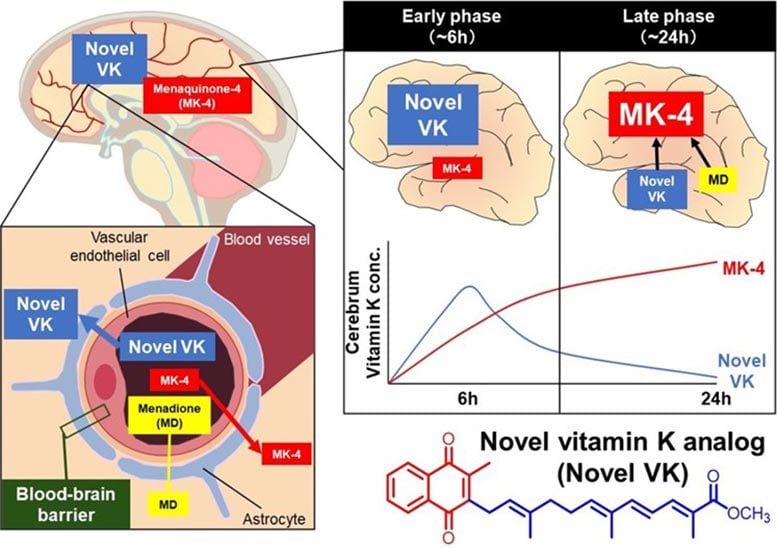
A compound that possessed both the conjugated structure of retinoic acid and a methyl ester side chain exhibited a three-fold higher neuronal differentiation activity compared with the control and significantly higher activity than natural vitamin K compounds, hereafter referred to as Novel vitamin K analog (Novel VK).
Unlocking the Mechanism Behind Neuroprotection
To better understand how vitamin K protects nerve cells, the researchers compared gene activity in neural stem cells treated with MK-4, a compound known to promote the development of neurons, with cells exposed to another substance that inhibits this process. Their analysis showed that metabotropic glutamate receptors (mGluRs) play a key role in how vitamin K triggers neuronal differentiation by influencing gene expression and epigenetic regulation. In particular, the effects of MK-4 were found to depend on the receptor mGluR1. This finding is significant because mGluR1 is already known to be involved in communication between nerve cells, and animals lacking this receptor often display problems with movement and neural signaling—both of which are hallmarks of neurodegenerative diseases.
The team then performed computer-based structural modeling and molecular docking experiments to determine whether vitamin K analogs interact directly with mGluR1. The results confirmed a strong binding relationship between the Novel VK compound and mGluR1, suggesting an enhanced biological effect. The researchers next examined how well Novel VK was absorbed by cells and converted into its active form, MK-4, both in cell cultures and in mice. They observed that MK-4 levels inside cells rose in proportion to the concentration of Novel VK, and that the new compound converted into MK-4 more efficiently than natural vitamin K. Animal testing further demonstrated that Novel VK maintained a stable pharmacokinetic profile, successfully crossed the blood-brain barrier, and produced higher levels of MK-4 in the brain than the standard form of vitamin K.
Toward Vitamin K-Based Therapies for Neurodegeneration
Overall, the study sheds light on the mechanism by which vitamin K and its structural analogues exert neuroprotective effects, paving the way for the development of novel therapeutic agents that can delay or reverse neurodegenerative diseases.
Concluding with the long-term implications of their work, Dr. Hirota says, “Our research offers a potentially groundbreaking approach to treating neurodegenerative diseases. A vitamin K-derived drug that slows the progression of Alzheimer’s disease or improves its symptoms could not only improve the quality of life for patients and their families but also significantly reduce the growing societal burden of healthcare expenditures and long-term caregiving.”
We hope their research translates into clinically meaningful treatments for patients battling neurological diseases.
Reference: “A New Class of Vitamin K Analogues Containing the Side Chain of Retinoic Acid Have Enhanced Activity for Inducing Neuronal Differentiation” by Yoshihisa Hirota, Taiki Sato, Rina Watanabe, Kazuki Takeda, Sho Sano, Satoshi Asano, Yuki Shibahashi, Yumi Yasuda, Yuta Takagi, Yutaro Yamashita, Wu YuXin, Mikino Arakawa, Yuri Maitani, Vannessa Lawai, Kurumi Nakagawa, Natsuko Furukawa, Atsuko Takeuchi, Chisato Tode, Maya Kamao, Akimori Wada, Zainab Ngaini and Yoshitomo Suhara, 3 July 2025, ACS Chemical Neuroscience.
DOI: 10.1021/acschemneuro.5c00111
Never miss a breakthrough: Join the SciTechDaily newsletter.
Follow us on Google and Google News.
1 Comment
SIGMA SIGMA BOY