
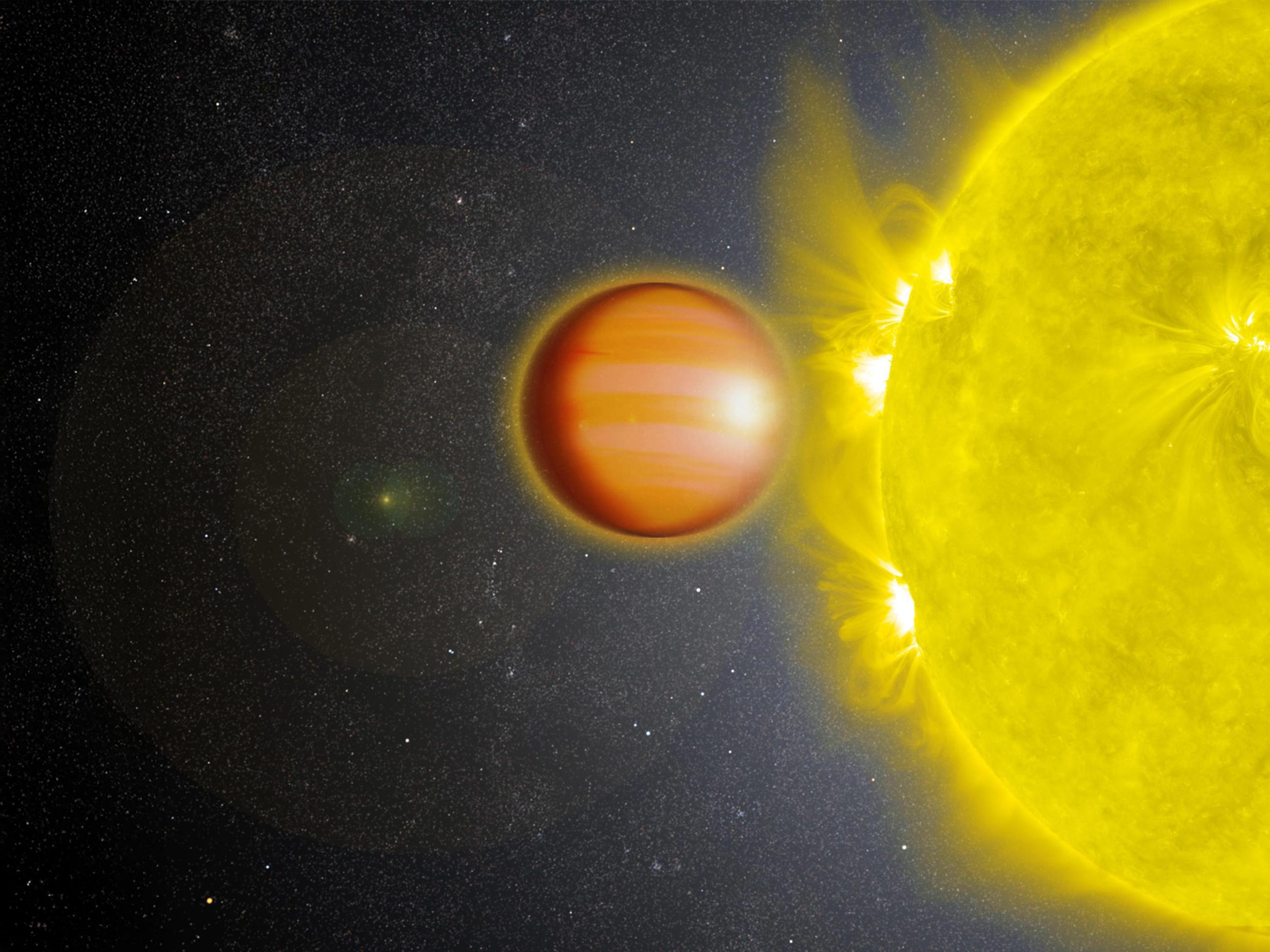
Astronomers have used the James Webb Space Telescope to build the first 3D map of a distant planet’s atmosphere. The target, WASP-18b, is an ultra-hot Jupiter with temperatures near 5,000°F—so extreme that water vapor disintegrates.
The map revealed a glowing hot spot and cooler surrounding zones, confirming models of atmospheric breakdown under intense heat. The method marks a major advance in studying distant worlds.
Mapping a Distant World in 3D
Astronomers have created the first three-dimensional map of a planet orbiting a distant star, revealing dramatic temperature differences across its atmosphere. One region is so intensely hot that it breaks apart water vapor, according to findings published in Nature Astronomy on October 28, 2025.
The research, led by teams from the University of Maryland and Cornell University, focused on WASP-18b, a massive gas giant about 400 light-years from Earth. Classified as an “ultra-hot Jupiter,” it is roughly ten times the mass of Jupiter and orbits its star in just 23 hours. Scientists used a technique known as 3D eclipse mapping (also called spectroscopic eclipse mapping) to build the planet’s temperature map. The new study expands on a two-dimensional version the same researchers published in 2023, which first showed the potential of using NASA’s James Webb Space Telescope (JWST) to explore exoplanet atmospheres in detail.
A New Dimension in Planetary Mapping
“This technique is really the only one that can probe all three dimensions at once: latitude, longitude and altitude,” said the paper’s co-lead author Megan Weiner Mansfield, an assistant professor of astronomy at UMD. “This gives us a higher level of detail than we’ve ever had to study these celestial bodies.”
With this approach, astronomers can begin charting the atmospheric behavior of other worlds visible to JWST, much like Earth-based telescopes once mapped Jupiter’s Great Red Spot and swirling cloud bands.
Seeing the Unseen: How Eclipse Mapping Works
“Eclipse mapping allows us to image exoplanets that we can’t see directly, because their host stars are too bright,” said the paper’s co-lead author Ryan Challener, a postdoctoral associate in Cornell University’s Department of Astronomy. “With this telescope and this new technique, we can start to understand exoplanets along the same lines as our solar system neighbors.”
Since exoplanets emit less than one percent of their stars’ brightness, studying them is notoriously difficult. Eclipse mapping measures the subtle variations in starlight as a planet passes behind its star, temporarily concealing parts of itself. These tiny changes can be linked to specific locations on the planet, allowing scientists to reconstruct a multicolored brightness map that reveals temperature variations in latitude, longitude, and altitude.
A Fiery World Perfect for Testing
WASP-18b proved an ideal target for testing this method. With surface temperatures approaching 5,000 degrees Fahrenheit and a rapid orbit that keeps it locked to its star, the planet produces a strong, measurable signal for JWST.
The team’s earlier 2D version relied on a single wavelength of light, but this time the researchers used JWST’s Near-Infrared Imager and Slitless Spectrograph (NIRISS) to analyze multiple wavelengths. Each wavelength corresponds to a specific atmospheric layer and temperature. Combining them allowed scientists to assemble the first three-dimensional view of the planet’s atmosphere.
Layers of Heat and Chemistry
“If you build a map at a wavelength that water absorbs, you’ll see the water deck in the atmosphere, whereas a wavelength that water does not absorb will probe deeper,” Challener explained. “If you put those together, you can get a 3D map of the temperatures in this atmosphere.”
The new map revealed several distinct atmospheric zones on WASP-18b’s permanently sunlit side, which always faces its star due to tidal locking. A circular hot spot marks the area receiving the most direct radiation, while a cooler ring surrounds it near the planet’s edges. The map also showed that water vapor levels in the hot region are much lower than elsewhere, suggesting that extreme heat is breaking the molecules apart.
Proof of Prediction: Watching Water Break Apart
“We’ve seen this happen on a population level, where you can see a cooler planet that has water and then a hotter planet that doesn’t have water,” Weiner Mansfield explained. “But this is the first time we’ve seen this be broken across one planet instead. It’s one atmosphere, but we see cooler regions that have water and hotter regions where the water’s being broken apart. That had been predicted by theory, but it’s really exciting to actually see this with real observations.”
The Future of Mapping Alien Worlds
Further observations with JWST could sharpen the detail of these 3D eclipse maps, offering even clearer insights into how heat and chemistry interact on distant planets. Weiner Mansfield said the method opens the door to studying hundreds of other “hot Jupiters” already known to exist among more than 6,000 confirmed exoplanets. She also hopes to extend the approach to smaller, rocky worlds that may resemble Earth in structure.
“It’s very exciting to finally have the tools to see and map out the temperatures of a different planet in this much detail. It’s set us up to possibly use the technique on other types of exoplanets. For example, if a planet doesn’t have an atmosphere, we can still use the technique to map the temperature of the surface itself to possibly understand its composition,” Mansfield said. “Although WASP-18b was more predictable, I believe we will have the chance to see things that we could never have expected before.”
Reference: “Horizontal and vertical exoplanet thermal structure from a JWST spectroscopic eclipse map” by Ryan C. Challener, Megan Weiner Mansfield, Patricio E. Cubillos, Anjali A. A. Piette, Louis-Philippe Coulombe, Hayley Beltz, Jasmina Blecic, Emily Rauscher, Jacob L. Bean, Björn Benneke, Eliza M.-R. Kempton, Joseph Harrington, Thaddeus D. Komacek, Vivien Parmentier, S. L. Casewell, Nicolas Iro, Luigi Mancini, Matthew C. Nixon, Michael Radica, Maria E. Steinrueck, Luis Welbanks, Natalie M. Batalha, Claudio Caceres, Ian J. M. Crossfield, Nicolas Crouzet, Jean-Michel Désert, Karan Molaverdikhani, Nikolay K. Nikolov, Enric Palle, Benjamin V. Rackham, Everett Schlawin, David K. Sing, Kevin B. Stevenson, Xianyu Tan, Jake D. Turner and Xi Zhang, 28 October 2025, Nature Astronomy.
DOI: 10.1038/s41550-025-02666-9
This research was supported by the James Webb Space Telescope’s Transiting Exoplanet Community Early Release Science Program.
Never miss a breakthrough: Join the SciTechDaily newsletter.
Follow us on Google and Google News.