
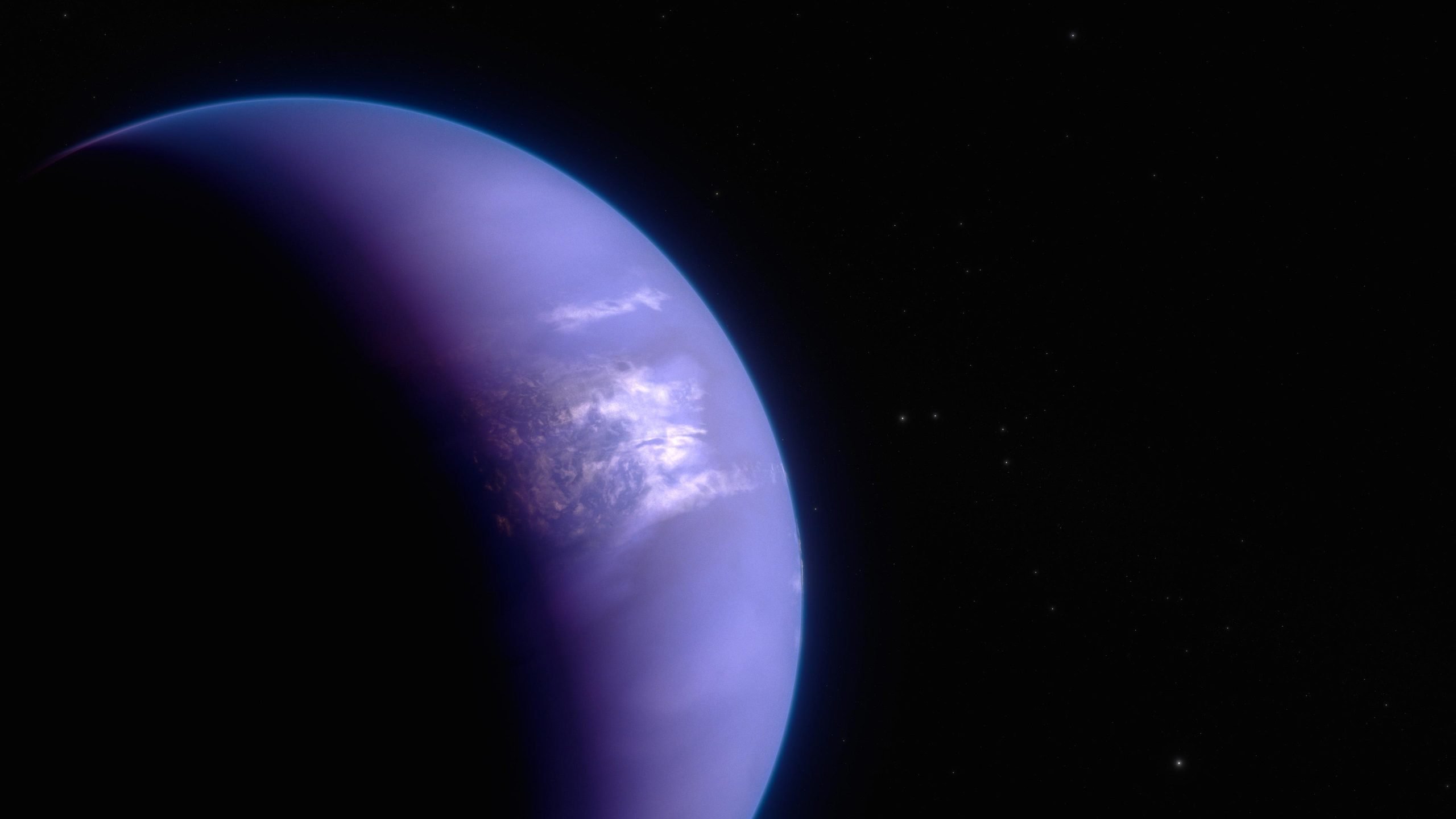
Temperature measurements based on the amount of 5- to 12-micron mid-infrared light emitted by the planet show that the nightside is probably covered in thick, high clouds. Spectroscopy measurements indicate the presence of water vapor on both the dayside and nightside. But because it is too hot for liquid water to exist, the clouds are probably made of tiny mineral grains instead of water droplets. A surprising lack of methane on the nightside suggests that strong eastward winds are mixing atmospheric gases around the planet. This illustration is based on new data gathered by Webb’s Mid-Infrared Instrument (MIRI) as well as previous observations from other ground- and space-based telescopes, including Hubble and Spitzer. Webb has not captured any images of the planet. Credit: NASA, ESA, CSA, Ralf Crawford (STScI)
Scientists used the James Webb Telescope to study WASP-43b, finding high-altitude clouds and large temperature differences between its day and night sides. Their findings provide insights into the planet’s extreme climate and atmospheric dynamics.
Jasmina Blecic, a Research Scientist at NYU Abu Dhabi, along with Associate Professor Ian Dobbs-Dixon from the Center for Astrophysics and Space Science (CASS) and the James Webb Space Telescope Transiting Exoplanet Early Release Science (JTEC-ERS) team, have utilized NASA’s James Webb Telescope to uncover new details about the atmosphere of a giant exoplanet, similar in size to Jupiter. This includes groundbreaking observations of the planet’s dust-laden clouds.
In a study recently published in Nature Astronomy, the researchers detail how they tested the unparalleled capabilities of Webb’s Mid-Infrared Instrument (MIRI) and observed the entire orbit of WASP-43b, a giant, gas-filled exoplanet. These “phase curve” observations, conducted during Webb’s inaugural year, revealed the temperature distribution across the entire planet and shed light on the planetary climate. The researchers found thick clouds and a surprising lack of methane on the planet’s nightside, and ubiquitous water presence throughout its atmosphere. This is the first time clouds have been inferred on the nightside of the planet; they were found at much higher altitudes in the planetary atmosphere compared to typical clouds observed on Earth.
Planetary Characteristics and Orbit
WASP-43b shares a comparable size and mass with Jupiter, yet it diverges significantly in its planetary characteristics. Its host star, WASP-43A, is much cooler and redder than our sun and is around 86 lightyears away from the Earth. WASP-43b orbits very closely to its star, resulting in a year that lasts only 19.5 hours. This close proximity causes the planet’s rotation to synchronize with its orbit, with one side always facing the star, similar to the tidal locking observed with our moon. As a result, one-half of the planet (dayside) is permanently illuminated and very hot, while the other half (nightside) is permanently shadowed and much colder.
“We observed this planet while it orbits around its star using an infrared spectrometer so that we could study the light emerging from the different regions of its atmosphere,” said Blecic. “This allowed us to distinguish between the day and nightside temperatures, and identify the presence of clouds and various molecules. Different chemical species absorb light at different wavelengths in infrared. Combining this fact with observations of the entire orbit, we were able to constrain the chemical composition, cloud coverage, and heat redistribution across the whole atmosphere and draw conclusions about the planet’s climate.”
The team found that WASP-43b’s permanently illuminated dayside is as hot as 2285°F (1250°C), while the planet’s nightside, although permanently shadowed, was still very hot 1115°F (600°C).
Extreme Climate and Atmospheric Dynamics
“The absence of direct sunlight on the planet’s nightside causes significant temperature differences between the day and night sides, which prompts the formation of exceptionally strong winds,” said Dobbs-Dixon, an expert in 3-dimensional atmospheric models and heat redistribution of exoplanetary atmospheres. “While winds on Earth form in a similar manner due to variations in temperature, the close proximity of WASP-43b to its host star results in much more extreme temperature differences. This produced winds of thousands of kilometers per hour, far surpassing those on Earth, crucial for the distribution of heat and shaping the overall planetary climate.”
In addition, comparisons of the planet’s temperature map with complex 3D atmospheric models demonstrated that this temperature contrast is stronger than expected for a cloud-free atmosphere. This suggests that the planet’s nightside is shrouded in a thick layer of clouds that blocks much of the infrared radiation that would otherwise be observed. Unlike Earth’s water clouds, the clouds on this extremely hot planet resemble dust and are composed of rocks and minerals.
Surprisingly, despite this thick layer of clouds, the JTEC-ERS team also detected clear signals of water on the planet’s nightside. This allowed them to determine, for the first time, the cloud height and thickness, unveiling their unusual altitude and density compared to Earth’s clouds. The researchers also detected wind-driven mixing, called “chemical disequilibrium,” that swiftly transports gas throughout the planet’s atmosphere and results in uniform atmospheric chemistry.
Reference: “Nightside clouds and disequilibrium chemistry on the hot Jupiter WASP-43b” by Taylor J. Bell, Nicolas Crouzet, Patricio E. Cubillos, Laura Kreidberg, Anjali A. A. Piette, Michael T. Roman, Joanna K. Barstow, Jasmina Blecic, Ludmila Carone, Louis-Philippe Coulombe, Elsa Ducrot, Mark Hammond, João M. Mendonça, Julianne I. Moses, Vivien Parmentier, Kevin B. Stevenson, Lucas Teinturier, Michael Zhang, Natalie M. Batalha, Jacob L. Bean, Björn Benneke, Benjamin Charnay, Katy L. Chubb, Brice-Olivier Demory, Peter Gao, Elspeth K. H. Lee, Mercedes López-Morales, Giuseppe Morello, Emily Rauscher, David K. Sing, Xianyu Tan, Olivia Venot, Hannah R. Wakeford, Keshav Aggarwal, Eva-Maria Ahrer, Munazza K. Alam, Robin Baeyens, David Barrado, Claudio Caceres, Aarynn L. Carter, Sarah L. Casewell, Ryan C. Challener, Ian J. M. Crossfield, Leen Decin, Jean-Michel Désert, Ian Dobbs-Dixon, Achrène Dyrek, Néstor Espinoza, Adina D. Feinstein, Neale P. Gibson, Joseph Harrington, Christiane Helling, Renyu Hu, Nicolas Iro, Eliza M.-R. Kempton, Sarah Kendrew, Thaddeus D. Komacek, Jessica Krick, Pierre-Olivier Lagage, Jérémy Leconte, Monika Lendl, Neil T. Lewis, Joshua D. Lothringer, Isaac Malsky, Luigi Mancini, Megan Mansfield, Nathan J. Mayne, Thomas M. Evans-Soma, Karan Molaverdikhani, Nikolay K. Nikolov, Matthew C. Nixon, Enric Palle, Dominique J. M. Petit dit de la Roche, Caroline Piaulet, Diana Powell, Benjamin V. Rackham, Aaron D. Schneider, Maria E. Steinrueck, Jake Taylor, Luis Welbanks, Sergei N. Yurchenko, Xi Zhang and Sebastian Zieba, 30 April 2024, Nature Astronomy.
DOI: 10.1038/s41550-024-02230-x
Never miss a breakthrough: Join the SciTechDaily newsletter.
Follow us on Google and Google News.