
Close Menu
    Facebook X (Twitter) Instagram
    SciTechDaily
    • Biology
    • Chemistry
    • Earth
    • Health
    • Physics
    • Science
    • Space
    • Technology
    Facebook X (Twitter) Pinterest YouTube RSS
    SciTechDaily
    Home»Health»Natural Compound From Pomegranate Leaves Destroys Deadly Amyloid Clumps
    Health

    Natural Compound From Pomegranate Leaves Destroys Deadly Amyloid Clumps

    By Kumamoto UniversityFebruary 25, 2026No Comments3 Mins Read
    Facebook Twitter Pinterest Telegram LinkedIn WhatsApp Email Reddit
    Share
    Facebook Twitter LinkedIn Pinterest Telegram Email Reddit
    Amyloid Plaques Forming Between Brain Neurons
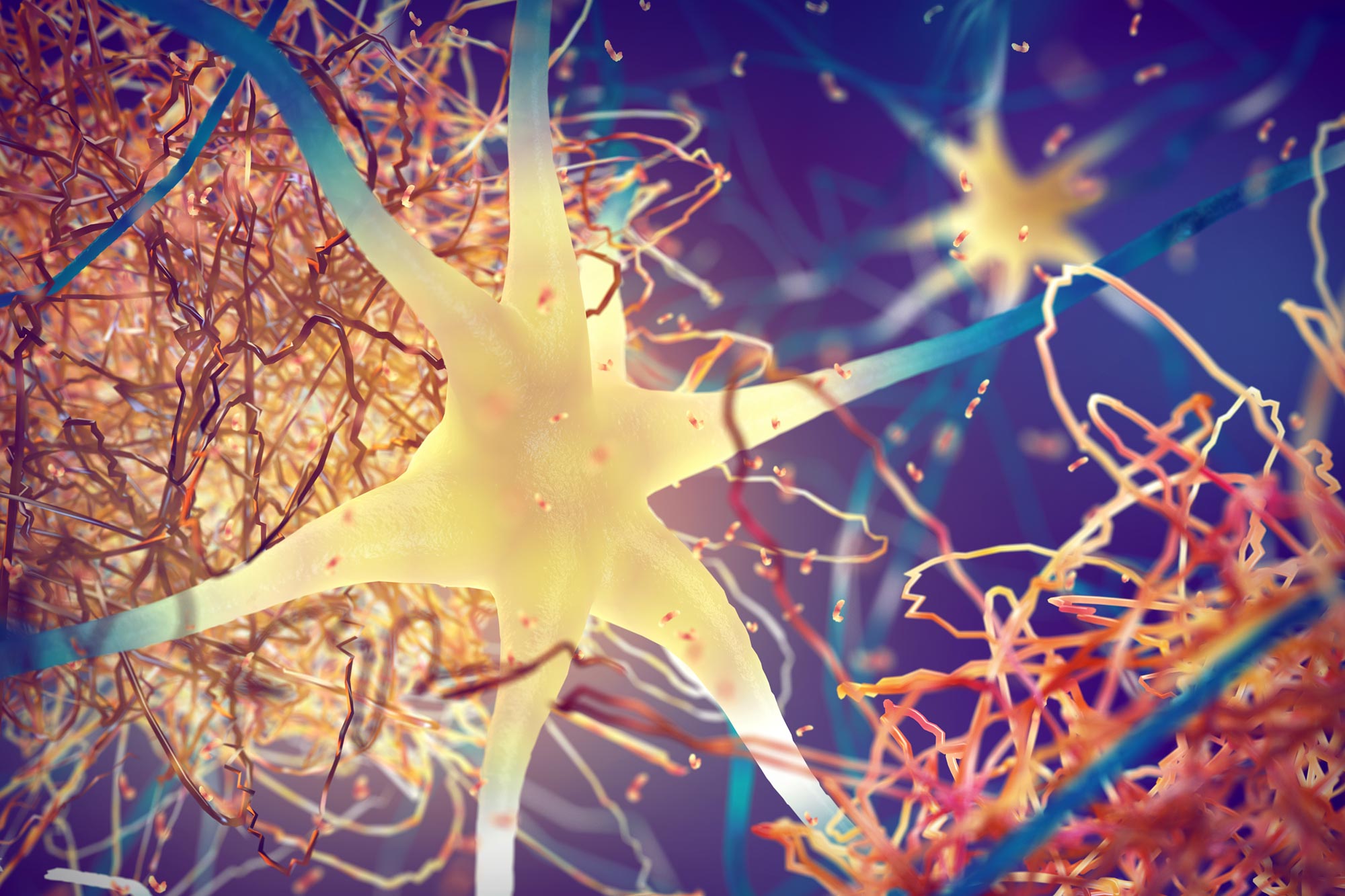
    A compound isolated from pomegranate has been shown to selectively break apart TTR amyloid fibrils, offering a potential new approach to treating transthyretin amyloidosis. Credit: Shutterstock

    Researchers have identified a natural compound from pomegranate leaves and branches that can directly dismantle the protein aggregates responsible for transthyretin amyloidosis.

    Pomegranate trees are best known for their fruit, but researchers at Kumamoto University are pointing to a different part of the plant as a potential source of new medicine. The team reports that a compound found in pomegranate leaves and branches can directly break apart the protein clumps involved in transthyretin (TTR) amyloidosis, a progressive disorder that can seriously damage the nerves and the heart.

    In iScience, the researchers describe 1,2,3,4,6-penta-O-galloyl-β-D-glucose (PGG) as an “amyloid disruptor.” In TTR amyloidosis, transthyretin, a transport protein, can lose its normal shape and stack into tough, insoluble amyloid fibrils that lodge in organs. Many existing approaches focus on keeping the protein stable or lowering how much of it is made. The problem is that once deposits are established, slowing new buildup does not necessarily remove what is already there.

    To address this unmet need, the group screened 1,509 plant extracts from a natural product library. Extracts from pomegranate (Punica granatum) leaves and branches stood out for their ability to disrupt preexisting TTR fibrils. After narrowing down the chemistry, they identified PGG as the key ingredient driving the effect.
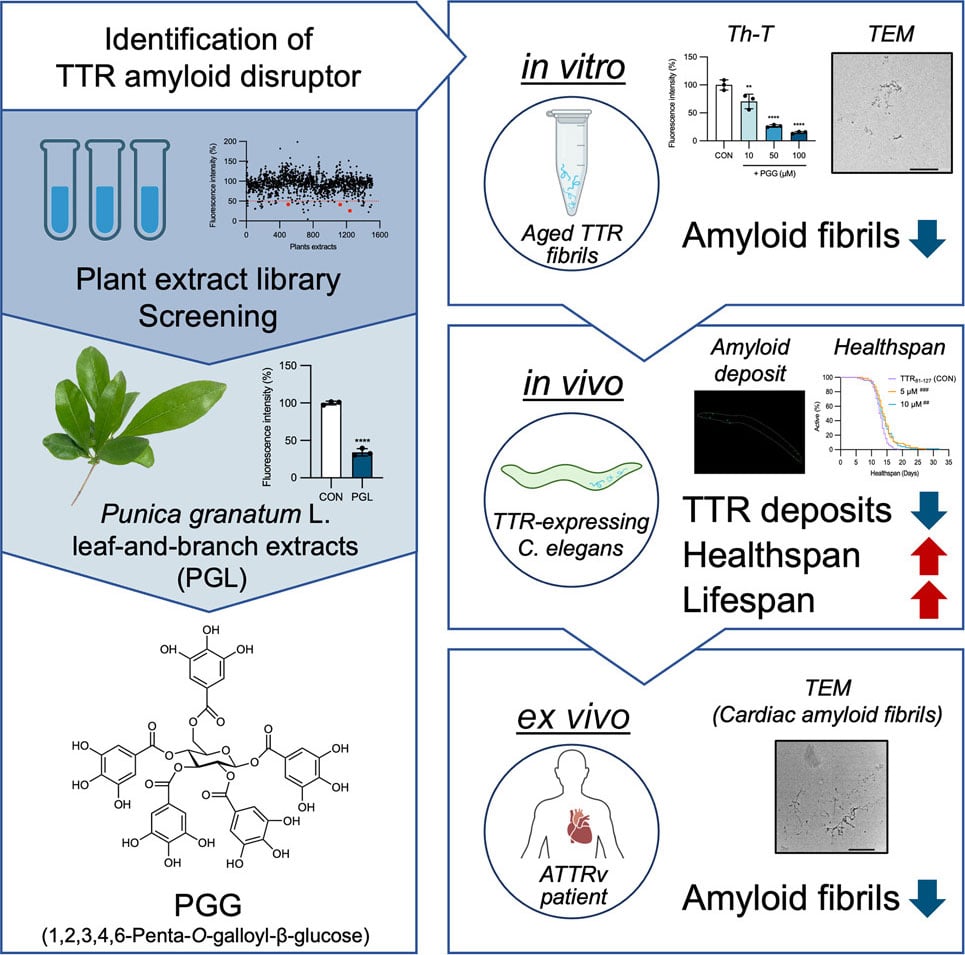
    Disruption of Transthyretin Amyloid Deposits by a Pomegranate Derived Natural Compound
    Researchers identified a bioactive compound called PGG (1,2,3,4,6-penta-O-galloyl-β-D-glucose) from pomegranate (Punica granatum) leaf and branch extracts through plant library screening. Laboratory (in vitro), animal model (in vivo), and patient-derived (ex vivo) experiments demonstrated that PGG breaks down transthyretin (TTR) amyloid fibrils, reduces amyloid deposits, and improves healthspan and lifespan in a TTR-expressing C. elegans model. These findings suggest a promising natural approach for targeting TTR amyloidosis. Credit: Kagami A. et al.

    Selective Disruption of TTR Amyloid

    In laboratory studies, PGG dismantled amyloid fibrils produced from both mutant and wild-type forms of TTR. Under the same experimental conditions, the compound did not interfere with amyloid-β fibrils linked to Alzheimer’s disease. This selectivity indicates that PGG interacts with TTR aggregates in a specific way rather than broadly attacking all amyloid structures.

    The researchers next evaluated PGG in a nematode model (C. elegans) engineered to produce fragments of human TTR. Animals treated with the compound showed fewer protein deposits and experienced significant increases in both lifespan and healthspan. The team also tested amyloid fibrils extracted from the heart tissue of a patient with hereditary TTR amyloidosis. PGG was able to break apart these patient-derived fibrils as well, underscoring its potential relevance in real-world disease.

    Structural Insights and Therapeutic Potential

    Structural analyses further revealed that multiple galloyl groups attached to a glucose core are essential for activity, providing insight into how the compound interacts with amyloid fibrils at the molecular level.

    While further studies are needed to evaluate safety and efficacy in humans, the findings suggest that plant-derived molecules such as PGG could serve as promising lead compounds for next-generation therapies that actively remove pathogenic amyloid deposits, addressing a major unmet need in TTR amyloidosis treatment.

    Reference: “Glycosidic scaffold bearing multiple galloyl moieties from pomegranate disrupts transthyretin amyloids” by Asuka Kagami, Nami Hashimoto, Ryoko Sasaki, Yutaro Fukushima, Hari Prasad Devkota, Shoya Tanaka, Mikiyo Wada, Kunitoshi Yamanaka, Shiori Yamakawa, Shogo Misumi, Takeshi Yokoyama, Mineyuki Mizuguchi, Takashi Sato, Teruya Nakamura, Shunsuke Kotani, Mary Ann Suico, Hirofumi Kai, Mitsuharu Ueda and Tsuyoshi Shuto, 20 November 2025, iScience.
    DOI: 10.1016/j.isci.2025.114170

    Funding: Japan Science and Technology Agency, Kumamoto University

    Never miss a breakthrough: Join the SciTechDaily newsletter.
    Follow us on Google and Google News.

    Cardiology Medicine Molecular Biology Neurology Popular
    Share. Facebook Twitter Pinterest LinkedIn Email Reddit

    Related Articles

    New Study Reveals Diabetes Physically Rewires the Human Heart

    Scientists Discover Exercise Literally Rewires Your Body at the Molecular Level

    Scientists Discover Hidden Cause of Alzheimer’s Hiding in Plain Sight

    Beyond Plaques and Tangles: Scientists Discover Key to Halting Brain Damage in Alzheimer’s

    A Common Medication Improves Survival for Heart Failure Patients

    Genomic Analysis Reveals Roots of Neuropsychiatric Diseases

    Physical Exercise Improves Cognition in Alzheimer’s Disease

    Blocking HDAC2 Enzyme May Reverse Memory Loss Caused by Alzheimer’s Disease

    Trans-Fatty Acid Ban Results in Reduced Heart Attacks and Stroke

    Leave A Reply Cancel Reply

    • Facebook
    • Twitter
    • Pinterest
    • YouTube

    Don't Miss a Discovery

    Subscribe for the Latest in Science & Tech!

    Trending News

    Beyond Pain Relief: Scientists Discover a Protein That Could Stop Osteoarthritis in Its Tracks

    Scientists Discover Why Alcohol Prevents the Liver From Healing, Even After You Quit

    Scientists Stunned As Volcano Removes Methane From the Air

    Scientists Discover Signs Africa May Be Splitting Apart Beneath Zambia

    Common Blood Pressure Drug Supercharges Cancer Treatment in Surprising New Study

    540-Million-Year-Old Fossils Reveal a Huge Surprise About Early Life on Earth

    Scientists Reverse Stroke Damage Using Stem Cells in Breakthrough Study

    Eating One Egg a Day Could Cut Alzheimer’s Risk by 27%

    Follow SciTechDaily
    • Facebook
    • Twitter
    • YouTube
    • Pinterest
    • Newsletter
    • RSS
    SciTech News
    • Biology News
    • Chemistry News
    • Earth News
    • Health News
    • Physics News
    • Science News
    • Space News
    • Technology News
    Recent Posts
    • This “Longevity Gene” May Protect the Brain From Aging and Dementia
    • Scientists Discover Surprising Effect of Ultra-Processed Foods Inside Thigh Muscles
    • Common Cleaning Chemical Could Triple Your Risk of a Dangerous Liver Disease
    • New Brain “Bypass” Technology Could Transform Treatment for Neurological Disorders
    • Physicists Observe Strange Quantum Rotation Effect That Defies Intuition
    Copyright © 1998 - 2026 SciTechDaily. All Rights Reserved.
    • Science News
    • About
    • Contact
    • Editorial Board
    • Privacy Policy
    • Terms of Use

    Type above and press Enter to search. Press Esc to cancel.