
Close Menu
    Facebook X (Twitter) Instagram
    SciTechDaily
    • Biology
    • Chemistry
    • Earth
    • Health
    • Physics
    • Science
    • Space
    • Technology
    Facebook X (Twitter) Pinterest YouTube RSS
    SciTechDaily
    Home»Space»Hubble Discovers Huge 150 Billion Miles Wide System of Dusty Material
    Space

    Hubble Discovers Huge 150 Billion Miles Wide System of Dusty Material

    By Ray Villard, Space Telescope Science InstituteMarch 6, 2018No Comments4 Mins Read
    Facebook Twitter Pinterest Telegram LinkedIn WhatsApp Email Reddit
    Share
    Facebook Twitter LinkedIn Pinterest Telegram Email Reddit
    Hubble Reveals Huge System of Dusty Material
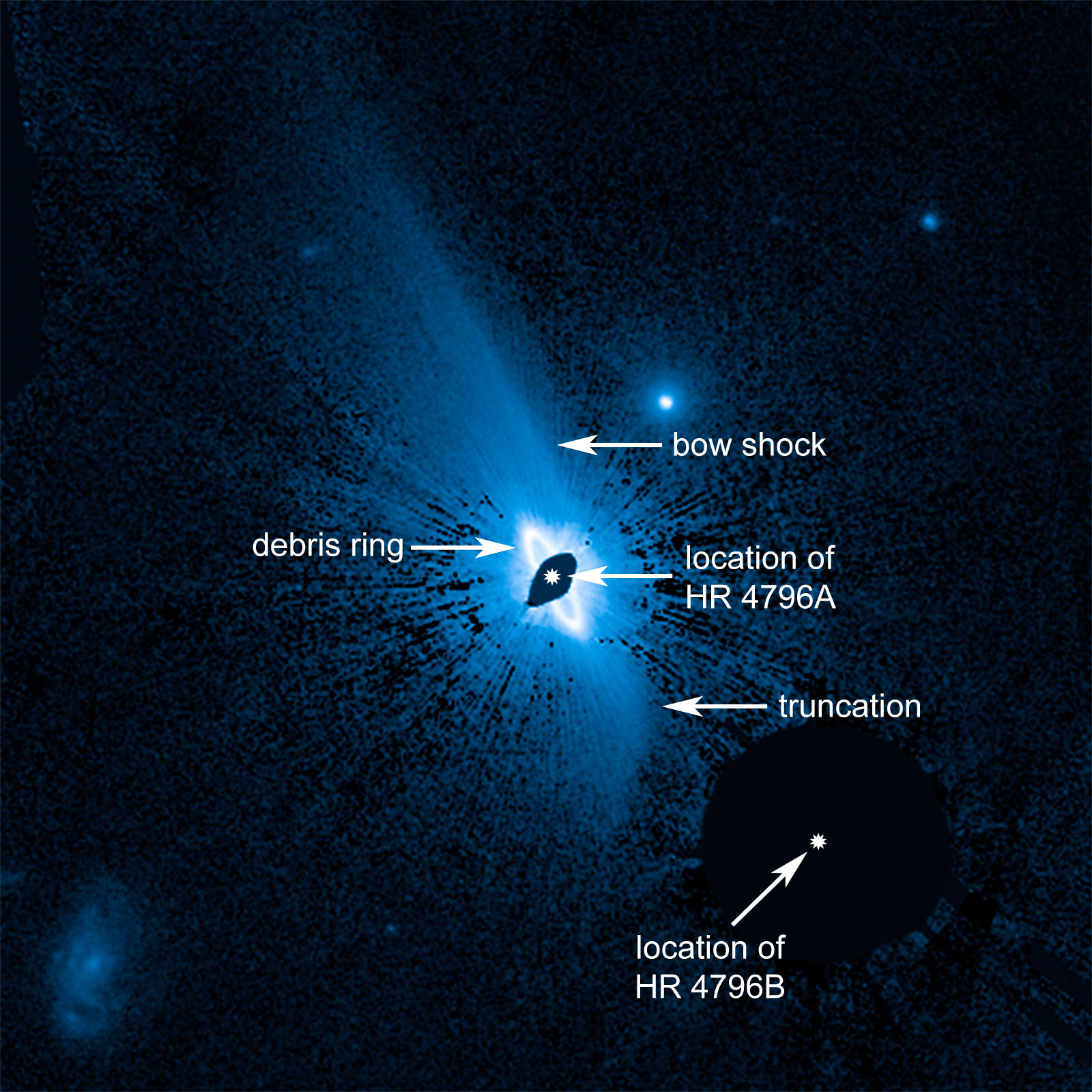
    Hubble uncovers a vast, complex dust structure, about 150 billion miles across, enveloping the young star HR 4796A. A bright, narrow inner ring of dust is already known to encircle the star, based on much earlier Hubble images. This newly discovered huge dust structure around the system may have implications for what a yet-unseen planetary system looks like around the 8-million-year-old star. Credit: NASA/ESA/G. Schneider (University of Arizona)

    Astronomers have used NASA’s Hubble Space Telescope to uncover a vast, complex dust structure, about 150 billion miles (240 billion kilometers) across, enveloping the young star HR 4796A. A bright, narrow, inner ring of dust is already known to encircle the star and may have been corralled by the gravitational pull of an unseen giant planet. This newly discovered huge structure around the system may have implications for what this yet-unseen planetary system looks like around the 8-million-year-old star, which is in its formative years of planet construction.

    The debris field of very fine dust was likely created from collisions among developing infant planets near the star, evidenced by a bright ring of dusty debris seen 7 billion miles from the star. The pressure of starlight from the star, which is 23 times more luminous than the Sun, then expelled the dust far into space.

    But the dynamics don’t stop there. The puffy outer dust structure is like a donut-shaped inner tube that got hit by a truck. It is much more extended in one direction than in the other and so looks squashed on one side even after accounting for its inclined projection on the sky. This may be due to the motion of the host star plowing through the interstellar medium, like the bow wave from a boat crossing a lake. Or it may be influenced by a tidal tug from the star’s red dwarf binary companion (HR 4796B), located at least 54 billion miles (87 billion kilometers) from the primary star.

    “The dust distribution is a telltale sign of how dynamically interactive the inner system containing the ring is,” said Glenn Schneider of the University of Arizona, Tucson, who used Hubble’s Space Telescope Imaging Spectrograph (STIS) to probe and map the small dust particles in the outer reaches of the HR 4796A system, a survey that only Hubble’s sensitivity can accomplish.

    “We cannot treat exoplanetary debris systems as simply being in isolation. Environmental effects, such as interactions with the interstellar medium and forces due to stellar companions, may have long-term implications for the evolution of such systems. The gross asymmetries of the outer dust field are telling us there are a lot of forces in play (beyond just host-star radiation pressure) that are moving the material around. We’ve seen effects like this in a few other systems, but here’s a case where we see a bunch of things going on at once,” Schneider further explained.

    Though long hypothesized, the first evidence for a debris disk around any star was uncovered in 1983 with NASA’s Infrared Astronomical Satellite. Later photographs revealed an edge-on debris disk around the southern star Beta Pictoris. In the late 1990s, Hubble’s second-generation instruments, which had the capability of blocking out the glare of a central star, allowed many more disks to be photographed. Now, such debris rings are thought to be common around stars. About 40 such systems have been imaged to date, largely by Hubble.

    Reference: “The HR 4796A Debris System: Discovery of Extensive Exo-ring Dust Material” by Glenn Schneider, John H. Debes, Carol A. Grady, Andras Gáspár, Thomas Henning, Dean C. Hines, Marc J. Kuchner, Marshall Perrin and John P. Wisniewski, 23 January 2018, The Astronomical Journal.
    DOI: 10.3847/1538-3881/aaa3f3

    Never miss a breakthrough: Join the SciTechDaily newsletter.
    Follow us on Google and Google News.

    Astronomy Cosmology Hubble Space Telescope Popular
    Share. Facebook Twitter Pinterest LinkedIn Email Reddit

    Related Articles

    Hubble Reveals Universe Is Expanding Faster Than Expected

    Hubble Image of the Week – Globular Cluster NGC 6496

    Astronomers Discover Clues For How Giant Black Holes Formed So Quickly

    Hubble Telescope Close-up of the Red Planet

    Hubble Image of the Week – Dwarf Galaxy Leo A

    Journey to the Center of the Milky Way

    Astronomers Measure the Farthest Galaxy Ever Seen in the Universe

    Magnified Image Reveals the Faintest Known Galaxy from the Early Universe

    Hubble Explores the Wings of the Twin Jet Nebula

    Leave A Reply Cancel Reply

    • Facebook
    • Twitter
    • Pinterest
    • YouTube

    Don't Miss a Discovery

    Subscribe for the Latest in Science & Tech!

    Trending News

    Don’t Miss: A Brilliant Venus and Glowing Harvest Moon Light Up the Sky

    New Twist on the Einstein Problem Reveals Unexpected Physics

    JWST Captures Stunning Evidence of How Supermassive Black Holes Feed

    Early Exercise May Permanently Change How Much Energy the Body Uses To Move

    New Molecule Wipes Out Aggressive Lymphoma Tumors in Mice in Just 11 Days

    The Human Family Tree May Need a Major Rewrite

    Scientists Find a Surprising Cancer-Fighting Effect in Dark Sweet Cherries

    New AI Detects Hidden Warning Signs of Solar Eruptions Hours Before They Emerge

    Follow SciTechDaily
    • Facebook
    • Twitter
    • YouTube
    • Pinterest
    • Newsletter
    • RSS
    SciTech News
    • Biology News
    • Chemistry News
    • Earth News
    • Health News
    • Physics News
    • Science News
    • Space News
    • Technology News
    Recent Posts
    • Could Alien Life Be Conscious in Ways We Can’t Imagine?
    • Scientists Develop a Fruit Wash That Removes Pesticide Residues and Keeps Produce Fresh Longer
    • Scientists May Have Finally Explained Why Astronauts Get Constipated in Space
    • Pomegranates Could Unlock a New Treatment for Heart Failure
    • Africa’s Giant Herbivores Were Disappearing Millions of Years Before Humans Could Hunt Them
    Copyright © 1998 - 2026 SciTechDaily. All Rights Reserved.
    • Science News
    • About
    • Contact
    • Editorial Board
    • Privacy Policy
    • Terms of Use

    Type above and press Enter to search. Press Esc to cancel.