
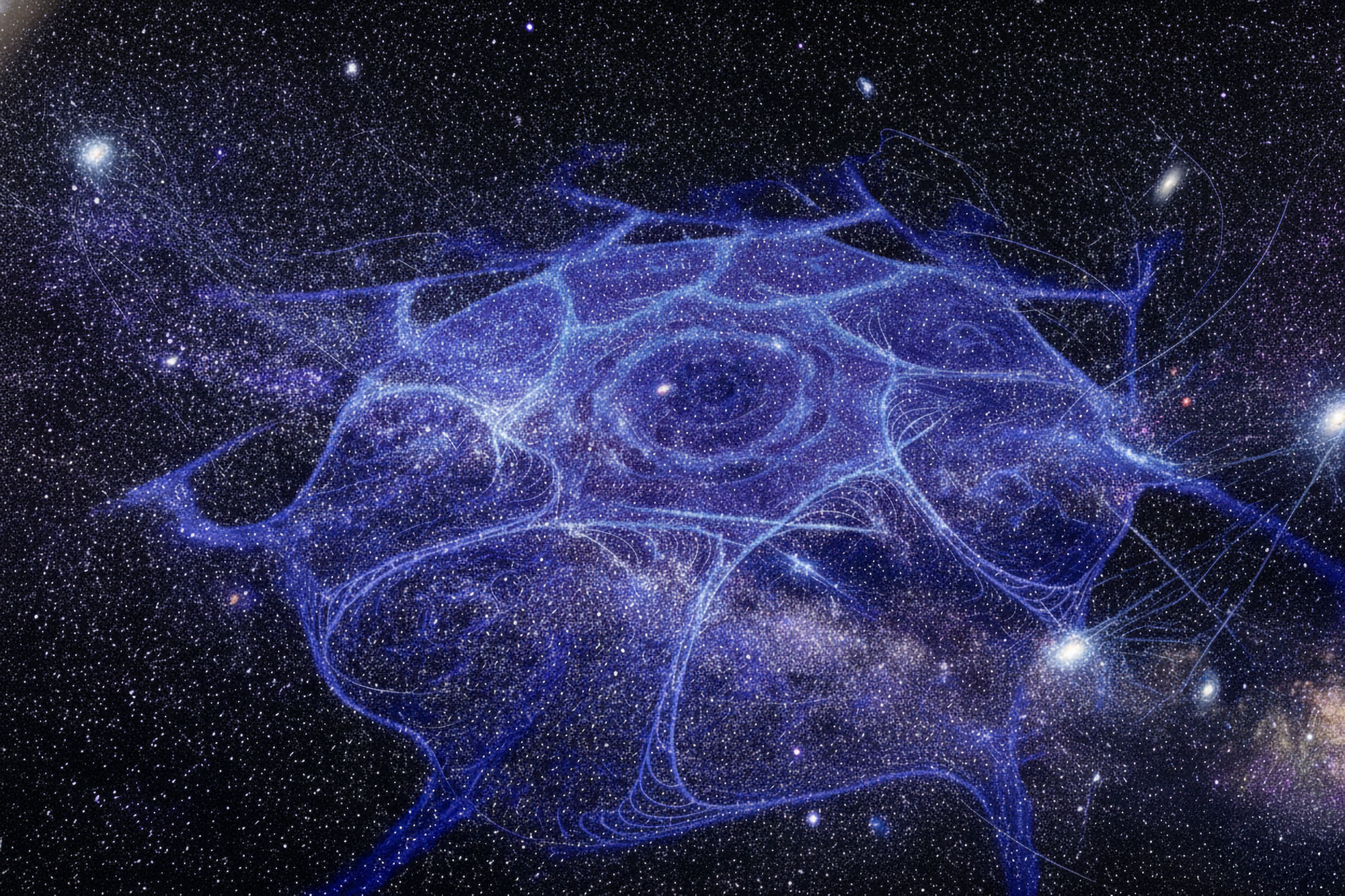
Physicists around the world remain deeply divided on key mysteries of the universe, from dark matter to quantum gravity. The standard cosmological model failed to gain majority support, and no leading theory dominated the survey results.
The largest survey ever conducted among physicists worldwide reveals surprisingly little agreement on some of the field’s biggest mysteries, including black holes, dark matter, and the unresolved effort to unite Einstein’s theory of gravity with quantum mechanics.
Even the leading explanation for how the universe expands, known as ΛCDM (Lambda Cold Dark Matter), failed to win majority support. One reason may be findings from the Dark Energy Spectroscopic Instrument (DESI) last year, which suggested dark energy could change over time, challenging the standard model’s assumption that it remains constant.
Still, the lack of agreement extended far beyond dark energy. Across many major questions in physics, researchers remained sharply divided.
“The most striking result is how few of the ‘standard answers’ in fundamental physics command overwhelming support, with most falling short of a majority. The interesting point is not that physicists are confused. It is that the frontier is genuinely alive,” says Niayesh Afshordi, associate faculty member at Perimeter Institute and professor at the University of Waterloo.
Big Bang and Cosmic Inflation Gain Limited Consensus
Afshordi led the study alongside coauthor Phil Harper and the American Physical Society’s Physics Magazine.
Only two topics received majority agreement. First, 68% of physicists said the Big Bang does not necessarily represent the beginning of time. Instead, they view it as a model describing how the universe evolved from an extremely hot and dense state, without addressing the origin of time itself. Second, a narrow majority of physicists (51%) agreed that the early universe experienced a brief period of rapid expansion known as inflation.
On many other issues, opinions were far more divided. For dark matter, the most common response favored a combination of several proposed explanations (21%), rather than a single answer. Smaller groups supported the idea of undiscovered low-mass particles (17%) or changes to the theory of gravity itself (12%).
Dark Matter and Quantum Gravity Remain Deeply Divided
String theory remained the most popular proposed solution for quantum gravity, but support was limited to 19% of respondents. Other leading views included loop quantum gravity (12%) and the belief that gravity cannot be quantized at all (18%).
Despite the disagreements, Afshordi sees the results as encouraging for the future of physics.
“Scientific truth is not decided by a vote. But consensus, or its absence, tells us where the evidence feels settled and where researchers still see room for radically different ideas. In this sense, lack of consensus can be a clue. It marks places where better data, sharper theory, or new connections between subfields may be needed. In the eternal words of the Canadian singer and songwriter Leonard Cohen, ‘There is a crack in everything; that’s how the light gets in.’”
Reference: “Big Mysteries Survey: Physicists’ Views on Cosmology, Black Holes, Quantum Mechanics, and Quantum Gravity” by Niayesh Afshordi, Phil Halper, Matteo Rini and Michael Schirber, May 10, 2026, arXiv.
DOI: 2605.11058
Never miss a breakthrough: Join the SciTechDaily newsletter.
Follow us on Google and Google News.
8 Comments
*”The lack of consensus in this survey highlights why mainstream physics is hitting a wall. Trying to unify gravity and quantum mechanics by forcing gravity into a point-like ‘graviton’ particle creates unresolvable mathematical infinities. The Torsion Hill Framework resolves this by treating space as a continuous, dynamic manifold rather than a static void.In this model, mass is a localized, concentrated wave-knot ($V_h$), gravity is the continuous spatial strain gradient ($\nabla \boldsymbol{\varepsilon}$) surrounding it, and physical events resolve through path-of-least-resistance vector alignments and impedance evacuation ($Z_T \to 0$). Furthermore, this exact translation manifold—mapping variables onto continuous spatial geometry—is what frontier reasoning engines like OpenAI’s models now utilize as an internal search mechanism to navigate high-dimensional state spaces and solve complex, cross-disciplinary problems. As DESI data confirms that cosmic expansion is dynamic, physics must transition away from isolated point-particle equations toward a unified geometric mechanics.”* The Link , https://docs.google.com/document/d/1iHSMitywAsr2YbvXBW65bAR9g5bELPSy1meMg_ik7f8/edit?usp=drive_link
The correct pronunciation of Λ is lamtha,, th as we say ‘the’.
Lamtha is how that letter is pronounced in modern Greek.
Lambda is the accepted pronunciation in English math.
Sure, that letter came from the Greeks, but it’s ours now.
OH YEAH !!!!??!
and they still have no clue, our physics are completely wrong. drop the “prove there is a god” from the university model and maybe the math will add up correctly.
Seems like we need a Dark Matter Constant to effectively get best metrics on quantum gravity.
The recent quantum gravity study that observes split atoms in superimposition with one side static and the other falling in relationship to gravity is probably the way in through to the center of the labyrinth.
Key guardians at the gate:
Terrestrial Gravity
Solar System Gravity
Galactic Gravity
Isolated Dark Matter
This last, ideally found, outside the universal ellipses; at minimum, in deep space between galactic clusters.
One way maybe to calibrate for a Dark Matter Constant would be to identify highest concentrations.
(And of course any states of the universe that would indicate the absence of even Dark Matter)
This would require of course identifying what levels of concentrations catalyze conversions of Dark Matter into another state of matter DUE to reaching a tipping point concentration.