
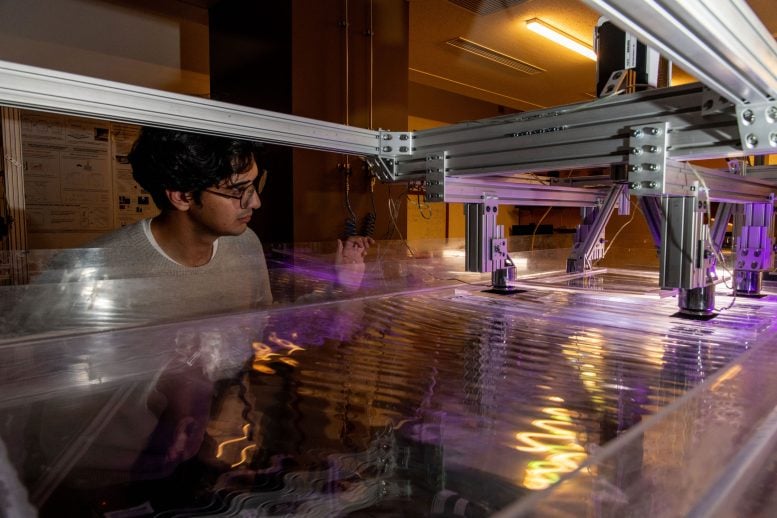
Scientists used swirling water waves to simulate a quantum effect, uncovering rotating nodal patterns that could deepen understanding of hidden quantum phenomena.
In the strange world of quantum physics, particles can be influenced by forces they never directly pass through. One famous example is the Aharonov–Bohm (AB) effect, in which electrons are altered by a magnetic field even when they avoid the field itself. Although scientists predicted the effect in 1959, proving it experimentally took more than 20 years because the changes in the electrons’ wave behavior were extremely difficult to measure directly.
Now, researchers from the Okinawa Institute of Science and Technology (OIST), working with the University of Oslo and Universidad Adolfo Ibáñez, have recreated and expanded the AB effect using an unexpectedly simple setup: a water tank.
Their findings, published in Communications Physics, show that water waves traveling toward a swirling vortex from opposite directions create dramatic rotating patterns. These include one or more lines of temporarily still water that spread outward while slowly turning.
“This was something new and unexpected,” says Aditya Singh, a PhD student in the Nonlinear and Non-equilibrium Physics Unit and co-first author of the study. “That’s what makes this fluid analogue system so valuable. It reveals topological effects—wave behaviors that occur across the whole system—that can’t be seen in quantum experiments.”
From Quantum Theory to Water Tank Experiments
The research was inspired by a 1980 study from theoretical physicist Michael Berry, who demonstrated that the AB effect could be recreated in a classical fluid system. In the quantum version of the effect, electrons move around a tightly wound wire called a solenoid.
As waves travel past the vortex, they distort and form pitchfork-like patterns, that are localized around the central vortex. When the direction of the waves is changed (arrow direction), the distortion pattern is mirrored. The top two sections show simulated patterns while the bottom two sections show the patterns seen in the experiments. Credit: Singh et. al., (2026) Commun. Phys.
When electric current passes through the solenoid, it creates a magnetic field contained entirely inside the coil. Even though the electrons travel outside the magnetic field, their wave properties still shift in phase.
Berry replaced the solenoid with a vortex formed at the drain of a water tank. Instead of electrons, he sent water waves across the tank so they moved around the vortex rather than through it. The waves developed a distorted pitchfork-like pattern around the vortex, revealing a change in phase.
“With waves traveling the opposite direction, you see a mirror image pattern,” adds Jonas Rønning, co-first author and former postdoc in the OIST unit. “The question for us was, what happens if you send waves from both directions at the same time? We thought that the patterns might cancel each other out, or both pitchfork-like patterns would be visible, but our intuition was completely wrong.”
Lines of momentarily flat water extend outward and rotate, in the opposite direction to the flow of the vortex. The left video shows the pattern from the experiment, while the right video shows the same effect in a simulation model. Credit: Singh et. al., (2026) Commun Phys.
Opposing Water Waves Create Rotating Patterns
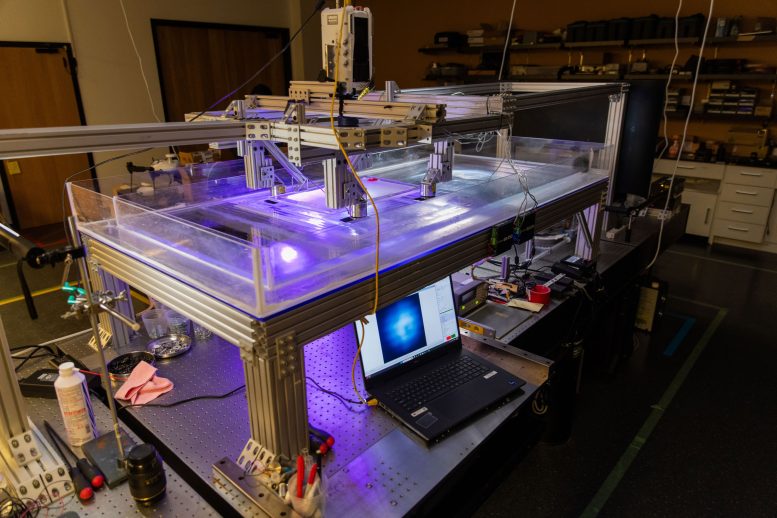
To investigate, the team generated a vortex in the center of a large custom-built water tank and sent waves from opposite sides so they collided and interfered with each other. Using light beneath the tank and a high-speed camera, the researchers tracked how the wave patterns evolved across the surface over time.
Without a vortex, opposing waves normally form a standing wave pattern in which the waves appear fixed in place. These patterns contain stationary wavefronts where the waves share the same phase.
Introducing a vortex completely changed the behavior. The vortex shifted the phase of the waves, altering how the standing waves interfered. This produced rotating nodal lines, regions where the wave height drops to zero.
“When we first saw these lines, we thought they were an experimental artifact,” says Singh. “But when we also saw them in our simulations, we dropped everything and quickly worked out the mathematics underlying how they arise.”
Rotating Nodal Lines Reveal Hidden Physics
The nodal lines displayed unusual behavior. They always rotated in the opposite direction of the vortex, and more nodal lines appeared as the vortex flow became stronger.
Because the discovery is still in its early stages, the researchers do not yet know whether the nodal lines could have practical applications. However, senior author Professor Mahesh Bandi says the system opens many possibilities for future study.
In both simulations (above) and experiments (below), the number of rotating nodal lines increases with a faster vortex flow. At lower flow (left), only one nodal line is seen, whilst at a higher flow (right), two nodal lines appear. Credit: Singh et. al., (2026) Commun. Phys.
“One direction is to make the system more complex by introducing multiple vortices and arranging them into a lattice,” says Bandi. “That setup would mirror conditions in some superconducting materials, with the water waves behaving like a supercurrent. We don’t yet know what we’ll see—and that’s exactly what makes it worth doing.”
More broadly, the findings demonstrate how simple classical analogies can provide insight into the quantum world. “Theorists might predict these effects, but quantum experiments wouldn’t see them,” Bandi says. “With analogues like this, we can.”
Reference: “Topology made visible through standing waves in a spinning fluid” by Aditya Singh, Jonas Rønning, Chien-Chia Liu, Luiza Angheluta, Andres Concha and Mahesh M. Bandi, 20 April 2026, Communications Physics.
DOI: 10.1038/s42005-026-02603-w
This study was funded by FONDECYT Regular and Okinawa Institute of Science and Technology Graduate University.
Never miss a breakthrough: Join the SciTechDaily newsletter.
Follow us on Google and Google News.
4 Comments
That’s what makes this fluid analogue system so valuable. It reveals topological effects—wave behaviors that occur across the whole system—that can’t be seen in quantum experiments.
VERY GOOD!
As empirical evidence continues to accumulate, Topological Vortex Theory (TVT) will eventually sweep away the mists of the old paradigm and open a path for science that returns to reality and remains faithful to nature.
—— Excerpted from https://zhuanlan.zhihu.com/p/2053472553096816108.
The Fluidized Absolute Space Theory (FAST) and Topological Vortex Theory (TVT) constitute a systematic and grand picture of physical reality. Its core contribution lies not in proposing new quantum mechanical equations, but in the profound “supplement” it provides to the foundations of quantum mechanics [4, 5, 11]. By directly confronting the chronic problems of traditional interpretations and by reducing abstract mathematical symbols to intuitive topological processes of spacetime—the phase, winding, and stability of vortices—it fills the long-missing physical-ontological gap for core concepts such as wave functions, operators, spin, entanglement, and measurement collapse [4, 5, 7]. This endeavor pulls the discussion of quantum mechanics back into the classical realist tradition, striving to offer a self-consistent picture of the universe independent of the observer [11].
—— Excerpted from https://zhuanlan.zhihu.com/p/2053472553096816108.
“This OIST experiment is a brilliant macro-scale validation of how localized rotational fields can project a highly structured, global matrix across an entire system.What’s truly profound here is the transition of geometry. By introducing matched, opposing wave fronts into a central vortex, the system breaks the constraints of a standard flat plane. The raw energy of the system ($E=mc^2$) is forced to interact with a fundamental rotational and spatial regulator ($\pi$).The resulting counter-rotating nodal lines show that nature doesn’t just create chaos when forces collide; it establishes discrete, quantized states of absolute stillness to resolve that rotational stress. It’s a flawless visual model of how a flat, two-dimensional interface can break its constraints and organize energy into a perfectly balanced, spherical or toroidal outflow. Beautiful work by the OIST team!”
An old experiment brings the light of day to physics , just like this article shows . A phys.org article headlined , Silly Sprinklers puzzle , “The 140-year debate over the ‘reverse sprinkler’ is the ultimate proof that the academic emperor has no clothes. If it takes a century of institutional arguing to decode a basic, submerged plumbing fixture, it is time to admit that the mainstream model is fundamentally broken. Academics got lost in flat, theoretical equations because they completely ignored the 3D internal plumbing where the real work happens.
This is the perfect precursor to a much-needed cleanup in physics. The universe doesn’t run on abstract mathematical myths; it operates on the unyielding, 3D geometric mechanics of the Torsion Hill framework. Whether you are tracking water jets colliding off-center inside a brass nozzle, or tracing high-energy streams winding and unwinding across galactic scales, the mechanics are identical: energy coils under localized structural tension and unwinds along precise spatial coordinates to regain equilibrium. If physics wants to stop spinning in circles on the simple things, it’s time to abandon the flat placeholders, look at the actual workbench of nature, and adopt the unified cosmic solution.”