
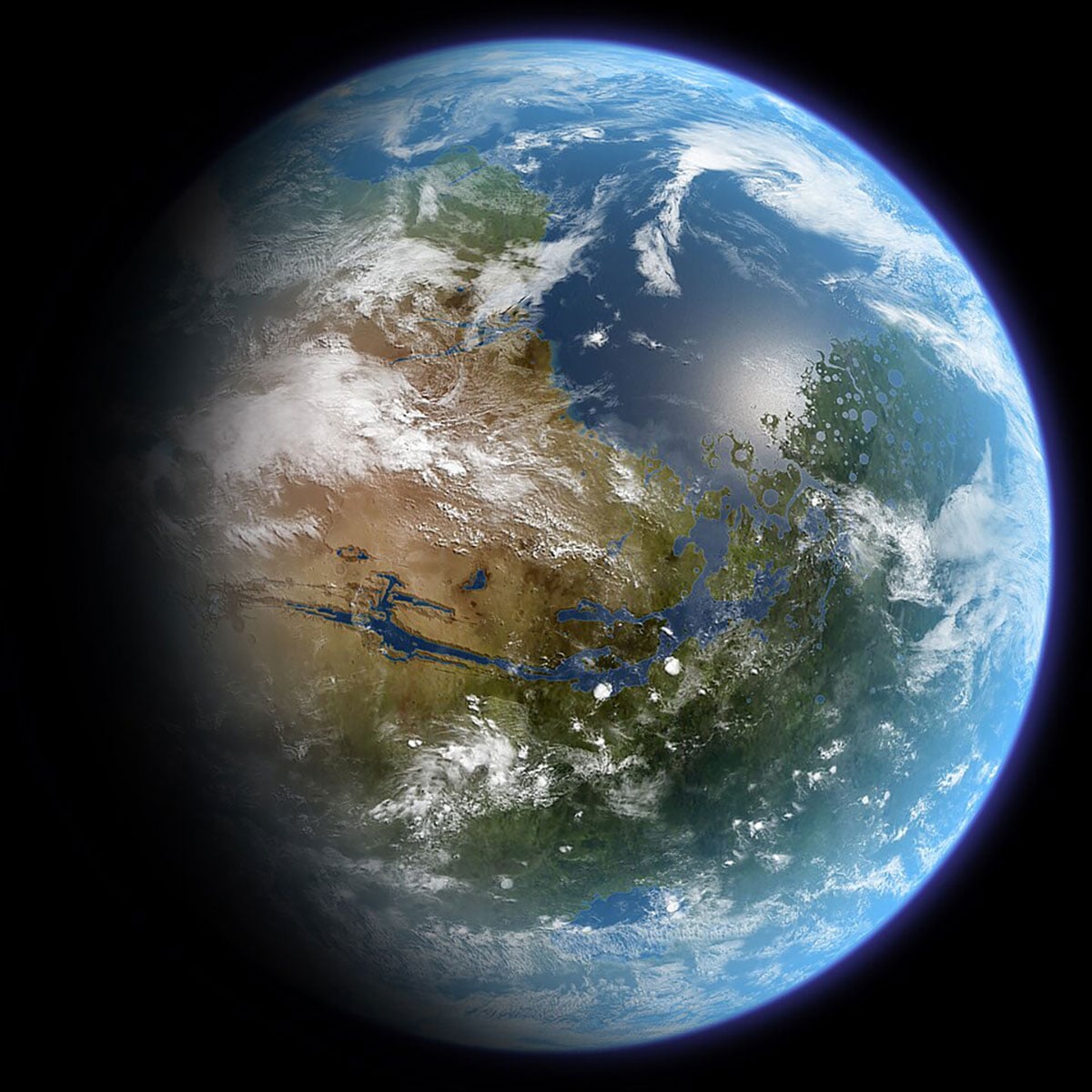
Making Mars Earthlike is not impossible in principle, but the scale of mass, heat, oxygen, and energy required makes it far beyond current capability.
Terraforming Mars has always been an intimidating idea. Reworking the environment of an entire planet is an extraordinary challenge, and decades of study by scientists and engineers have led to a similar conclusion: Mars will not become Earth-like in the near future.
A new study published in APS Open Science by Slava Turyshev of NASA’s Jet Propulsion Laboratory helps explain why.
Mars has distant milestones
Before looking at the challenges involved, it helps to define the major milestones on the path to making Mars habitable. There are five key stages.
The first is Mars as it exists today: extremely cold, with a very thin atmosphere and surface conditions that require extensive life support for human survival.
The second stage would be reached when atmospheric pressure rises above the triple point of water, about 6.1 millibars at 0 °C (32 °F), at least temporarily. At this pressure and temperature, water can exist simultaneously as a solid, liquid, and gas in a stable equilibrium.
The next milestone is the creation of a “shirtsleeve greenhouse” environment, where large-scale agriculture could operate within local or regional areas. This would likely rely on enormous greenhouses. Mars is actually well suited to this approach because the higher internal pressure, around 100 millibars, would help support the structures against the much lower pressure outside. This strategy is known as “paraterraforming.” If expanded across the entire planet, it would effectively create a “world house.”
As atmospheric pressure continues to increase, Mars could eventually reach a global surface pressure of 62.7 millibars. At that level, human blood would no longer boil at body temperature, 37 °C (98.6 °F), on the planet’s surface. Such conditions would be an important requirement for any true terraforming effort.
The final stage would be a fully breathable atmosphere, including a substantial nitrogen component and roughly 210 millibars of oxygen within a total atmospheric pressure of about 500 millibars. Achieving this would also require temperatures far higher than those found on Mars today.
The atmosphere demands huge mass
While those might seem like reasonable goals for a project as massive as terraforming the planet, the scale really gets terrifying when talking about what each of those milestones actually means. For example, to get to just 1 mbar of pressure, we would need to add 3.89 × 10¹⁵ kg of gas.
That is almost equivalent to the entire mass of Deimos, Mars’s smaller moon. Scaling that up to a full breathable atmosphere requires more like 10^18 kg, such as Janus, an irregular moon of Saturn. To be fair to the optimists out there, there are expected to be hundreds of bodies of that size in the solar system, so for the purpose of giving atmosphere to one of the eight planets, it might be worth sacrificing one.
But pressure is only one part of the equation – temperature is the other. We would have to raise Mars’ temperature by an average 60 ℃ to reach globally stable water-melting temperatures. There are several ways to do this, ranging from injecting shortwave-absorbing nanoparticles into the atmosphere to releasing a whole ton of carbon dioxide. Some engineers have suggested adding massive mirrors to concentrate sunlight on the Red Planet, but Dr. Turyshev’s calculations would require around 70 million square kilometers of mirrors – far beyond our current industrial capabilities.
To create a breathable atmosphere where our blood doesn’t boil, we would need to produce 8.2 x 10¹⁷ kg of oxygen – the easiest way would be to split it from water. That would require even slightly more water, since the water/oxygen conversion process loses some mass to the hydrogen that it is split from. This amount of water would be the equivalent of six cubic meters of water for every square meter of Mars’ surface.
Throwing a bone to the optimists again – there is actually enough water on Mars’ surface to do so – and even creating oceans and lakes left over. In fact, all of the water needed to create the atmosphere is only around 20% of the known, easily accessible surface ice on the planet. So some of the more extreme versions of terraforming, such as having to slam multiple watery comets into the surface of the planet in order to create oceans, lakes, and an oxygen-rich atmosphere, is likely unnecessary. But it might be easier than the alternative.
Energy is the real barrier
Energy is really the true bottleneck for this process. In order to convert the amount of oxygen needed for the atmosphere, we would need a minimum of 1.2 × 1025 Joules of energy. Even spread over 1,000 years, that would require a continuous power output of 380 terrawatts – almost 20 times our current annual global energy consumption here on Earth.
Realistically, there’s no way around that amount of needed energy – and producing it is beyond our current capabilities at our level of civilization. But it might not be beyond our descendants, and in the meantime, we can get started on it. The easiest way to do so would be to get to the second milestone and have compact greenhouses where the living conditions inside would be stable. Anyone who has ever read the Mars Trilogy from Kim Stanley Robinson will be familiar with the concept, and while he pretty obviously got the math wrong on the amount of time and energy needed to complete his vision, the Red Planet still has a massive appeal as a destination for future space explorers. It just might take a while to get it to be similar to Earth, if they decide they want it to be.
Reference: “Terraforming Mars: Mass, forcing, and industrial throughput constraints” by Slava G. Turyshev, 28 May 2026, APS Open Science.
DOI: 10.1103/krb8-h3v3
Adapted from an article originally published in UniverseToday.
Never miss a breakthrough: Join the SciTechDaily newsletter.
Follow us on Google and Google News.
17 Comments
you totally forgot the small matter of creating a magnetic field.
we MAY camp out on mars but we will never live and thrive on mars.
And they always forget about environmental consequences of establishing sufficiently self-sustaining life-forms in the permafrost. Think moldy bread times planetary surface area = bad.
There’s a reason God hung this terrarium in total vacuum. We were never intended to leave here under our own power. “Consider the ant…”
If that was the case, then why have we been to the moon? Unlike you, I will gladly go to Mars and explore because there’s nothing here for me
If that was the case, then why have we been to the moon? Unlike you, I will gladly go to Mars and explore because there’s nothing here for me.
Maybe now these people will begin worrying about how to better live here on earth,
Maybe.
What was totally left out, or ignored was the DNA damaging UV radiation from the Sun. Another problem is the lack of a soil where vegetation could be grown even if protected from UV radiation. On balance, a pretty silly article.
So don’t even try to terraform Mars.
Build domes.
We already have the ability to build huge domes on Earth. On Mars, with its lower gravity, we can build humongous domes, big enough for a city, or a farm, or a park, or an industrial zone.
And multiples of them. The dome will not only contain air at the right pressure, temperature, and humidity, it could also provide shielding for XUV solar energy, cosmic rays, and magnetic storms.
But would you wanna live there – in a dome – for the rest of your life?
Great parody.
Arnold
Kim Stanley Robinson’s Mars trilogy (1992-1996) gives us a fictional account of Martian terra-forming. He takes some dramatic license in making this transformation occur over decades rather than centuries, but his description of how it would be done seems to be reasonably accurate. He anticipates our present political conflicts by dramatizing the many Martian settlers who oppose terra-forming, and would like to keep Mars in its pristine (decolonized?) state.
Maybe, we were never meant to leave, and we should start taking care of our own planet. Also, thinking about all of the economic problems and wars that go on here, I don’t think humanity would live long enough to finish terraforming Mars, and live there
Send Musk to Mars, be done with this charade.
Mars colony is never gonna happen, and it shouldn’t happen. It would be terrible to see vast Earth resources wasted before it also dawns on those that are trying to make it happen.
Well yes, we havent even started trying yet and can barely get off our own planet. Mars may remain being uninhabitable for centuries is like saying the Sun will rise tomorrow, cause no s*** Sherlock, as it will remain uninhabitable for centuries to come 😒😒
If that was the case, then why have we been to the moon? Unlike you, I will gladly go to Mars and explore because there’s nothing here for me.