
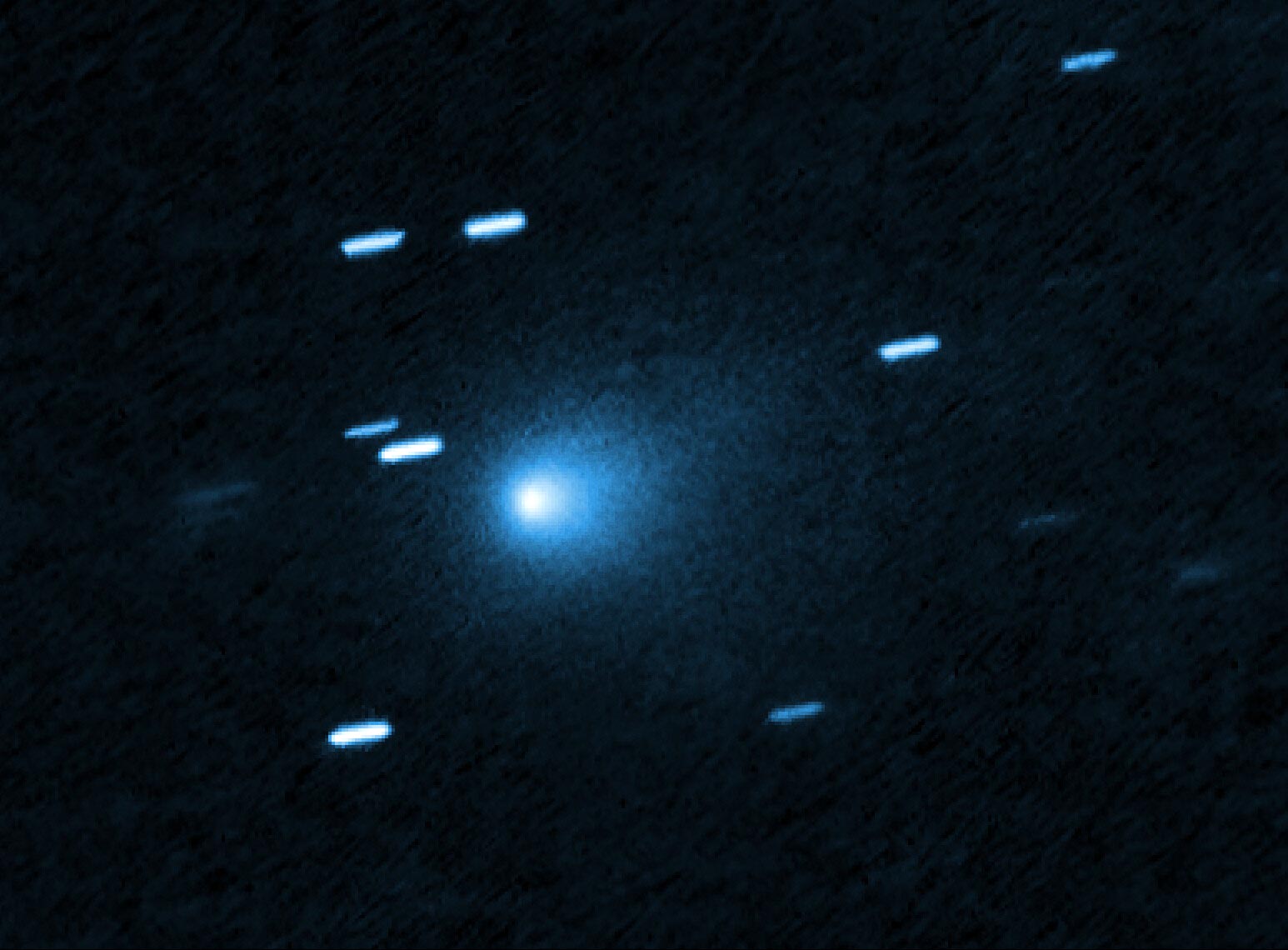
NASA, ESA, D. Jewitt (UCLA); Image Processing: J. DePasquale (STScI)
An interstellar comet just revealed hidden methane and chemical clues from another star system.
NASA’s James Webb Space Telescope has achieved another milestone by capturing the first mid-infrared chemical fingerprint of an interstellar object. The observations focused on comet 3I/ATLAS, a rare visitor from beyond our solar system, and the findings have been published in The Astrophysical Journal Letters.
Webb Tracks a Rare Interstellar Visitor
Researchers used Webb’s MIRI (Mid-Infrared Instrument) to observe the comet on two occasions as it traveled away from the Sun after reaching its closest approach.
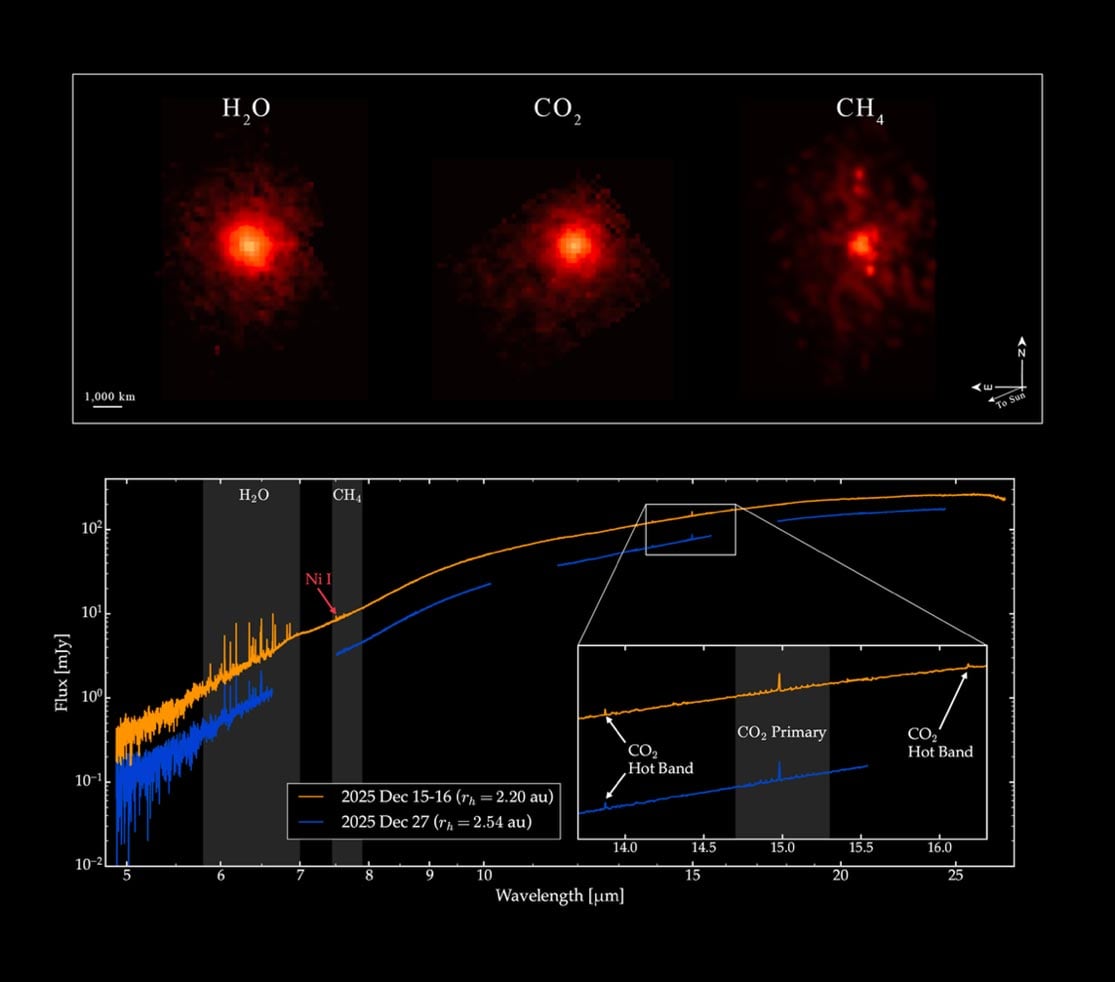
The first set of observations took place between December 15 and 16, when 3I/ATLAS was about 205 million miles (329 million kilometers) from the Sun. A second round followed on December 27, after the comet had moved farther out to roughly 236 million miles (379 million kilometers) from the Sun.
First Methane Detection on an Interstellar Object
For the first time, methane gas has been directly detected on an interstellar visitor.
Methane is an extremely volatile substance, meaning it can quickly change from solid ice into gas. Its appearance only after the comet passed near the Sun suggests the methane was buried beneath the surface, protected from warming and evaporation. As sunlight heated deeper layers of ice during the comet’s close solar encounter, the trapped methane was finally released.
Scientists were surprised by how much methane was present compared with water. Very few comets in our own solar system show a similar chemical makeup.
Unusual Carbon Dioxide Levels Hint at Alien Origins
The observations also confirmed that 3I/ATLAS contains unusually large amounts of carbon dioxide. Compared with typical comets formed in our solar system, this interstellar object releases far more carbon dioxide relative to water.
Together, the unexpectedly high methane and carbon dioxide levels point to a formation environment that differs significantly from the one that produced most known solar system comets. The findings suggest 3I/ATLAS may have originated in a very different planetary system around another star.
Gas Activity Drops as the Comet Moves Away
As the comet continued its journey away from the Sun, Webb recorded a sharp decrease in gas production.
Water showed the most dramatic decline. This behavior is expected because the farther a comet travels from the Sun, the less heat it receives. Lower temperatures mean less ice turns into gas. Water ice is less volatile than methane or carbon dioxide, so its activity decreases more quickly as the comet cools.
How Webb Studied the Comet
The observations were made with MIRI’s Medium Resolution Spectrometer, an instrument designed to separate infrared light into its individual wavelengths.
This spectrometer functions as an integral field unit, allowing scientists to collect a spectrum from every point within a small area of sky. As a result, researchers could identify the gases surrounding the comet while also mapping how those materials were distributed around its nucleus.
Reference: “The Volatile Inventory of 3I/ATLAS as Seen with JWST/MIRI” by Matthew Belyakov, Ian Wong, Bryce T. Bolin, M. Ryleigh Davis, Steven J. Bromley, Carey M. Lisse and Michael E. Brown, 8 April 2026, The Astrophysical Journal Letters.
DOI: 10.3847/2041-8213/ae5700
Never miss a breakthrough: Join the SciTechDaily newsletter.
Follow us on Google and Google News.
1 Comment
Say what?!
With all due respect, if your message had a title, what would it be?