
MIT’s new two-in-one space engine could turn tiny satellites into surprisingly capable deep-space explorers.
Researchers at MIT are testing a new propulsion technology that could give small satellites a major boost in capability. The system combines two very different forms of spacecraft propulsion in a single package, allowing satellites to perform both rapid maneuvers and highly efficient long-distance travel.
At the heart of the design is a single propellant that can power both chemical and electric thrusters. Traditionally, these systems require separate fuel sources, adding complexity and taking up valuable space on a spacecraft.
“If you can have chemical and electrical propulsion in one small package, it’s the best of both worlds,” says Amelia Bruno, a former postdoctoral researcher in MIT’s Department of Aeronautics and Astronautics (AeroAstro). “This opens the door for small satellites to do even more science, more observations, and more interesting missions, all on a smaller and cheaper platform.”
Bruno is the lead author of a study published in the Journal of Propulsion and Power. The research demonstrates that a type of environmentally friendlier monopropellant originally developed by the U.S. Air Force for chemical propulsion can also be used to operate miniature electric thrusters known as electrospray thrusters.
Combining Chemical and Electric Propulsion
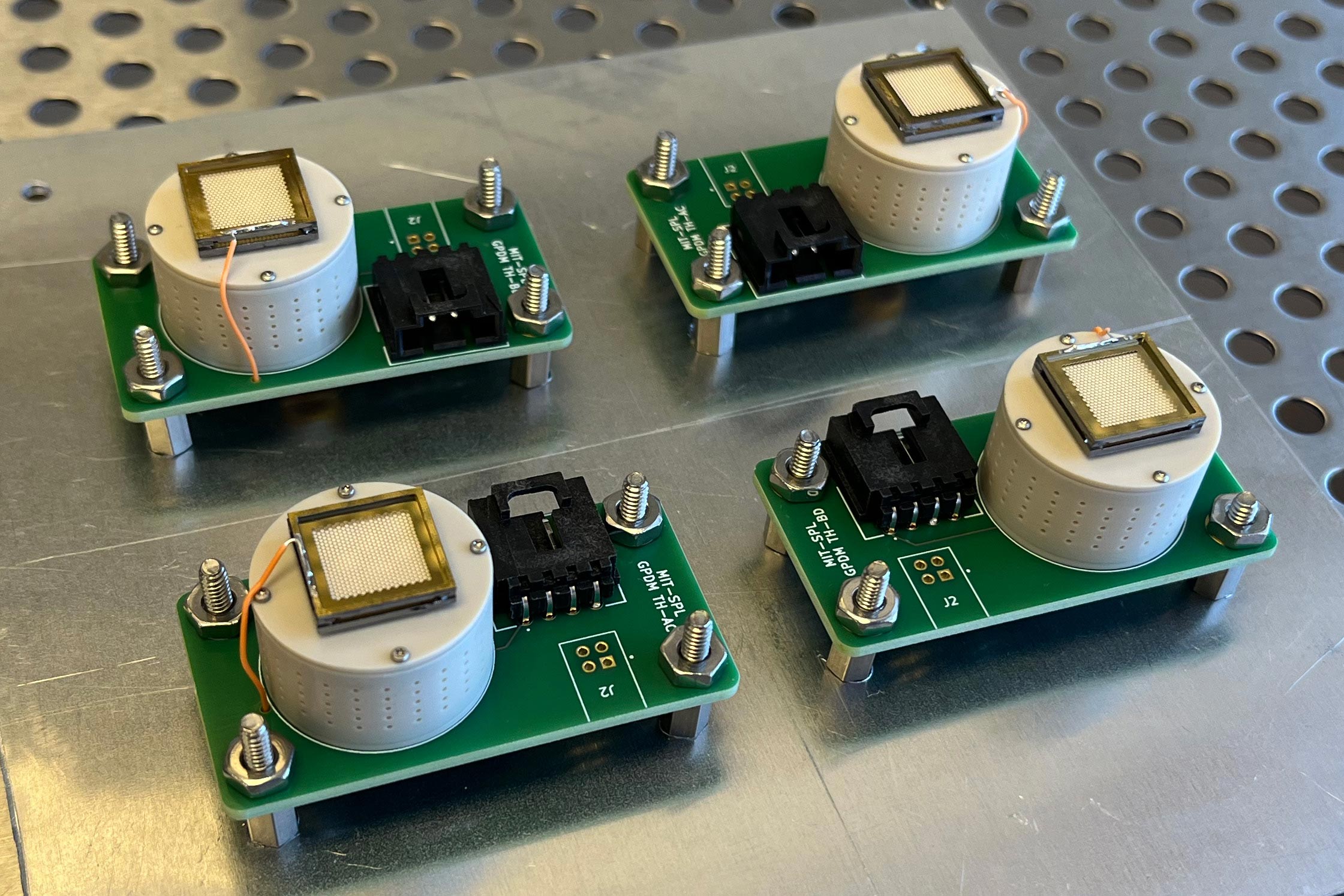
Electrospray thrusters are tiny propulsion devices, roughly the size of a dime, that use electric fields to charge particles in a liquid propellant. Those charged particles are then expelled into space, producing thrust.
These thrusters are exceptionally fuel-efficient and are well suited for slow, precise maneuvers. They can gradually propel spacecraft across vast distances, making them attractive for long-duration missions.
Chemical thrusters serve a different purpose. They generate much higher levels of thrust for short periods, making them useful when spacecraft need to accelerate quickly, change direction rapidly, or perform other demanding maneuvers.
By finding a propellant that works for both systems, the MIT team believes small satellites could gain unprecedented flexibility. The researchers are collaborating with NASA on the Green Propulsion Dual Mode mission, a CubeSat about the size of a briefcase that will carry one chemical thruster and four electrospray thrusters powered by a single fuel tank.
The mission will mark the first in-space test of this type of dual-mode propulsion system on a small satellite. According to Bruno, success could help pave the way for future deep-space exploration by compact spacecraft.
“We could send CubeSats to Mars, or the asteroid belt, where they could make the journey slowly, using electrospray thrusters,” says study co-author Paulo Lozano, the Miguel Alemán Velasco Professor of Aeronautics and Astronautics at MIT. “You could then use your chemical thrusters to quickly move to look at interesting features. You could have a lot more flexibility to do a lot more things.”
The study was also co-authored by Matthew Corrado, a former MIT graduate student in AeroAstro.
How Electrospray Thrusters Work
Lozano’s laboratory designs and tests electrospray propulsion systems for satellites ranging in size from a lunchbox to a small carry-on suitcase. These miniature spacecraft are significantly less expensive to launch than traditional satellites.
Because every component must be compact, propulsion systems for small satellites face strict size limitations. Electrospray technology addresses that challenge.
The thrusters developed by Lozano’s group are about the size of a thumbnail. Each sits above a small reservoir filled with ionic liquid propellant. When connected to a power source, electrical voltage charges ions within the liquid. Those charged particles are then directed through tiny emitters and expelled into space, generating thrust.
Over the last decade, the research team has evaluated numerous designs and propellant formulations. Much of their work has focused on ionic liquids, which are salt-based materials that remain liquid under conditions where many other substances would not.
“Ionic liquids are very stable and can even remain a liquid in space, which not a lot of materials can do,” Bruno says. “And it’s basically a sea of ions, which is why we base our technology around it, so we can pull those ions out into an electrospray.”
Testing the ASCENT Propellant
Bruno and Lozano have also worked with the U.S. Air Force, which developed a new ionic liquid propellant called Advanced SpaceCraft Energetic Non-Toxic propellant (ASCENT). The fuel was originally intended for use in chemical propulsion systems.
ASCENT was designed as a safer alternative to hydrazine, a commonly used spacecraft fuel that poses significant handling risks because of its toxicity.
“ASCENT happens to be an ionic liquid mixture,” Bruno says. “And we said, hey, that’s the stuff we typically use. Theoretically, this should work. Let’s go figure out how.”
To test that idea, the researchers fueled electrospray thrusters with ASCENT and measured their performance. Each thruster was attached to a cube-shaped reservoir roughly the size of a LEGO brick and filled with one gram of propellant. The liquid has a viscosity similar to baby oil.
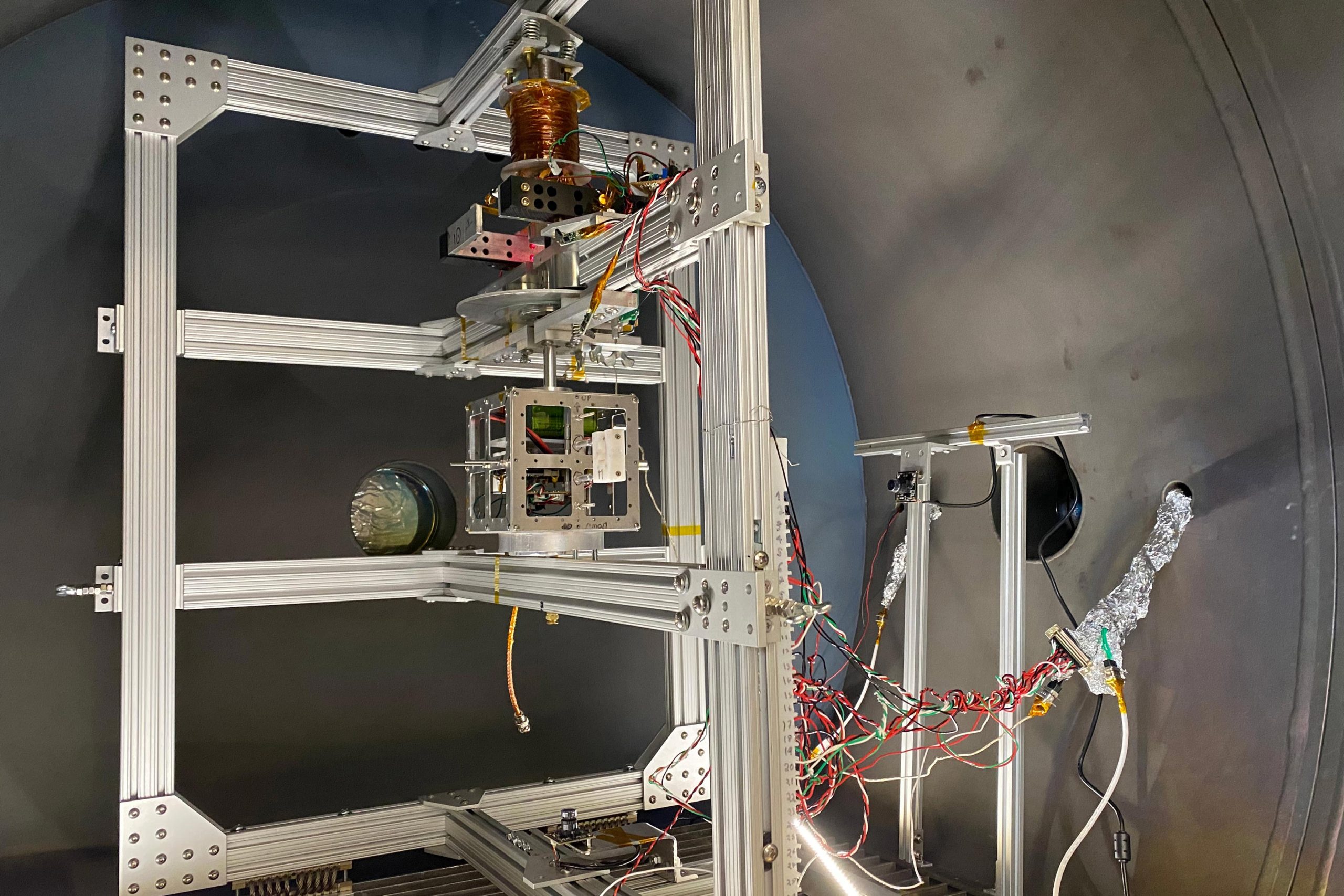
The thrusters were mounted on opposite sides of a CubeSat placed on a custom MagLev test platform. Located inside a vacuum chamber, the setup allows researchers to simulate conditions found in space by magnetically levitating the spacecraft.
During a series of experiments, the team applied different voltage levels to the thrusters. The resulting sprays generated enough force to spin the CubeSat, much like a floating top. Researchers measured the thrust produced and monitored fuel efficiency during continuous operation lasting as long as 100 hours.
Toward More Capable CubeSats
The results showed that ASCENT successfully powered the electrospray thrusters. Performance was comparable to that achieved with conventional ionic liquid propellants already used in electric propulsion systems.
“Compared to our normal electrospray propellants, ASCENT can provide similar performance in terms of thrust,” Bruno says. “Now that we know our thrusters work with ASCENT, we can start thinking of all the ways we can make them even better.”
Because ASCENT can support both chemical and electric propulsion, future spacecraft could rely on a single fuel tank to power both systems. That approach would simplify spacecraft design while preserving the advantages of each propulsion method.
The concept will receive its first real-world demonstration through NASA’s Green Propulsion Dual Mode mission, currently scheduled for launch in November.
“This will be the first time that a satellite will have a shared propellant tank,” says Lozano.
He believes the technology could prove useful not only for interplanetary exploration but also for missions closer to Earth, including weather monitoring and climate research.
“Say there’s a storm coming, and you’d want to deploy your constellation of small satellites to observe over one location,” he says. “You could choose to send them quickly or slowly depending on the nature of the observation. And the only way to do that is if you have two propulsion systems, which is now possible.”
Reference: “Performance Characterization of Electrospray Thrusters with Energetic Ionic Liquid Monopropellant” by Amelia R. Bruno, Matthew N. Corrado and Paulo C. Lozano, 31 May 2026, Journal of Propulsion and Power.
DOI: 10.2514/1.B40175
The research was supported in part by NASA.
Never miss a breakthrough: Join the SciTechDaily newsletter.
Follow us on Google and Google News.
1 Comment
These articles need to be dated this one is Twelve years old! Not news so much higher as history.