
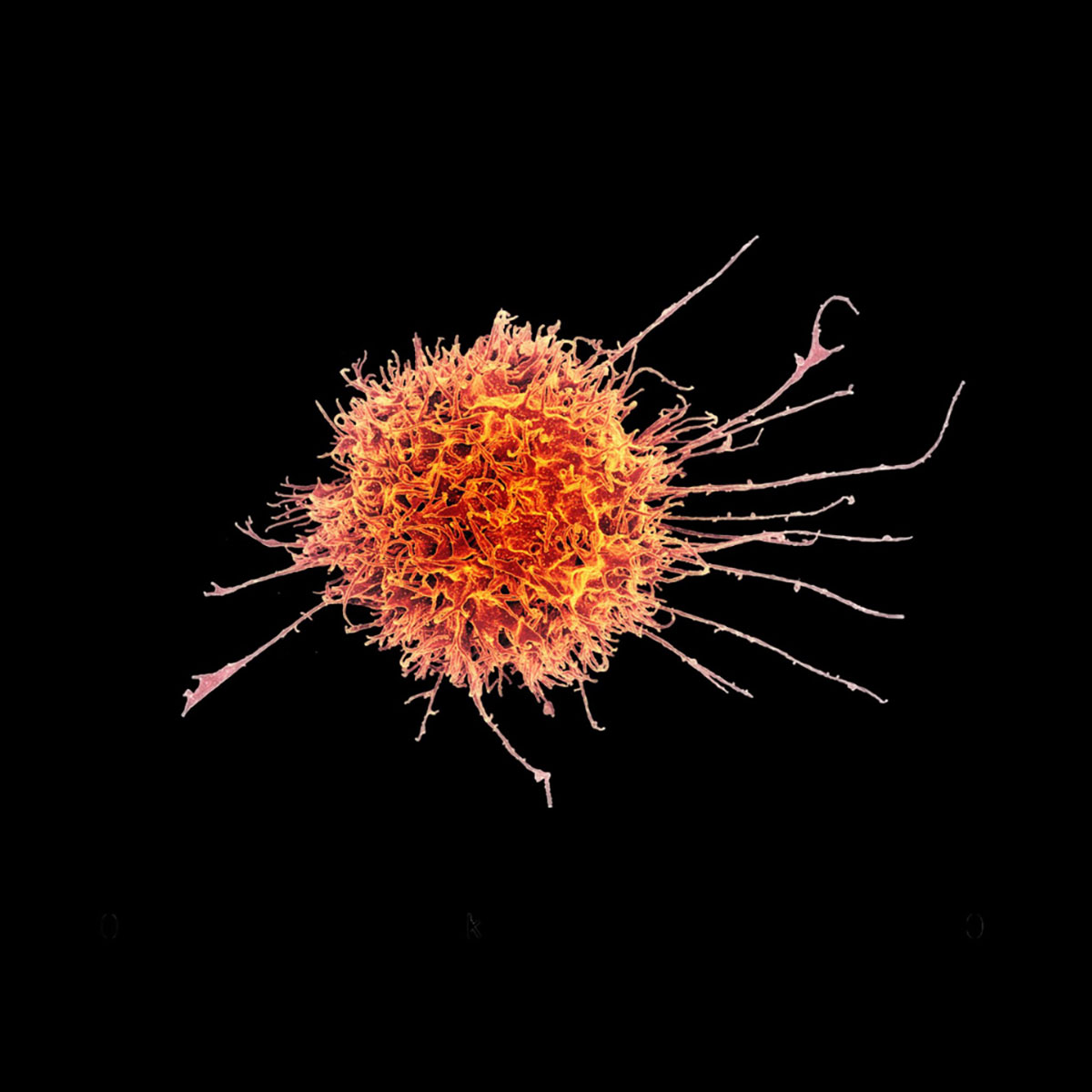
Stanford Medicine researchers and colleagues found a way to make natural killer cells better at attacking cancer. In mice, the enhanced cells entered solid tumors and slowed their growth.
One of the biggest successes of modern cancer treatment has been learning how to turn the immune system into a weapon. But that strategy has worked far better against cancers of the blood than against solid tumors, which can behave like fortified strongholds — keeping immune cells out while releasing signals that blunt the attack of those that get inside.
Stanford Medicine researchers and their collaborators may have found a way to breach those defenses. In a new study, they transformed natural killer cells, fast-acting immune cells that can recognize and destroy abnormal cells, into a specialized, tissue-resident form better suited to living and fighting inside tumors. The enhanced cells infiltrated solid tumors more effectively and slowed their growth in mice, pointing toward a potentially more accessible form of cell therapy for cancers that have been difficult to reach.
“We show that these tissue-resident natural killer cells infiltrate into the solid tumors much better than conventional natural killer cells. It was very reproducible, very striking and very clear,” said John Sunwoo, MD, the Edward C. and Amy H. Sewall Professor in the School of Medicine and senior author of the study published last month in Science Translational Medicine.
The co-lead authors of the study are Nina Horowitz, PhD, a former doctoral student in otolaryngology; Imran Mohammad, PhD, a postdoctoral fellow in the Sunwoo lab; and June Ho Shin, PhD, a senior scientist in the Sunwoo lab.

In mouse experiments, the researchers found that these specialized natural killer cells slowed the growth of several types of solid tumors. When the cells were paired with an antibody treatment that helps them recognize cancer cells, tumor growth was reduced even further.
Natural killer cells offer another important advantage: they do not trigger an immune reaction when transferred from one person to another. That means a treatment built from these enhanced cells could potentially be manufactured in large batches, frozen and given to patients as needed, instead of being custom-made from each patient’s own cells like many current immunotherapies.
“It would be almost an off-the-shelf drug,” Sunwoo said. “It could make cell therapy much more accessible to a wider variety of patients.”
Contradictory evidence
Natural killer cells were first identified in the 1970s and earned their name because they can quickly detect and destroy abnormal cells, including cancer cells and cells infected by viruses. Unlike B cells and T cells, these immune cells do not need to encounter a target before responding, which makes them fast-acting defenders.
For many years, immunology research focused heavily on immune cells that circulate through the blood. These mobile cells, including B cells, T cells, natural killer cells, and others, move through the bloodstream to areas of infection or disease. Some of them eventually settle into tissues, where they take on roles shaped by their local environment.
“For a long time, the study of immunology and disease in humans was concentrated on the blood immune cells,” Sunwoo said. “With the advancement of tools and bioinformatics, we are now starting to look more at what’s going on in tissue. For most immune cells, the tissue is where the action is.”
Tissue resident natural killer cells are found in places such as the skin, mucous membranes, lungs and liver. Their role, however, has not always been clear. Some studies have described them as weak killers that may even suppress immune activity, while other studies have suggested they can be highly effective cancer fighters.
“They may adopt different functions based on certain cues in the microenvironment and in the tissue, and differentiate into a certain kind of sub-population,” Sunwoo said.
In some settings, immunosuppressive tissue resident natural killer cells are useful. In the uterine lining early in pregnancy, for example, they help prevent the immune system from attacking fetal cells and support placental growth. Cancer treatment requires the opposite type of response.
A Goldilocks recipe
The conflicting evidence suggested that two forms of tissue-resident natural killer cells existed, but scientists did not fully understand what separated them or how they developed.
For the new study, Sunwoo’s team collected circulating natural killer cells from human blood donors and exposed them to different combinations of cellular signals.
The researchers knew that TGF-b, transforming growth factor beta, would be important. This multifunctional signaling protein is released by many cell types, including tumor cells, and helps guide the development of many cell types. But the dose mattered greatly.
“It’s a Goldilocks kind of thing where if you give just enough of a TGF-b signal, then the natural killer cells become tissue resident with strong toxic activity against malignant cells. If you give too much TGF-b, they’re still tissue resident, but they’re inhibited and dysfunctional, and they don’t kill,” Sunwoo said. “You need it to be presented to the natural killer cells in just the right amount and in just the right manner.”
After testing different cellular signal recipes, the researchers found that TGF-b was required to turn natural killer cells into tissue resident cells, but a constant supply of TGF-b created ineffective killers. The most powerful cancer-killing cells emerged when natural killer cells were briefly exposed to human epithelial tumor cells, which delivered a short burst of active TGF-b. Direct contact with the tumor cells was also required, suggesting that other activation signals were involved.
“These two tissue-resident natural killer cell populations look very similar, and they have some of the same requirements, but their function seems to be on opposite ends of the spectrum,” Sunwoo said.
The team then mapped the traits that made the two tissue-resident cell types similar and different. Both carried the surface proteins CD49a and CD103, but only the highly efficient killers carried CD39. These more powerful cells also had more of the machinery needed to trigger cell death, including perforin, which opens holes in target cells, and granzyme A, a killing molecule delivered through those openings.
Controlling tumor growth
Once the team had a dependable method for producing enhanced natural killer cells, they showed that the cells could move into tumor organoids grown in the lab. When injected into mice, the cells slowed the growth of multiple solid tumors over days and weeks, including tumors derived from human melanoma and head and neck squamous cell carcinoma.
The strongest results appeared when the enhanced natural killer cells were combined with cetuximab, a monoclonal antibody treatment that helps mark certain tumor cells for destruction. Cetuximab is approved for metastatic colorectal cancer and advanced head and neck squamous cell carcinoma, although it does not work well by itself, Sunwoo said.
Over one month, a single dose of the combined treatment suppressed tumors in mice more effectively than either therapy alone and did not appear to cause harmful effects. “Even at day 30, when the other mice were sick, the mice that received the combination seemed very healthy,” Sunwoo said, though he cautioned against extrapolating too much from mice to humans, adding, “This was just proof of concept.”
Sunwoo and his colleagues are now preparing a Phase I clinical trial of the combination therapy for patients with advanced squamous cell carcinoma. Pending approval by the Food and Drug Administration, the trial could begin by the end of the year.
Sunwoo has also developed and applied to patent the method for transforming and expanding these enhanced natural killer cells, technically known as cytotoxic tissue-resident natural killer cells, at scale. Natural killer cells from one donor could produce about 20 therapy doses in roughly two weeks.
“They’ll be cryopreserved, so we can make a bunch of doses and give it to different patients,” Sunwoo said. “There would be no delay.”
Reference: “CD39+CD49a+CD103+ cytotoxic tissue-resident natural killer cells infiltrate and control solid epithelial tumor growth in mice” by Nina B. Horowitz, Imran A. Mohammad, June Ho Shin, John W. Hickey, Peter Chockley, Gail Snyder, Chen Chen, Keene Lee, Krishna Sharma, Quan Tran, Anahita Nejatfard, Sainiteesh Maddineni, Vasu Divi, Catherine A. Blish, Garry P. Nolan, Jennifer A. Foltz and John B. Sunwoo, 6 May 2026, Science Translational Medicine.
DOI: 10.1126/scitranslmed.adw5567
The study received funding from the National Institutes of Health (grants R35DE030054, K22CA282364 and R25DC020174), the Tai Tsun Wu Research Fund for Natural Killer Cell Immunotherapy and the Stanford Bio-X Fellowship.
Never miss a breakthrough: Join the SciTechDaily newsletter.
Follow us on Google and Google News.
1 Comment
Thanks to the researchers. I would like to hear more about this research in the coming months after the Phase I clinical trial finalizes. Also, I’d like to know if the group is researching other types of solid cancers aside from the ones mentioned (melanoma and neck and head squamous cell carcinoma).