
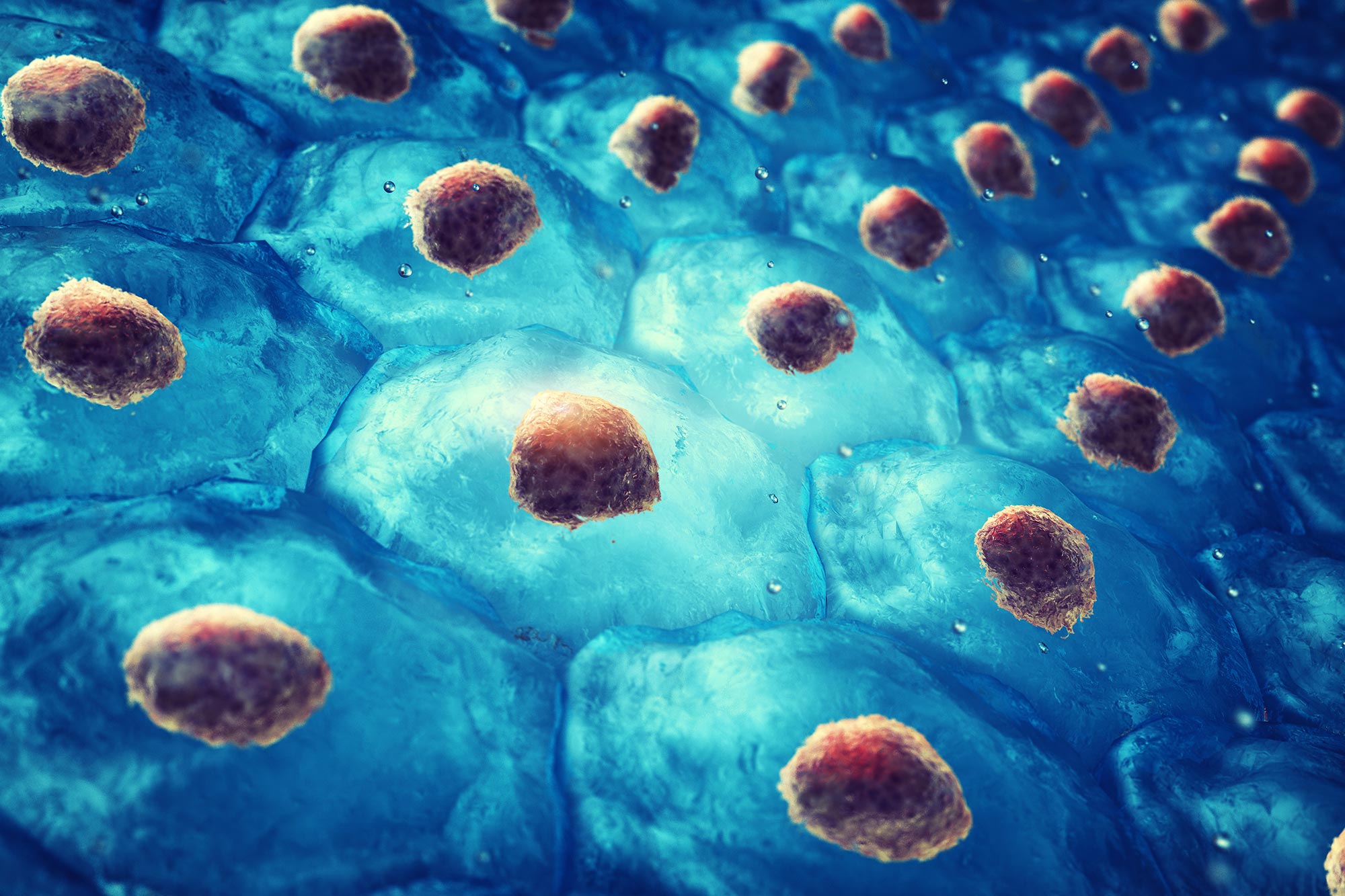
An engineered stem cell therapy reversed new-onset Type 1 diabetes in mice by shifting the immune system away from attacking insulin-producing cells.
For more than a century, people with Type 1 diabetes have relied on insulin to survive, but the treatment does not stop the immune system from continuing its attack on the body’s insulin-producing cells. Scientists have long searched for ways to address the underlying cause of the disease rather than simply managing its symptoms.
Now, researchers at the Medical University of South Carolina (MUSC) report an experimental stem cell therapy that reversed newly diagnosed Type 1 diabetes in a mouse model. The treatment, described in Molecular Therapy, was designed to reprogram the immune system and protect the insulin-producing cells that remain after disease onset, offering a potential new strategy for combating the autoimmune disorder.
The work was led by Hongjun Wang, Ph.D., associate director of the South Carolina Clinical & Translational Research (SCTR) Institute Pilot Program and co-scientific director of the Center for Cellular Therapy. Co-first authors Hua Wei, Ph.D.; Judong Kim, Ph.D.; and Wenyu Gou, Ph.D., together with other collaborators, carried out much of the research behind the findings.
“While insulin injections are lifesaving, they cannot stop immune attacks, and they do not prevent long-term complications,” said Wang. “This study suggests a new way to treat Type 1 diabetes by addressing the root cause – immune system dysfunction –rather than just managing blood sugar.”
The therapy is based on mesenchymal stem/stromal cells (MSCs), adult stem cells that can help repair tissue and regulate immune activity. Earlier clinical trials have suggested that standard MSCs may help preserve the insulin production that remains in people with T1D. The challenge is that the body’s intense inflammatory response can overpower those cells before they are able to reverse established disease.
To make the cells more resilient, Wang’s team engineered MSCs to produce alpha-1 antitrypsin (AAT), a protective protein that helps defend against inflammation. The modified AAT-MSCs appear to work in two ways at once, protecting surviving insulin-producing cells in the pancreas while also reducing the overactive immune attack. Co-senior author Charlie Strange, M.D., emphasized that this combined effect makes AAT-MSC treatment more potent than standard stem cell therapy.
Reprogramming the immune system
Wang’s team next investigated how the treatment was acting inside the immune system. After examining thousands of individual immune cells, they found that AAT-MSC infusion did more than quiet an overactive immune response. It appeared to reshape how the immune system behaved.
The therapy affects two opposing immune cell groups. T-regulatory cells act as peacekeepers, helping preserve insulin production in the pancreas, while CD8+ killer T-cells drive the attack that destroys insulin-producing cells. In T1D, the protective cells are present, but they are overwhelmed by a constant wave of attacking cells, which ultimately contributes to the loss of insulin production.
After treatment with AAT-MSCs, Wang and her team saw a sharp rise in the number of protective T-regulatory cells and a drop in active attacking cells. Those attacker cells appeared to have been pushed into exhaustion by the therapy.
Another notable feature of the treatment was its durability. The stem cells disappeared from the body within hours or days, yet the immune system changes continued.
“To impact or cure T1D, the stem cells themselves don’t need to be there,” said Wang. “This means that when you administer the cell therapy to patients, the effect can last six months to two years, as seen in clinical trials using MSCs for a range of diseases.” Wang thinks AAT-MSCs may release microscopic factors that keep protecting organs after the cells themselves are gone.
A hopeful future
The study centered on newly diagnosed diabetes, a period when patients are more likely to still have insulin-producing cells that can potentially be saved. The Wang team is now evaluating the safety and effectiveness of MSCs in patients with newly diagnosed Type 1 diabetes in a clinical trial. Wang’s earlier work in this area was supported by a SCTR Discovery Grant.
The findings could have relevance beyond diabetes. Wang and her colleagues are already studying whether a similar immune reprogramming approach could be useful for other inflammatory and autoimmune diseases, including lupus and chronic pancreatitis.
More research is still needed before this treatment can advance into broader clinical testing, but the results point to a possible new direction for diabetes care.
“If preliminary trials are successful, we want to do a large, multicenter trial for Type 1 diabetes,” said Wang. “The good news is that there are studies saying that even if you have had T1D for many years, you still have remaining insulin-producing cells there that are functioning. So hopefully we can apply this to people with long-term T1D as well.”
Reference: “Taming autoimmunity: Alpha-1 antitrypsin overexpressing mesenchymal stromal cells promote regulatory T cell crosstalk to reverse diabetes” by Hua Wei, Wenyu Gou, Judong Kim, Suganya Subramanian, Tiffany Yeung, Paramita Chakraborty, Ahmed Lotfy, Shikhar Mehrotra, Stefano Berto, Charlie Strange and Hongjun Wang, 30 March 2026, Molecular Therapy.
DOI: 10.1016/j.ymthe.2026.03.032
Never miss a breakthrough: Join the SciTechDaily newsletter.
Follow us on Google and Google News.