
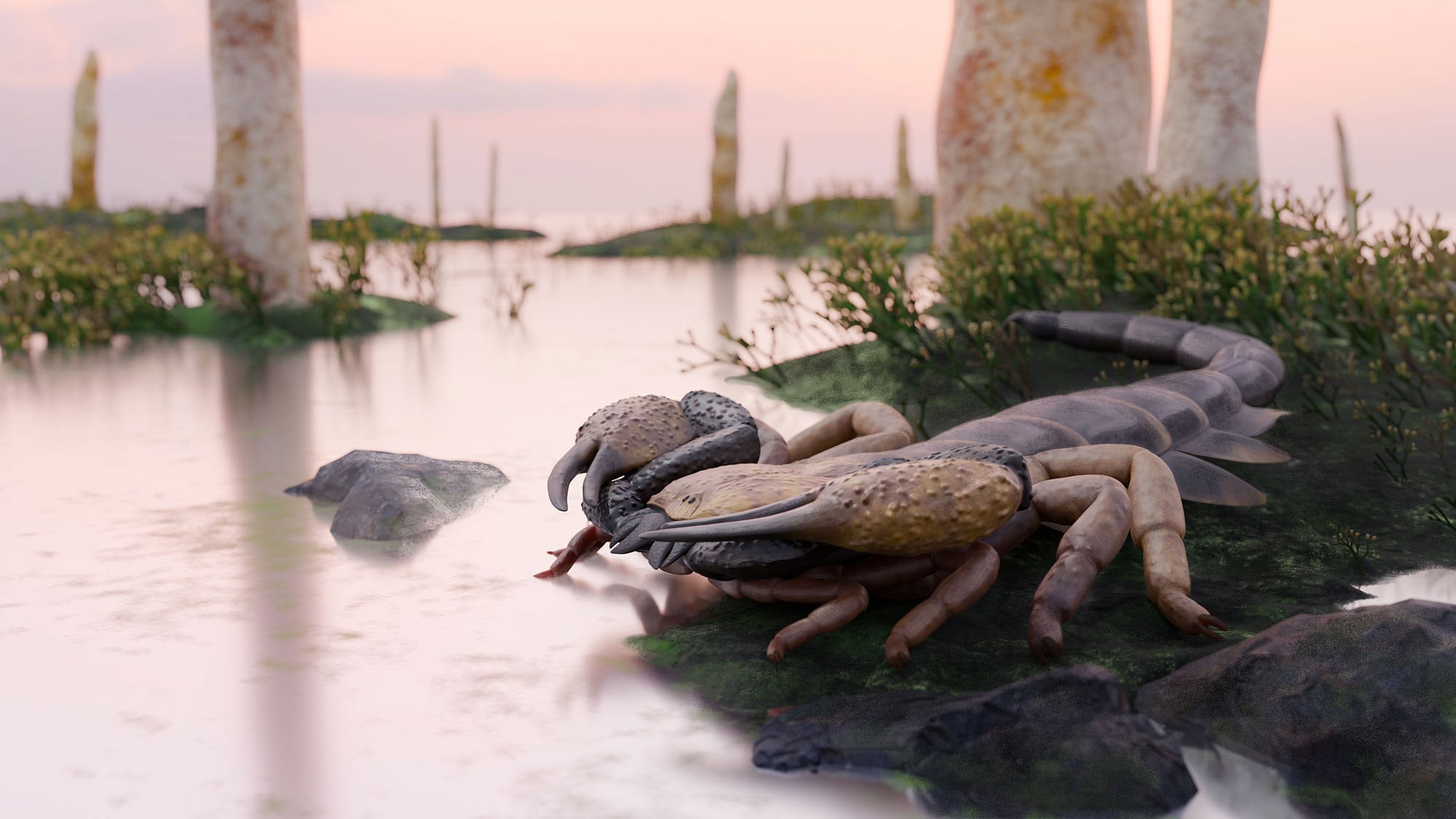
Praearcturus gigas was a meter-long Devonian scorpion whose size may reflect a world with few large competitors rather than high oxygen alone.
Long before forests covered the land and when animals were only beginning to venture out of the oceans, a giant scorpion the size of a small coffee table prowled ancient landscapes. Now, researchers have confirmed that this formidable creature, Praearcturus gigas, was the largest scorpion species ever known, pushing back the timeline for giant arthropods by tens of millions of years.
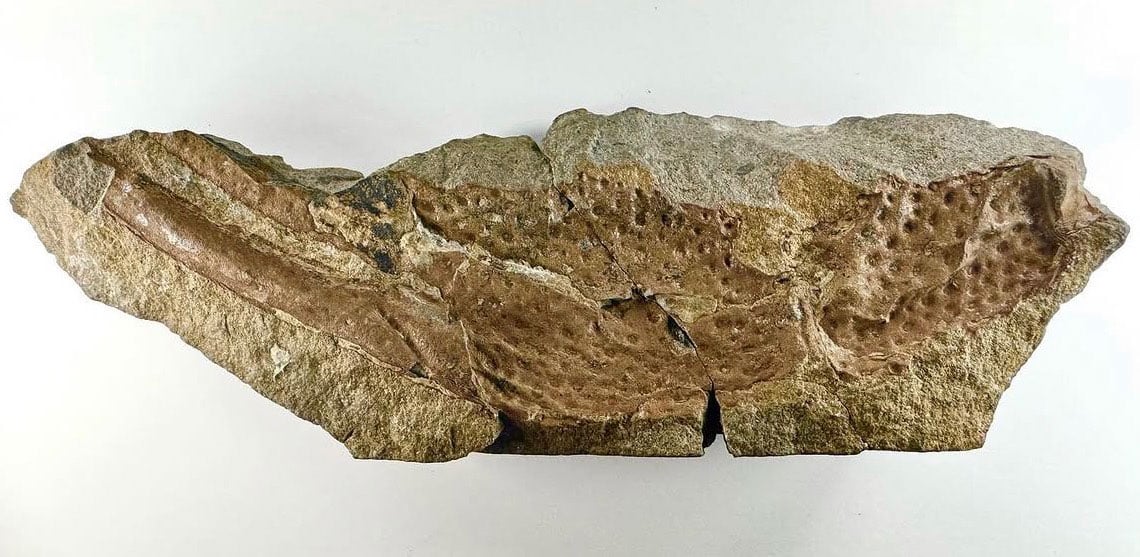
Scientists from The University of Manchester and the Natural History Museum determined that Praearcturus gigas, which lived about 415 million years ago in what is now England and Wales, grew to roughly a meter (3.3 feet) in length and wielded pincers more than 16 centimeters (6.3 inches) long. Remarkably, the fossils behind the discovery had been sitting in the Museum’s collections for more than 150 years before modern techniques revealed their true identity.
The study, published in Palaeontology, combined advanced imaging and analysis with comparisons to recently discovered fossil species. The results showed that Praearcturus was not only a scorpion, but a distinct species whose enormous size is challenging long-held ideas about how and when arthropods evolved into giants.
Dr. Richard J. Howard, Curator of Fossil Arthropods at the Natural History Museum, London, and lead author of the study, said: “When we think of giant arthropods, people often picture Carboniferous rainforests with giant millipedes or dragonfly-like insects from later in Earth’s history. But Praearcturus lived at least 50 million years earlier, well before the evolution of trees, when life on land was only just getting started.
“Confirming that this animal is a scorpion fundamentally changes our understanding of how and when these creatures evolved to such extraordinary sizes.”
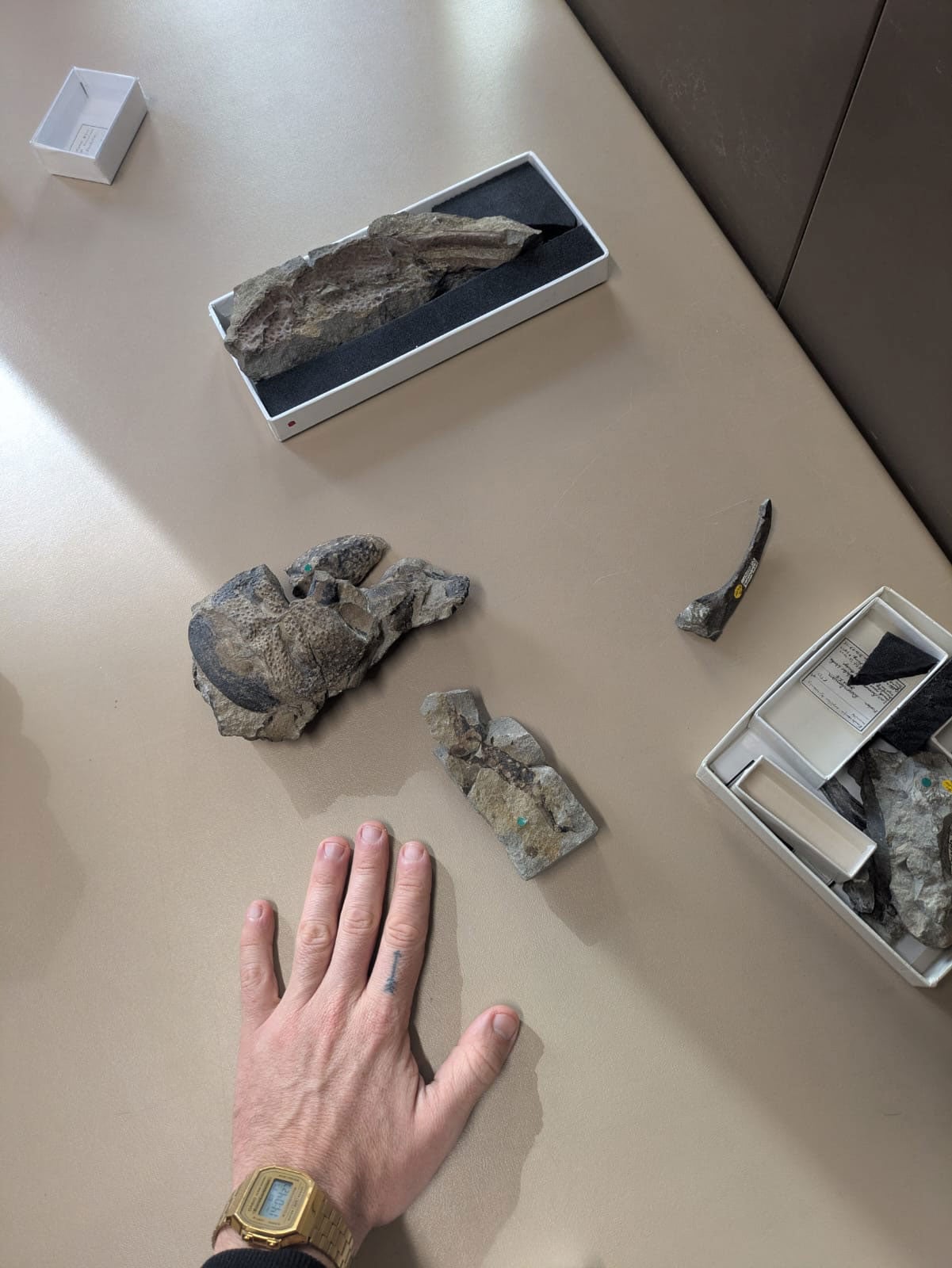
Dr. Russell Garwood, Paleontologist at The University of Manchester, added: “Praearcturus has puzzled us paleontologists for more than a century. By bringing together material from several collections and using cutting-edge imaging techniques, we’ve been able to build a clearer picture of the animal than was previously possible, which is really exciting.
“What makes Praearcturus so interesting is that it became enormous at a time when life on land was otherwise very small. But it was a world that could somehow support a giant predator. To try and better understand this ancient world, we compared the size of fossil scorpions with other animals alive at the time. To reach such extraordinary sizes, and conclude that perhaps it lived in water, where life was bigger.”
A predator before forests
Praearcturus gigas lived in the Early Devonian, a period when life on land was still in its early stages. Small plants and fungi had only recently begun spreading across the landscape, and forests and other complex land ecosystems had not yet appeared.
Unlike the giant arthropods that evolved later, Praearcturus did not grow during a time of high atmospheric oxygen linked to the rise of forests. Its large size may instead reflect an environment with few other big predators. With limited competition, Praearcturus may have been able to dominate its surroundings in a way that would have been much harder later in Earth’s history.
A life between water and land
The fossils suggest that this giant scorpion may have spent part of its life in water. Some specimens preserve flap-like structures on the abdomen that resemble features seen in modern crustaceans such as lobsters, raising the possibility that Praearcturus could move between aquatic and land environments.
Dr. Garwood and the team also analyzed the wider arachnid fossil record and found that scorpions are unusually common in rocks from this period compared with other arachnids. That pattern supports the idea that some early scorpions may have lived in freshwater habitats, where fossil preservation was more likely.
This places Praearcturus at a key point in Earth’s history, when animals were beginning to explore life beyond the oceans.
Dr. Greg Edgecombe, Merit Researcher at the Natural History Museum, London, and co-author of the study, said: “The boundary between land and sea was much less defined at this time. Praearcturus gives us a fascinating glimpse into how early animals adapted to these changing environments.
“It may even represent a lineage that returned to the water after earlier ancestors had already begun living on land.”
Old fossils answer new questions
Praearcturus gigas was first described in 1871 and was initially thought to be a giant crustacean similar to a woodlouse. Because the known fossils were fragmentary and lacked important features such as a tail, scientists struggled for more than a century to classify the animal with confidence.
The breakthrough came when the specimens were compared with better-preserved fossils discovered more recently. Those comparisons revealed important anatomical traits unique to scorpions, underscoring the lasting scientific value of museum collections.
Dr. Howard added, “Specimens collected over a century ago can still hold entirely new insights. By revisiting them with modern techniques, we can uncover discoveries that reshape our understanding of life on Earth.”
Finding such a large scorpion so early in the history of life on land challenges previous ideas about why ancient arthropods became giants. Instead of being explained only by environmental conditions such as oxygen levels, the new findings suggest that ecological opportunity, including a lack of major competitors, may have been just as important.
Reference: “A revision of Praearcturus gigas: a giant scorpion from the Lower Devonian (Lochkovian) of Britain” by Richard J. Howard, Russell J. Garwood, Gregory D. Edgecombe and David A. Legg, 2 June 2026, Palaeontology.
DOI: 10.1111/pala.70064
RJG was supported by NERC award NE/T000813/1, the Alexander von Humboldt Foundation, and a Leverhulme Trust Research Project Grant (RPG-2023-234).
Never miss a breakthrough: Join the SciTechDaily newsletter.
Follow us on Google and Google News.
14 Comments
So, how big is a coffee table? I mean, really? No one know what meters, mm, cm mean still? Wow!
It did say a small coffee table
So why did it need big claws if it had no competition ? No competition on land or in water ? Why did it evolve if it had no competition ? We’re dropping the survival of the fittest story ?
No. Survival of the fittest is not the only mechanism in the theory of evolution. In this particular case, it was more likely that disruptive selection was at play.
Big claws is not just for competition. Just like the peacock’s tail or the hermit crab claw, it could evolve through sexual selection. Also keep in mind that the claws are used for catching prey. Even small prey that had hard shells (like smaller scorpions) would need strong claws to break them open. If it preyed on smaller scorpions, a larger body size would have been an advantage (which is the principle of disruptive selection).
Haven’t large marine scorpions long been known to have existed in the Devonian and Silurian eras?
I remember them , they are from God of war 3
The giant scorpion if left sea to live on land in the stone, rubble hills, & plains it might have evolved from large lobster.
No
Scorpions don’t evolve from lobsters. Just compare the mouthparts and eyes; they are completely different, as are the number of legs.
The giant scorpion if left sea to live on land in the stone, rubble hills, & plains it might have evolved from large lobster.
No, scientists aren’t “re-thinking evolution”, you pathetic little dumfux at scitechdaily.
Your disgusting craving for clicks is one of the reasons science denialism is on the rise today. Your click-bait headlines reinforce the confirmation bias of religiotards who won’t bother to read the article and understand that nowhere in the article does it say that scientists are rethinking evolution. In fact, this discovery nicely reinforces one of the key tenets of the theory of evolution. Can you guess which one, you incompetent dumfux?
Bravo.
Herşeyi metalaştıran kapitalizm elbette bunu da pas geçmeyecektir.
Gelelim Evrim Yasasına, insanlık tarihinin en uzun teorisi, onun gerçeğin ta kendisi olmasından değil, ‘Zülfü yâre’ dokunmasındandır, ‘feleğin tekerine çomak soması’ndandır.
Darwin başına gelecekleri bildiği için TÜRLERİN KÖKENİ kitabını yazdıktan 25 yıl sonra yayınlamıştır.
Temper, temper… Play nice (we are on the same team). Corrections are more effective than messy insults.
I have some ocean front property for sale in Arizona for whoever believes this. Lol