
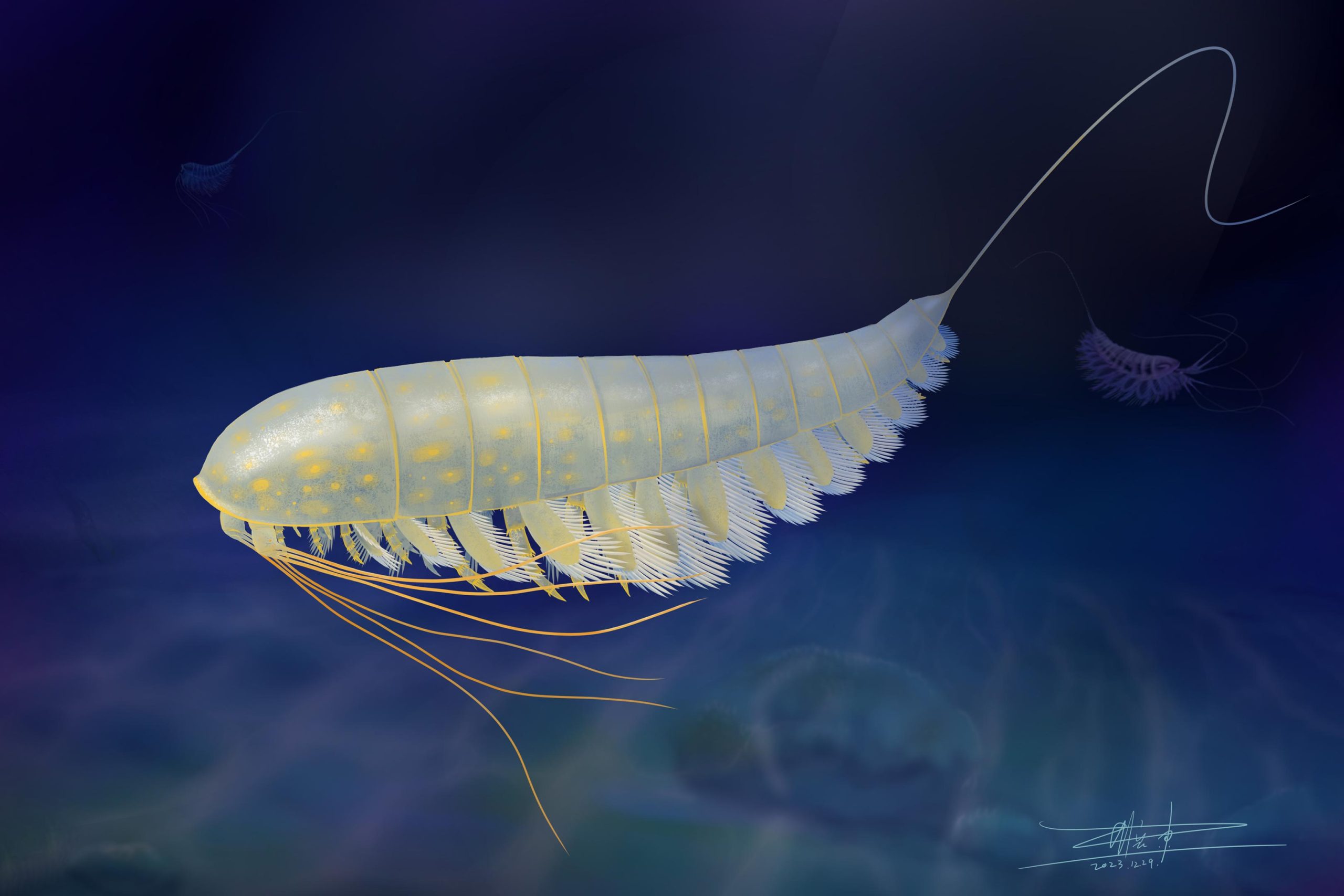
A new 450-million-year-old arthropod fossil, Lomankus edgecombei, has been uncovered in New York, revealing crucial evolutionary shifts in appendage function from predation to environmental sensing among ancient arthropods.
- A new 450-million-year-old fossil arthropod, preserved in 3D by iron pyrite (fool’s gold), has been unveiled by scientists.
- The new species, Lomankus edgecombei, is distantly related to spiders, scorpions, and horseshoe crabs.
- The findings have been published today (29 Oct) in the journal Current Biology.
New Arthropod Discovery
A team of researchers led by Associate Professor Luke Parry from the University of Oxford’s Department of Earth Sciences has unveiled a stunning 450-million-year-old fossil arthropod—a group that includes creatures like spiders, centipedes, and insects. Remarkably, the entire fossil is preserved in fool’s gold, lending it a unique, striking appearance.
“As well as having their beautiful and striking golden color, these fossils are spectacularly preserved,” Associate Professor Parry said. “They look as if they could just get up and scuttle away.”
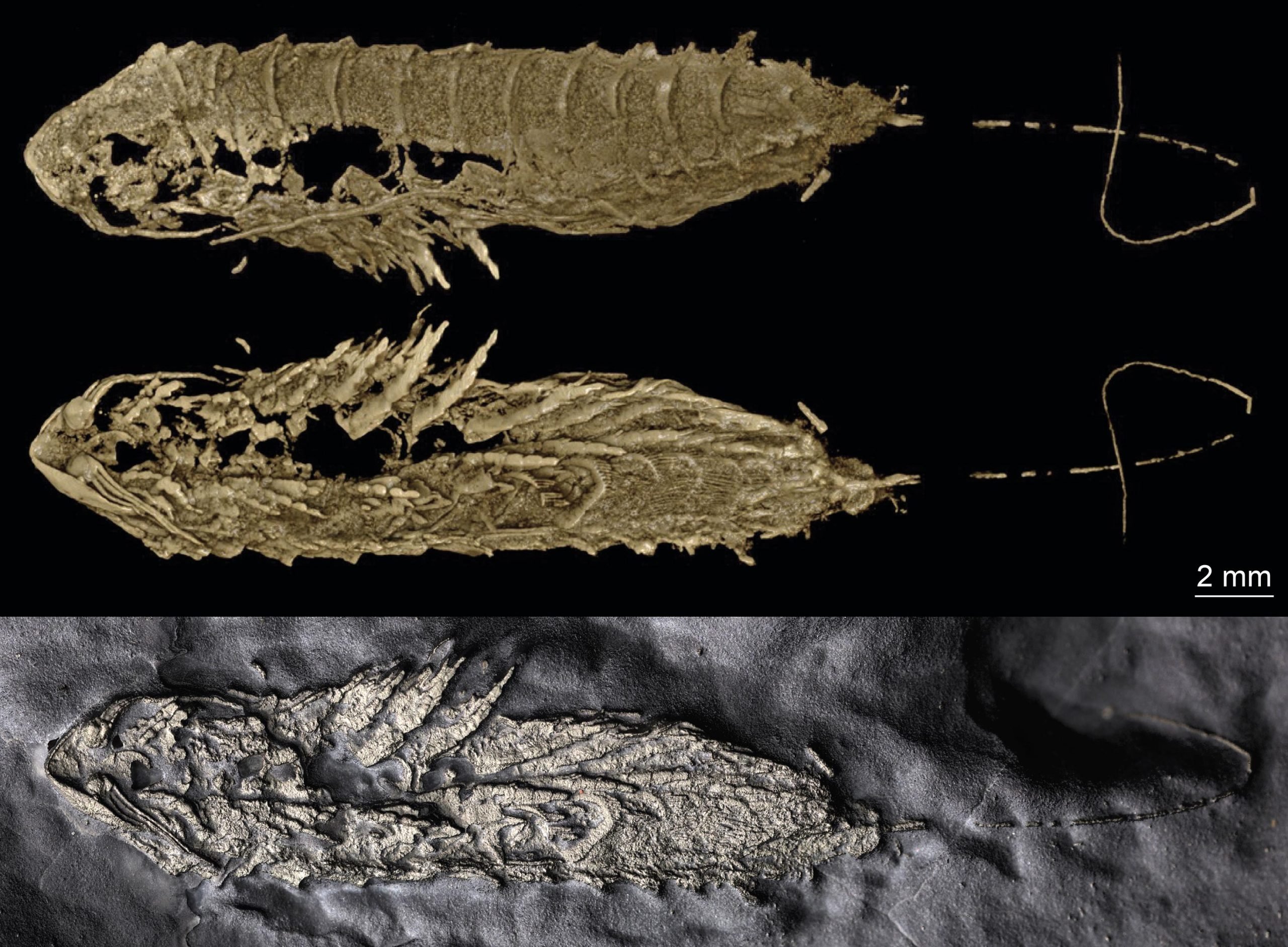
The new species, named Lomankus edgecombei in honor of arthropod expert Greg Edgecombe from London’s Natural History Museum, belongs to a group known as megacheirans. These arthropods are known for their distinctive “great appendage,” a large, modified leg at the front of their bodies used to capture prey.
Megacheirans like Lomankus thrived during the Cambrian Period (538-485 million years ago) but were believed to have mostly disappeared by the Ordovician Period (485-443 million years ago).
Evolutionary Significance of Arthropod Appendages
This discovery offers important new clues towards solving the long-standing riddle of how arthropods evolved the appendages on their heads: one or more pairs of legs at the front of their bodies modified for specialized functions like sensing the environment and capturing prey. Such appendages include the antennae of insects and crustaceans, and the pincers and fangs of spiders and scorpions.
“Today, there are more species of arthropod than any other group of animals on Earth. Part of the key to this success is their highly adaptable head and its appendages, that has adapted to various challenges like a biological Swiss army knife” Associate Professor Parry continued.
Unveiling the Mysteries of Megacheirans
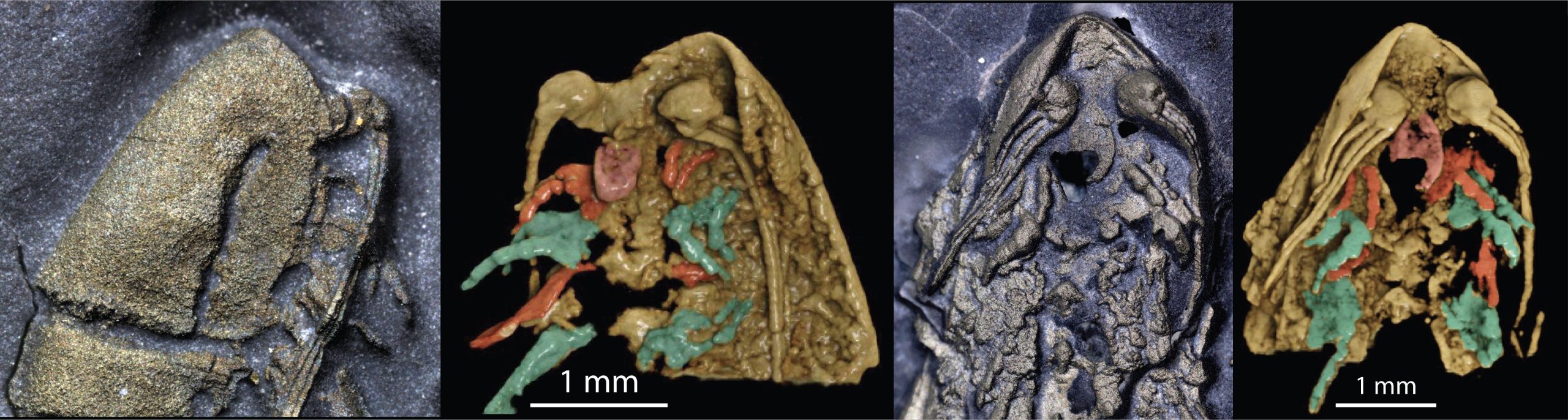
While other megacheirans used their large first appendage for capturing prey, in Lomankus the typical claws are much reduced, with three long and flexible whip-like flagella at their end. This suggests that Lomankus was using this frontal appendage to sense the environment, rather than to capture prey, indicating it lived a very different lifestyle to its more ancient relatives in the Cambrian Period. Unlike other megacheirans, Lomankus seems to lack eyes, suggesting that it relied on its frontal appendage to sense and search for food in the dark, low-oxygen environment in which it lived.
“Rather than representing a ‘dead end’, Lomankus shows us that megacheirans continued to diversify and evolve long after the Cambrian, with the formerly fearsome great appendage now performing a totally different function” Associate Professor Parry continued.
Comparative Anatomy of Ancient and Modern Arthropods
The fossil offers new clues towards solving the highly-debated question of what the equivalent of the great appendage of megacheirans is in living species. Co-corresponding author Professor Yu Liu (Yunnan University) said: “These beautiful new fossils show a very clear plate on the underside of the head, associated with the mouth and flanked by the great appendages. This is a very similar arrangement to the head of megacheirans from the early Cambrian of China except for the lack of eyes, suggesting that Lomankus probably lived in a deeper and darker niche than its Cambrian relatives.”
This arrangement of features on the head is similar to living arthropods, suggesting the great appendage is the equivalent of the antenna of insects and the chelicera (mouthparts) of spiders and scorpions.
Remarkable Fossil Preservation Techniques
The fossil was found at a site in New York State, USA that contains the famous ‘Beecher’s Trilobite Bed’; a layer of rock containing multiple trilobites with incredible preservation. Aside from trilobites, other kinds of organisms are much less common at this site, reflecting the rarity of this find.
The animals preserved in Beecher’s Trilobite Bed lived in a hostile, low-oxygen environment that allowed pyrite, commonly known as fool’s gold, to replace parts of their bodies after they were buried in sediment, resulting in spectacular golden 3D fossils. Pyrite is a very dense mineral, and so fossils from this layer can be CT scanned to reveal hidden details of their anatomy. This technique involves rotating the specimen while taking thousands of X-ray images, allowing the fossils to be reconstructed in three dimensions.
Conclusion and Implications of the Find
Professor Derek Briggs, a co-author of the study at Yale University said: “These remarkable fossils show how rapid replacement of delicate anatomical features in pyrite before they decay, which is a signature feature of Beecher’s Trilobite Bed, preserves critical evidence of the evolution of life in the oceans 450 million years ago.”
For more on this discovery, see Ancient Bug Unearthed in New York After 450 Million Years.
Reference: “A pyritized Ordovician leanchoiliid arthropod” by Luke A. Parry, Derek E.G. Briggs, Ruixin Ran, Robert J. O’Flynn, Huijuan Mai, Elizabeth G. Clark and Yu Liu, 29 October 2024, Current Biology.
DOI: 10.1016/j.cub.2024.10.013
Never miss a breakthrough: Join the SciTechDaily newsletter.
Follow us on Google and Google News.
3 Comments
Looks gold, but is simply sedimentary rock, laid down rapidly, entombing and sealing all within. These scientists are godless persons worshiping
the tomes of Evolution and Uniformitarianism.
What are you, another anti-science freak? Get an education!
Very cool , all information is given about the animal
Whoever made it , thanks to you