
Scientists modeled a millennium of earthquake history and found unusually high stress accumulating along major Southern California faults.
For more than 150 years, Southern California’s most powerful faults have been storing energy deep underground. While the region experiences frequent small earthquakes, geologists know that the largest and most damaging events are separated by long periods of relative quiet as tectonic stress steadily accumulates.
Much of that stress is concentrated along the San Andreas and San Jacinto faults, two major fault systems that accommodate the movement between the Pacific and North American tectonic plates. Northeast of Los Angeles, the faults converge near Cajon Pass, a geologically complex junction that has long intrigued scientists because a rupture on one fault could potentially spread onto the other.
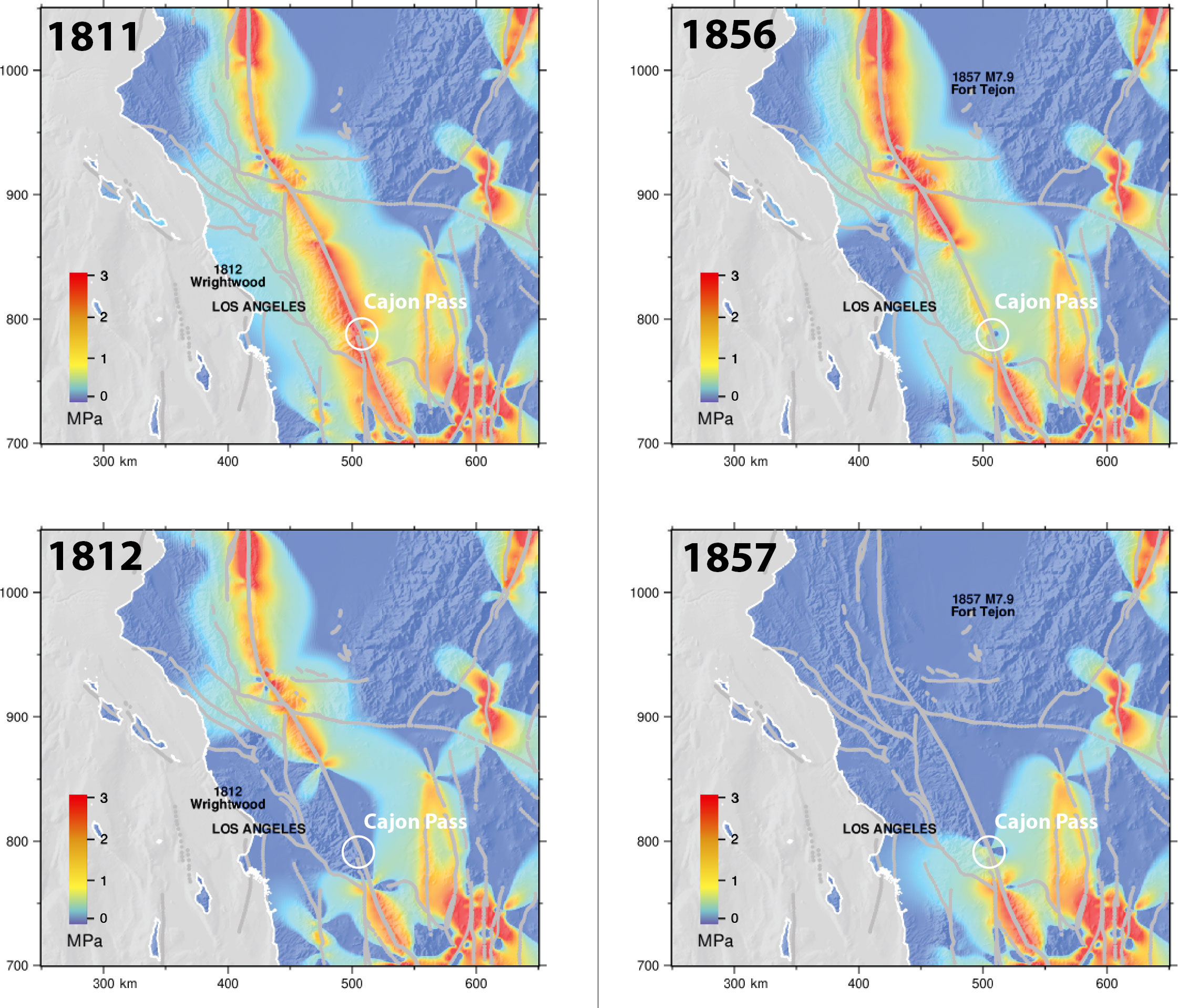
The last major earthquake to impact the broader Los Angeles region was the magnitude 7.9 Fort Tejon earthquake in 1857. Since then, stress has continued to build along these fault segments, creating an unusually long quiet period that researchers have increasingly viewed as a cause for concern.
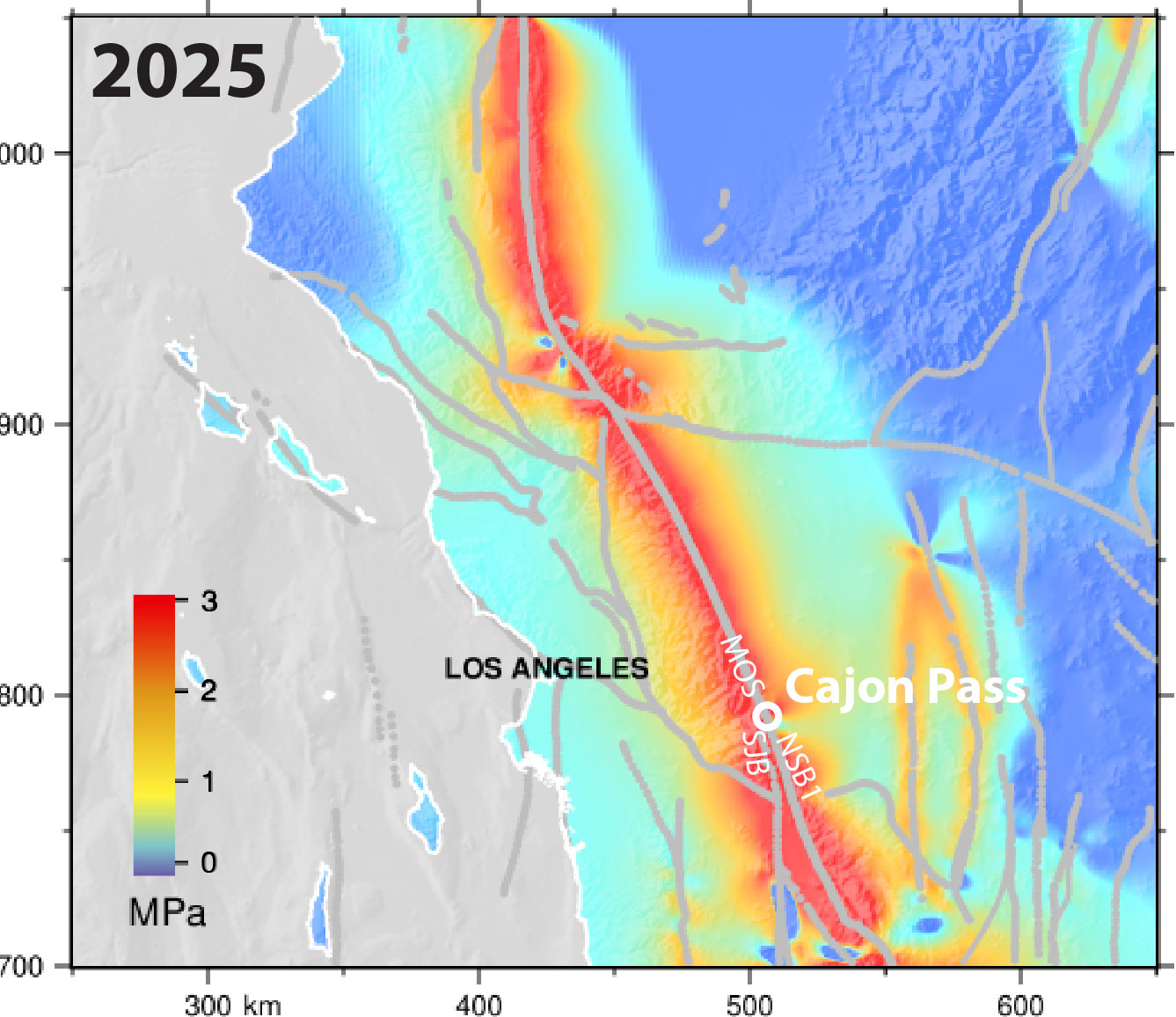
A new study led by Dr. Liliane Burkhard of the Division of Space Research and Planetary Sciences (WP) at the Physics Institute of the University of Bern modeled a millennium of earthquake activity along the southern San Andreas and San Jacinto fault systems to estimate how much stress is now loaded at Cajon Pass.
The international team included researchers from the University of Hawaiʻi at Mānoa, the U.S. Geological Survey Earthquake Science Center in Pasadena, and the Scripps Institution of Oceanography at UC San Diego.

The findings indicate that tectonic stress in the area has reached, and in some places surpassed, the highest levels seen in the past 1,000 years. The study also describes Cajon Pass as an “earthquake gate”: a fault junction that helps determine whether a large earthquake stays on one fault or spreads across both systems at once. The study has just been published in the Journal of Geophysical Research: Solid Earth.
Modeling 1,000 years of earthquake history
To examine how stress has changed over time along the San Andreas and San Jacinto faults and at the key Cajon Pass junction, the research team built a physics-based earthquake cycle model in four dimensions, meaning it simulates three spatial dimensions as well as time. The model was then supplied with a 1,000-year earthquake record reconstructed from geological clues, including radiocarbon dating, tree ring anomalies, and historical records of ground ruptures.
“The model tracks how each earthquake changes stress on neighboring fault segments, how stress accumulates during the quiet intervals between events, and how the deeper layers of the crust slowly relax following large ruptures,” explains Burkhard. “This simulation allows us to understand how stresses in the fault system build up over centuries,” continues Burkhard. “By running the earthquake history of Southern California as a simulation, we can estimate the extent to which the fault system is already under stress today.”
The researchers show that stresses in the region are currently at their highest level in the last 1,000 years.
“Earthquake gate” as a decisive key factor
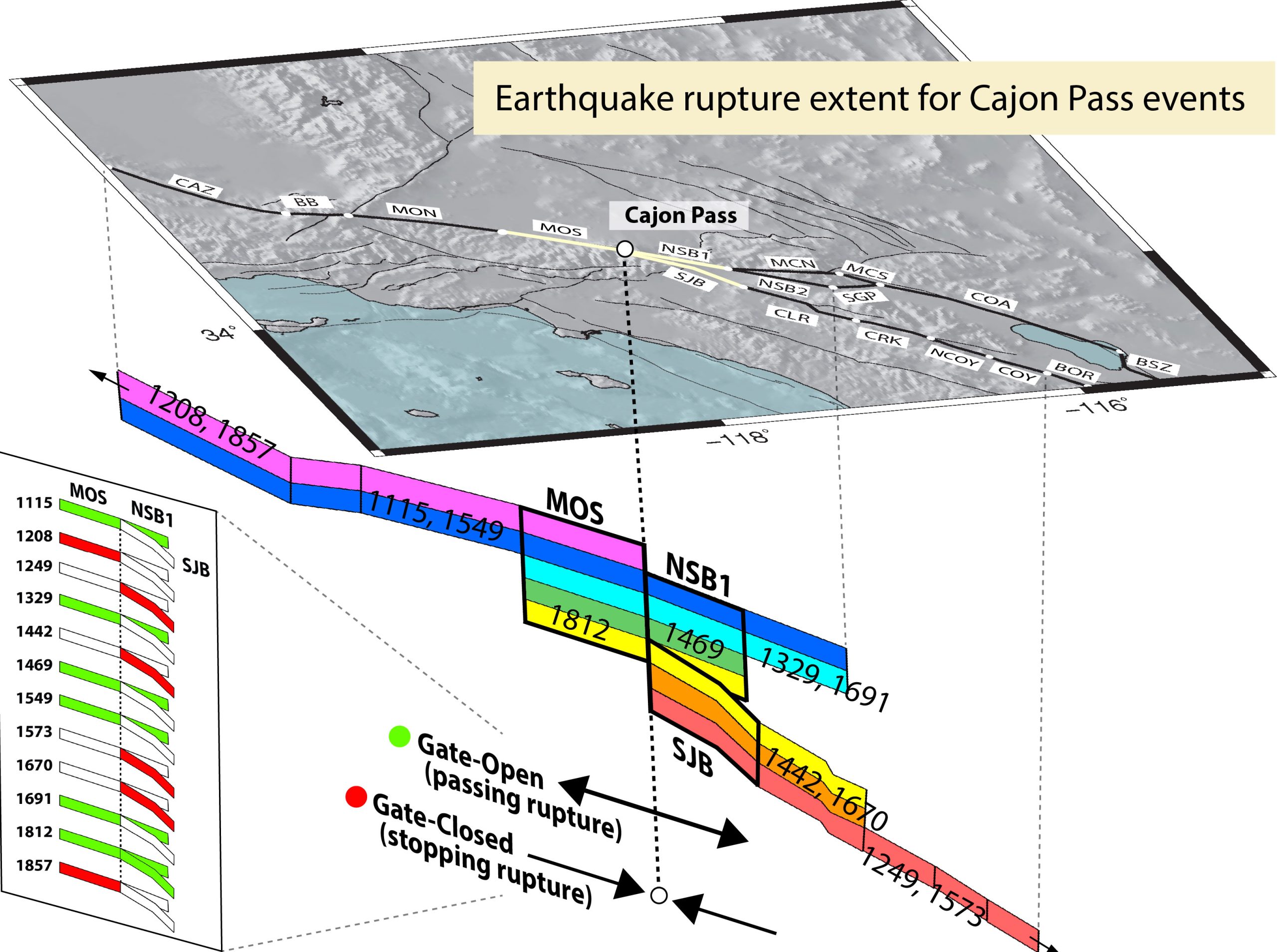
One of the study’s central conclusions is that Cajon Pass can behave as an “earthquake gate”, a junction that influences whether a major rupture stops on one fault or continues across both systems. Past earthquakes show both possibilities. The Fort Tejon earthquake of 1857 stopped at Cajon Pass and did not rupture the San Jacinto Fault, while the Wrightwood earthquake of 1812 passed through the junction and ruptured both systems in one continuous event.
“The earthquake gate concept captures something important about how fault junctions work,” explains Burkhard. “Cajon Pass doesn’t simply block or channel earthquakes: It responds to stress conditions, and those conditions change over centuries.”
The study found that the main issue is not just the amount of stress on one fault, but whether stress on the two fault systems is rising in a similar way. When both faults become highly stressed together, conditions are more favorable for a large rupture that crosses both systems. When the stress levels are out of sync, ruptures are more likely to stop at the junction.
The model currently estimates stress of 3.6 MPa on the San Jacinto-Bernardino section, higher than any value seen in the 1,000-year simulation. On the nearby Mojave South section of the San Andreas fault, stress is 2.8 MPa. That means both segments are highly stressed and relatively similar in stress level, a pattern that has historically come before joint ruptures.
“So not only is it concerning that the stresses are reaching historic highs,” says Burkhard, “but also that the relative stress conditions between the two fault systems are approaching the range we associate with major ruptures crossing both faults simultaneously – and that is a scenario with much larger consequences for the region.”
Increased risk in densely populated regions
If a rupture crossed Cajon Pass and involved both the San Andreas fault and the San Jacinto fault, it would be far more serious than an earthquake limited to one fault. The area at risk includes some of the most densely populated and infrastructure-critical corridors in the United States, including greater Los Angeles, San Bernardino, Riverside, and the Coachella Valley. Cajon Pass itself carries major highways, rail lines, and energy infrastructure.
“The question of when and how the next major earthquake will occur in this region is one of the most pressing problems in applied geoscience. Our results provide a clearer, physics-based picture of the current stress state of the fault system, and the framework we developed is not just applicable to California, but also for other complex fault junctions worldwide,” says Burkhard.
However, Burkhard emphasizes: “The study is not a prediction of when an earthquake will occur. What we can say is that the system is critically stressed and that physics-based models like ours give a clearer picture of the range of scenarios we should be prepared for. This information is important for hazard assessment, infrastructure planning, and emergency preparedness.”
Reference: “Cajon Pass and the Southern San Andreas Fault System: Earthquake Cycle Stress Accumulation and Present-Day Loading” by Liliane M. L. Burkhard, Bridget R. Smith-Konter, Katherine M. Scharer and David T. Sandwell, 3 June 2026, Journal of Geophysical Research: Solid Earth.
DOI: 10.1029/2025JB033213
This research was supported by the Statewide California Earthquake Center (Contribution No. 15025) with SCEC awards 17169, 18149, and 19161. SCEC is funded by NSF Cooperative Agreement EAR-2225216 and USGS Cooperative Agreement G24AC00072. Additional support was provided by NSF EarthScope awards EAR-0847499 and EAR-1614875, and NASA Earth Surface and Interior Program awards 80NSSC19K1043 and 80NSSC23K0744. This research is SOEST contribution #12140.
Never miss a breakthrough: Join the SciTechDaily newsletter.
Follow us on Google and Google News.
5 Comments
So what would we need to be ready for an event like this. What supplies or where should we head out to?
You should be prepared to sit it out at home because many of the roads will be blocked and most of the freeway overpasses will have collapsed. Without electricity, gasoline/diesel fuel pumps will not work so you will only be able to drive as far as the gas in your tank allows you, perhaps stranding you on the side of the road in the desert, without the food and water that you have at home. Even camping in a tent in your yard, with neighbors nearby, is better than being alone in the desert. Instead of asking for advice, think for yourself because that is what you will have to do if the infrastructure and support system collapses. Even police and EMT vehicles may have limited fuel supplies, and may have to conserve it for the most critical situations — assuming that they can even be made aware of the numerous problems.
It probably has something to do with the immense stress caused by all the dmbazz liberals on the surface. 🤷♀️
I could have told you that there was underlying stress forming beneath Southern California
Yes, that… is for damn certain.😅