

Colorectal cancer diagnoses are rising among younger adults, prompting surgeons to highlight subtle warning signs that are often overlooked.
For decades, colorectal cancer was considered a disease of older adults. Today, however, a growing number of cases are being diagnosed in people under 50, making it the leading cause of cancer-related deaths in younger adults. Many of the earliest warning signs can be easy to dismiss or attribute to less serious conditions, delaying diagnosis when early treatment is often most effective.
To encourage people to seek medical advice sooner, the American College of Surgeons (ACS) has released free educational materials and a patient checklist designed to highlight potential warning signs of colorectal cancer. The resources aim to help individuals recognize symptoms, understand their risk, and have more informed conversations with their primary care providers.
“A lot of times when younger patients seek care for bowel symptoms, those symptoms are too often attributed to hemorrhoids or constipation and treated conservatively,” said Marylise Boutros, MD, FACS, FRCSC, FASCRS, a member of the ACS Patient Education Committee, and a colorectal surgeon and vice chair of Digestive Diseases Research at the Cleveland Clinic Florida, who helped develop the new ACS educational materials. “As more young people are diagnosed with colorectal cancer, awareness of the subtle signs and symptoms of the disease can save lives. The ACS educational materials and checklist were created to help patients clearly raise concerns and keep conversations about colorectal cancer focused.”
Colorectal cancer is still diagnosed more often in older adults, affecting about 1 in 25 men and women during their lifetime. Yet cases among younger adults are increasing. According to the American Cancer Society, about 1 in 5 colorectal cancer cases are now found in people younger than 54, compared with 11% (about 1 in 10) three decades ago.
Colorectal Cancer Symptoms Not to Ignore
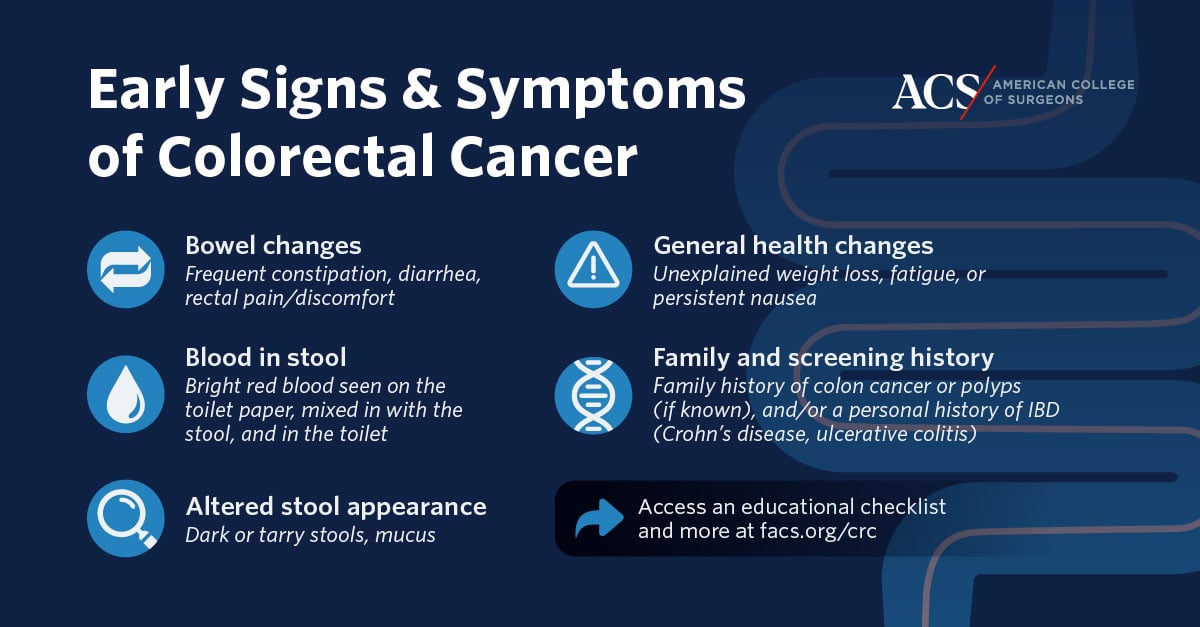
Early signs of colorectal cancer can be easy to overlook, but they should not be ignored or left without medical evaluation. The ACS checklist points to the following symptoms.
Persistent Bowel Changes
Long-lasting constipation or diarrhea, thin stools, or a clear shift in bowel habits may point to an underlying issue. A feeling that the bowel does not fully empty, or rectal discomfort, can occur when a tumor causes inflammation or blockage.
“In younger patients, these symptoms can sometimes be due to noncancerous conditions,” said Paula Denoya, MD, FACS, FASCRS, Commission on Cancer (CoC) State Chair of the Eastern Long Island New York chapter, and a colorectal surgeon at Stony Brook University Hospital in New York. “However, any bowel change that is new or different for you deserves medical attention. An annual wellness visit is a good time to raise these concerns.”
Blood in Stool
Blood in the stool is an important warning sign of colorectal cancer, especially when it happens more than once. Research presented at the ACS Clinical Congress 2025 found that among patients younger than 50 who had a colonoscopy because of symptoms, rectal bleeding was the strongest predictor of a colorectal cancer diagnosis, raising the odds by 8.5 times.
“Bleeding is the most common symptom of colorectal cancer but can also be caused by other diseases,” said James T. McCormick, DO, FACS, FASCRS, CoC State Chair of the Southwestern Pennsylvania chapter, professor of surgery at Drexel College of Medicine, and chair of the Colorectal Cancer Program at Allegheny Health Network in Pittsburgh, Pennsylvania. “People may notice bright red blood on the toilet paper or in the bowl, or it may cause a red or dark color when mixed in with the stool. Any amount of recurring blood should be evaluated, and colonoscopy may be indicated to determine the underlying cause.”
Changes in Stool Appearance
Stools that are bright red, dark and tarry, or contain mucus may signal bleeding somewhere in the gastrointestinal tract, colon, or rectum.
General Health Changes
Weight loss without a clear reason, fatigue, weakness, loss of appetite, nausea, or vomiting may indicate an underlying gastrointestinal condition and should be checked by a medical professional.
Family History and Screening
The U.S. Preventive Services Task Force recommends that adults at average risk begin colorectal cancer screening at age 45. People with a family history of colorectal cancer, Crohn’s disease, ulcerative colitis, or other risk factors may need to start earlier. Several screening methods are available, but colonoscopy remains the gold standard because it can detect cancer and remove precancerous polyps during the same procedure.
“Colorectal cancer is highly treatable when found early, and surgical advances continue to make treatment less invasive,” Dr. Boutros said. “I encourage patients to be proactive and use the checklist to start a conversation with their primary care provider about any concerning bowel changes.”
Never miss a breakthrough: Join the SciTechDaily newsletter.
Follow us on Google and Google News.
3 Comments
Read labels on food products. Stay a way from chemicals and artificial sweeteners that cause inflammation, brain fog and joint pain. Great health is our responsibility! No pill or shot is going to cure your ailments when you continue to poison yourself. You Can Heal Your Life by Louise Hay a metaphysical teacher and healer who proved what you think you allow into your life only to suffer the consequences. She cured herself of cancer once she realized the psychological trauma endured as a child and while growing up. We all have baggage better dumped to move on our journey in good health and happiness.💞✌🏻
Mostly good advice, Divine Spirit, but reading labels and mind power methods may not be enough. More specifically when it comes the rising rates of colorectal cancer in younger American adults, I wonder if Metamucil Orange Powder (sweetened with “aspartame,” FDA approved in 1981) might be a factor? Also, FDA approved in 1972, the toxic cooking oil preservative TBHQ is now known to cause neurological events, vision changes, hearing loss and anal leakage in some people and, as only a preservative (a processing agent), it may not be included in ingredient lists. Good luck avoiding/navigating the minefield of FDA approved food poisoning.
Ignoring the symptoms indicated in the study/suggestion are not new and I was brought up as a medical student to make sure I ask patients even if they don’t volunteer. However, ignoring the symptoms in patients under 50 is newly important finding, and needs great attention especially at the time when body image or mental problem issues are becoming a norm in every society in the world.