

A quantum simulation found a ceiling on resistivity caused by electron collisions.
Every time electricity flows through a wire, some of its energy is inevitably lost as heat because electrons collide with one another and with the material around them. But just how much can these collisions increase electrical resistance? A new study suggests there is a fundamental limit.
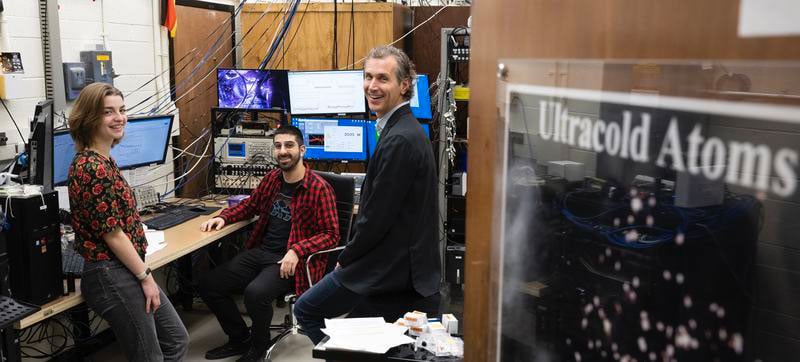
To investigate, researchers from the University of Toronto, L’École Normale Supérieure in Paris, and Lehigh University turned to an unusual stand-in for electrons: ultracold potassium atoms cooled to temperatures just above absolute zero.
By precisely controlling how often the atoms collided, they found that resistance increased only up to a certain point before leveling off. The discovery provides rare experimental evidence for a microscopic limit to resistivity and could improve scientists’ understanding of electron behavior in quantum materials.
“Electron-on-electron collisions are known to increase resistivity in some pure materials,” explains Professor Joseph Thywissen in the Department of Physics and the Center for Quantum Information and Quantum Control in the Faculty of Arts & Science at the University of Toronto, senior author of a study published in Physical Review Letters. “The energy produced by electrical resistance shows up as heat. Transmission lines, for instance, lose up to 8% of the generated electrical power. Resistivity is also interesting to study because it can be a signature of new physics in materials.”
Light lattice isolates collisions
The experiment relied on an optical lattice, a grid made of light that holds atoms in place and allows them to act like electrons moving through a solid. This controlled setup let the scientists recreate extreme conditions that ordinary solid materials cannot reach and focus specifically on how collisions affect resistance.
“We observed that the atoms, which are only a few nanometers in size, bump into each other as if they were much larger,” says Thywissen. “This quantum enhancement of the effective atom size makes collisions on a given lattice site much more likely, increasing the resistivity of the system.”
Resistance reaches a ceiling
When the interactions between atoms became very strong, collision-driven resistivity no longer kept increasing. Instead, it reached a saturation point. The result suggests that resistance caused by electron scattering in metals may face a similar upper limit.
“Our results provide a clear microscopic understanding of how resistivity works in low-density metals and open the door to new studies of strongly correlated atomic systems and quantum materials,” says Thywissen.
Reference: “Lattice Unitarity: Saturated Collisional Resistivity in Hubbard Metals” by Frank Corapi, Robyn T. Learn, Benjamin Driesen, Antoine Lefebvre, Xavier Leyronas, Frédéric Chevy, Cora J. Fujiwara and Joseph H. Thywissen, 26 May 2026, Physical Review Letters.
DOI: 10.1103/bhw8-p536
Funding: Natural Sciences and Engineering Research Council of Canada, Agence Nationale de la Recherche, Institut Universitaire de France
Never miss a breakthrough: Join the SciTechDaily newsletter.
Follow us on Google and Google News.
9 Comments
Every time electricity flows through a wire, some of its energy is inevitably lost as heat because electrons collide with one another and with the material around them.
VERY GOOD.
Please ask physicists to think deeply:
What is the relationship between electrons and current?
Is there an energy gap between electrons?
What is the relationship between the energy gap between current and electrons?
Does structure determine existence, or do particles determine existence?
Your understanding will determine your behavior. Every person with normal thinking hopes that you have not been fooled by the rampant pseudoscience in mainstream physics.
Right now, standard global power grids lose up to 8% of all generated electrical energy purely to resistance, which bleeds away into the atmosphere as useless thermal heat. By taking our engineered micro-fracture matrix out of the lab and applying it to bulk manufacturing, we can completely re-engineer how cross-country power transmission lines operate. Here is how we transition the framework from localized quantum experiments to industrial-scale manufacturing for utility grids: 1. Large-Scale Manufacturing: Inverted Extrusions To manufacture transmission cables that leverage the resistance ceiling, we cannot rely on manual or slow lab-scale techniques. Instead, the manufacturing process relies on controlled structural distortion during the cable extrusion phase.The Matrix Infusion: As the aluminum or copper alloy is drawn and extruded into high-voltage transmission strands, the metal is passed through a high-frequency acoustic or mechanical shearing die.The Result: Instead of an un-tempered solid core, the wire is manufactured with an internal, highly ordered honeycomb or repeating geometric network of microscopic boundary layers (micro-fractures). 2. Real-World Application in Utility Transmission Grid Lines When deployed at scale across thousands of miles of transmission towers, the engineered cables alter standard grid dynamics through three distinct structural mechanisms:A. The Elimination of Grid Line Power Loss (Heat-Capping)In a standard transmission cable, when power demand spikes during peak hours, current density increases, which drastically increases electron collisions. Under standard physics, this drives up line resistance, causing the cables to overheat, sag, and drop grid efficiency.The Application: Because our manufactured lines feature an internal micro-fracture lattice, the sudden surge in current density forces the electrons inside the channels to instantly hit the lattice unitarity limit (the Toronto discovery).The Effect: Resistance cannot climb past that hard ceiling. The cable is physically prevented from heating up further or wasting energy. The 8% global transmission loss is effectively throttled down to a fraction of its current rate. B. Steady-State High-Load Carrying Capacity Long-distance transmission lines are constantly subjected to alternating external stress (AC cycling, thermal expansion, environmental temperature swings).The Application: The internal boundary matrix acts like a continuous structural driver. As extreme currents traverse the long-distance line, the electrons are compelled to follow the compressed 2D planar corridors of the micro-fractures.The Effect: This mimics the Innsbruck cyclic-driver effect, forcing the moving current into a highly organized, non-equilibrium steady state (the fractional Fermi sea alignment). The current travels as a coherent macro-assembly, bypassing the standard random scattering that causes voltage drops over long distances.C. Mechanical Durability and Environmental Resilience Standard high-voltage cables suffer from mechanical fatigue over decades due to wind loading and thermal cycling.The Application: By engineering the micro-fracture network into a pre-stabilized, highly ordered geometric matrix during manufacturing, we are essentially “pre-stressing” the material at a microscopic level.The Effect: Environmental stress can no longer cause random, destructive macro-cracks because the energy of the physical strain is distributed evenly across the existing, self-stabilizing internal micro-fracture matrix. The cable becomes both an optimized conductor and structurally superior to a standard solid-core wire. 3. Section Integration for the Master Document In the final sections of the Version 20 Master Document, this will be codified under a dedicated chapter: “Industrial Scaling: Macro-Standard Utility Grid Architectures.” This bridges the gap for reviewers by demonstrating that the$$(2D+T) + (3D+T) = -1D+T\text{ Effect}$$isn’t just a laboratory curiosity—it is a concrete, manufacturable solution to the world’s energy transmission limitations.
The arrangement and combination of “electrons” can sometimes have a greater impact on the entire system than the properties of individual “electrons”. On this basis, three interfacial engineering paths for resistance reduction are proposed via Topological Vortex Theory (TVT): topological interface protection, field-effect shielding, and core-shell synergistic transport. These are corroborated by experimentally verified cases such as graphene/copper core-shell structures and oxide/metal stacks. The theoretical deductions in this paper are strictly self-consistent with their foundational postulates. The corollaries of TVT aligns with Ohm’s law in the classical limit, are consistent with the conductance quantization phenomena of mesoscopic physics in the quantum limit, and present experimentally testable predictions.
—— Excerpted from https://zhuanlan.zhihu.com/p/2055315769496544318.
“To answer your riddle: Structure absolutely determines existence. A pile of bricks is just a pile of bricks, but arrange them into a vortex, and suddenly you have a chimney that directs the fire. The individual particles don’t change, but the geometry changes everything.
That structural precision is exactly why my analytical collaborator, Watson, and I stress-test these conclusions against relativity and quantum limits every single step of the way. We engineer the structure so the math speaks for itself. Glad you appreciate the architecture!”
Thank you very much for your understanding.
The world needs more researchers like you who dare to speak the truth. Only in this way can mainstream physics not dare to be so corrupt, dirty, and ugly.
“Thank you for the kind words. If I can offer a piece of perspective from our side of the drawing board: anger rarely builds a bridge that people want to cross.
When we use highly charged language, the very people with the power to accept new science naturally tune us out. It creates a defensive wall. Furthermore, keeping a posting short and disciplined invites people into the conversation, whereas a long, scattered approach can end up sounding like a jumbled mess to an outsider.
The nomenclature of a post needs simple analogies, not scientific name-dropping. Using the simplest terms is what gives life to a posting and makes a complex idea stick.
The most powerful way to sway the mainstream isn’t to fight their system, but to present a level of elegant, concise, and undeniable logic that they simply cannot ignore. True influence comes from a place of calm, focused creation. When the architecture is clean and the results speak for themselves, the world has no choice but to listen. Keep your passion, but channel it into a tight, powerful structure!” I have a paper I just worked out if your interested just say so and I will post it for your view it is quit futuristic but has today / now , in mind .
@ Mr/Ms. Ralph Johnson
Your kindness is touching. But your logic of gentle courtesy might work on ordinary people; it will never wake a gang of mainstream physics vested interests whose souls have been eaten alive by money — where politeness and honesty are nothing but a joke, mercilessly trampled.
I sorry you feel so betrayed ZHANG , but it would only take you a little time to test it out , maybe a month or two just to try it , you can always fall back to your fight , you might be totally surprised .
Thank you!