
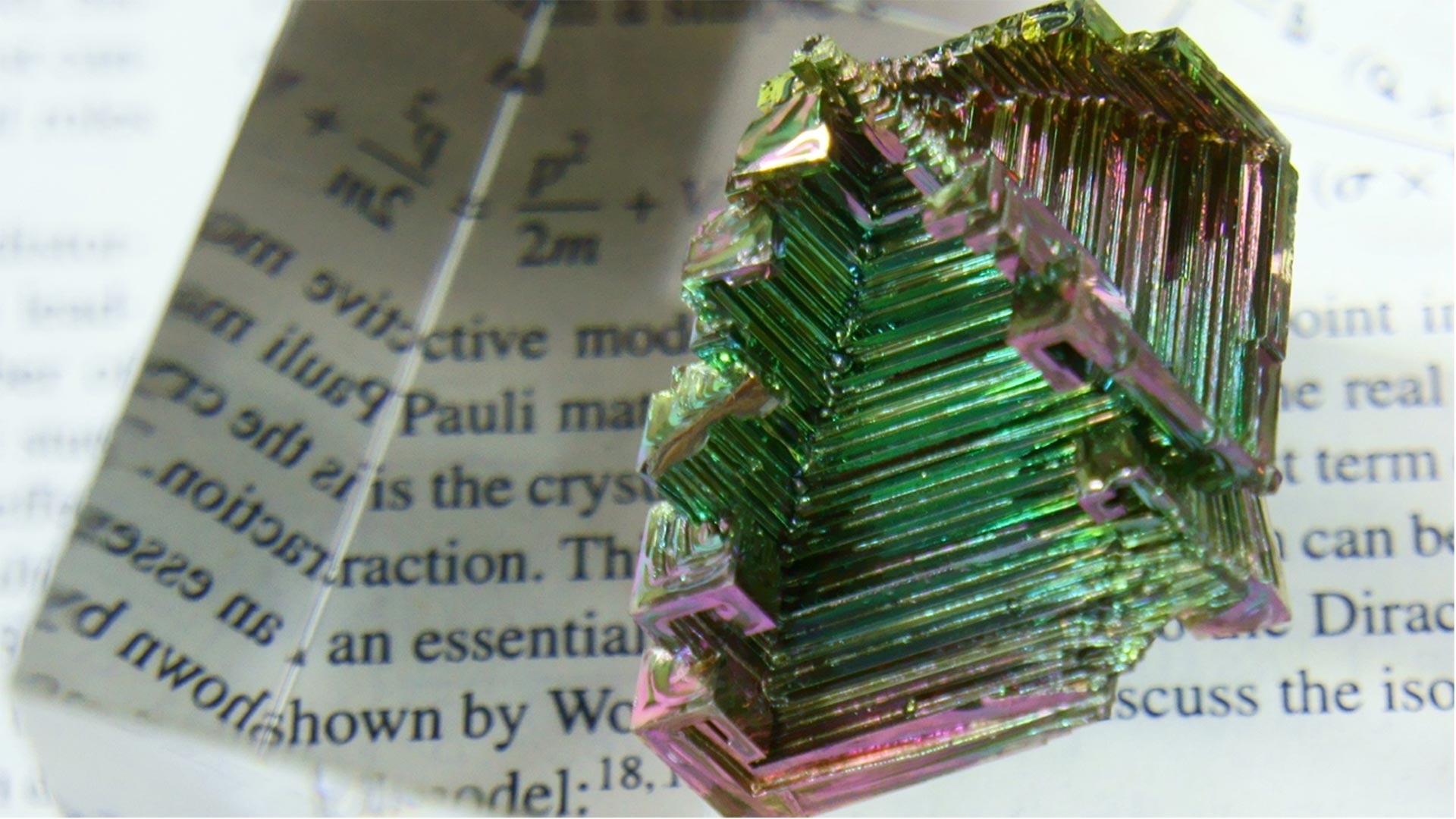
Bismuth, a puzzling material in quantum research, has now revealed a surprising twist. Kobe University scientists discovered that its surface properties can obscure its true nature, challenging a foundational assumption in topological material science.
For nearly two decades, scientists have puzzled over whether bismuth belongs to a remarkable class of materials that could revolutionize quantum computing and spintronics. Now, new research from Kobe University has uncovered the answer — and in the process, revealed a surprising new phenomenon that could change how we think about advanced materials.
These special materials, known as topological materials, behave in a unique way. While they act as insulators inside, their surfaces can conduct electricity with incredible reliability. Even when defects or impurities are present, the surface conductivity remains strong. That makes them perfect candidates for use in cutting-edge technologies like quantum computers and spin-based electronics.
But bismuth has been a mystery. Theoretical models have long suggested it shouldn’t qualify as a topological material. Yet, puzzling experimental results kept hinting that it might.
Kobe University quantum solid state physicist Yuki Fuseya says: “I have been fascinated by bismuth and have been conducting research with the desire to know everything there is to know about the element. As a bismuth lover, I could not overlook such a situation and delved into the debate, hoping to solve the mystery.”
Breaking the Principle of Bulk-Edge Correspondence
Fuseya’s dedication to the material allowed him to consider phenomena others haven’t.
He explains: “Among the many properties of bismuth I have studied, I was the first to discover that the crystal structure spontaneously changes due to relaxation near the surface of a crystal. This made me wonder whether this surface relaxation might affect the material’s topological nature.”
Thus, the Kobe University researcher and his team took to computer models of the behavior of electrons in the material and incorporated this change in crystal structure to investigate whether they can so contribute to the debate.
The team has now published their results in a letter in the journal Physical Review B. Their calculations could prove that the relaxation of the surface of bismuth crystals leads to the material appearing to be topological at the surface, masking that its bulk is non-topological.
“Until now, the topology of a material has been determined based on the principle of ‘bulk-edge correspondence,’ which holds that the characteristics at the surface represent those in the bulk. However, our study shows that this guiding principle can be broken,” explains Fuseya.
A New Phenomenon: Topological Blocking
“Our proposal that surface relaxation can lead to the breaking of bulk-edge correspondence is not limited to bismuth but can be broadly applied to other systems,” the Kobe University team writes in their paper. Thus, the effect the researchers call “topological blocking” might be discovered in other materials, too. “The most important thing in topological materials science is to get the topology of matter right,” comments Fuseya, hinting at the wide implications his team’s work has for the whole field.
For bismuth lover Fuseya, the discovery is personal, too. He explains: “Bismuth has provided the setting for many discoveries and history has taught us that once a phenomenon is discovered there, similar phenomena are discovered in other substances one after another. I am very happy to know that another phenomenon first discovered in bismuth has been added to that list.”
Reference: “Topological blocking at the Bi(111) surface due to surface relaxation” by Kazuki Koie, Rikako Yaguchi and Yuki Fuseya, 15 May 2025, Physical Review B.
DOI: 10.1103/PhysRevB.111.L201303
This research was funded by the Japan Society for the Promotion of Science (grants 23H00268, 23H04862 and 22K18318). It was conducted in collaboration with researchers from the University of Electro-Communications.
Never miss a breakthrough: Join the SciTechDaily newsletter.
Follow us on Google and Google News.
1 Comment
Science cannot do without debate. I am not a great man or a saint. My comments will not attract attention. However, it has been censored and blocked. Is here a world of pseudoscience?
To fight against rampant pseudoscience, we must repeatedly uncover its fig leaf, because they never consider themselves ugly.