
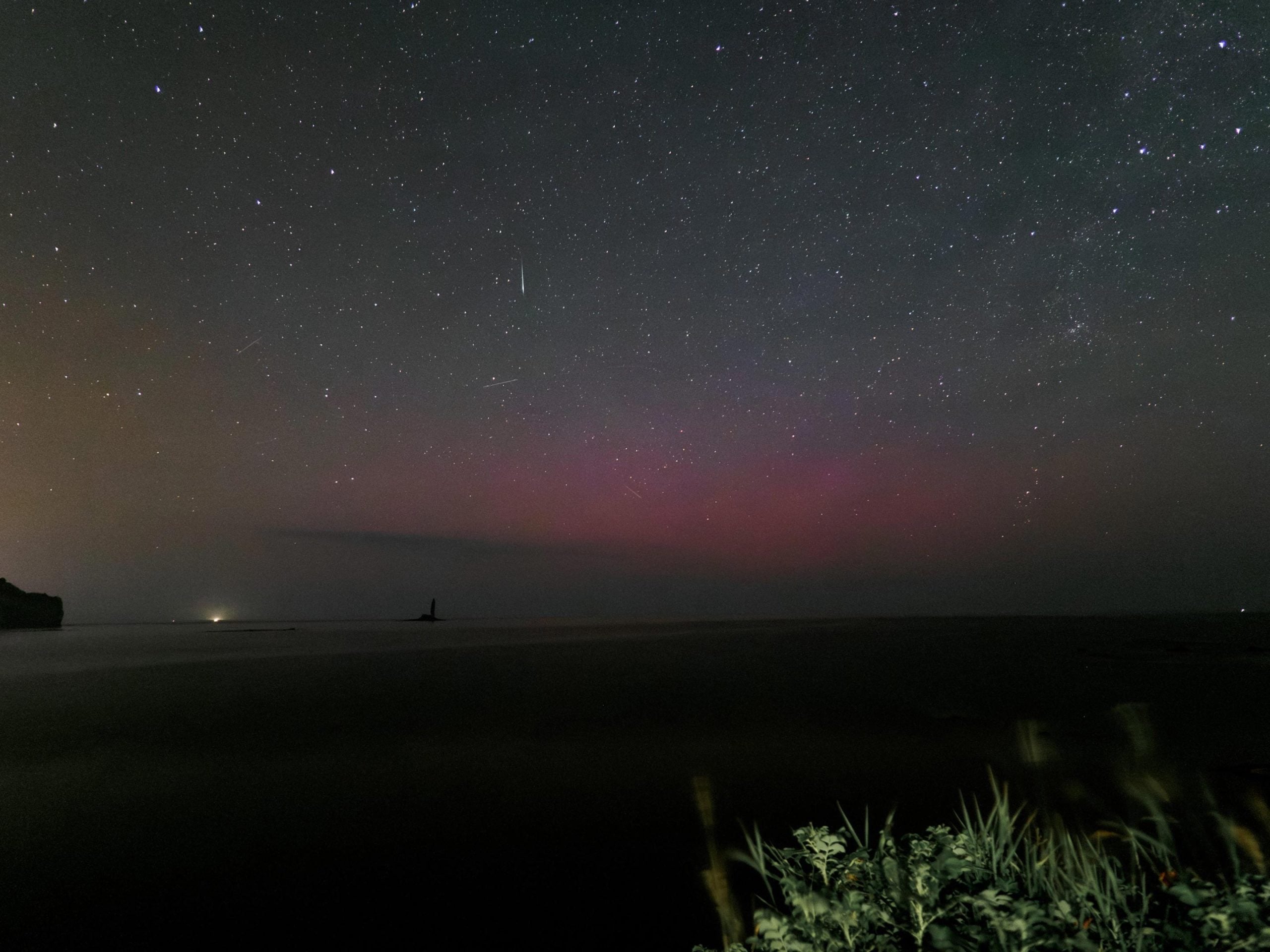
Unusually tall red auroras over Japan may be revealing that some solar storms are stronger than scientists realize.
A study published in the Journal of Space Weather and Space Climate reports that red auroras observed over Japan extended to altitudes of roughly 500-800 kilometers above Earth.
The discovery was made by researchers from Hokkaido University and the Okinawa Institute of Science and Technology, who examined several auroral events that occurred between June 2024 and March 2025.
Auroras are typically associated with geomagnetic storms, which occur when streams of charged particles from the Sun disturb Earth’s magnetic field. Bright auroras are most commonly seen near the polar regions, but they can occasionally appear farther south, including over Japan, during especially strong storms.
When red auroras occur at these lower latitudes, they are generally found at altitudes of around 200 to 400 kilometers. The newly observed events, however, reached much higher into space than expected.
“We found that red auroras can extend to extremely high altitudes even during those storms that are measured as moderately intense. I was really surprised because I didn’t expect such tall auroras to appear even during moderately intense storms,” says Tomohiro M. Nakayama, lead author of the study. “This suggests that these storms may actually be stronger than conventional indices indicate.”
Video of a low-latitude aurora observed on November 9, 2024, in Otaru, Hokkaido, Japan. Credit: Tomohiro M. Nakayama
Solar Wind May Be Hiding Stronger Storms
To better understand what was happening, the researchers analyzed five auroral events recorded from Hokkaido. During each event, incoming bursts of charged solar particles compressed Earth’s magnetosphere, the protective magnetic region surrounding the planet.
Although standard measurements classified the storms as only moderate in strength, the compression of the magnetosphere was unusually intense.
The research team believes dense streams of solar wind may have dramatically squeezed Earth’s magnetic shield, heating the upper atmosphere and pushing the region where red auroras form to much higher altitudes. At the same time, the movement of charged particles away from the region may have made the storms appear weaker than they truly were, masking their actual intensity.
If correct, the findings suggest that some geomagnetic storms could be more powerful than current space weather indices indicate.
Citizen Scientists Helped Solve the Mystery
The researchers combined satellite observations with photographs taken by citizen scientists across Japan. Using the images, they measured the apparent elevation of the auroras and traced their positions along Earth’s magnetic field lines to estimate how high the glowing structures extended.
Contributions from observers throughout the country proved especially valuable. Because the auroras were photographed from multiple locations, the team was able to reconstruct rare events in greater detail than would have been possible using traditional observation networks alone.
Why the Discovery Matters
The findings are important for more than understanding beautiful displays in the night sky.
When the upper atmosphere becomes heated, it expands. This increases atmospheric drag on satellites orbiting Earth, which can alter their trajectories and cause some spacecraft to lose altitude faster than expected.
“As the number of satellites in low Earth orbit continues to grow, understanding these effects is increasingly important,” says Nakayama. “Our results could help improve space weather forecasting and support safer satellite operations.”
Reference: “Faint red auroras as seen from Japan associated with intense magnetospheric compression” by Tomohiro M. Nakayama and Ryuho Kataoka, 19 May 2026, Journal of Space Weather and Space Climate.
DOI: 10.1051/swsc/2026004
Never miss a breakthrough: Join the SciTechDaily newsletter.
Follow us on Google and Google News.
1 Comment
Got lots of tall red and deep blue aurora pics from west coast of Canada as well during that same storm. SFU Astronomy dept. confirmed it was the same aurorae as JP.