
The famed northern and southern lights have been studied for millennia, but they still hold secrets. In a new study, physicists led by the University of Iowa describe a new phenomenon they call “diffuse auroral erasers,” in which patches of the background glow are blotted out, then suddenly intensify and reappear. Credit: Riley Troyer, University of Iowa
Discovery Comes From Reanalysis of Two-Decade-Old Video
For millennia, humans in the high latitudes have been enthralled by auroras—the northern and southern lights. Yet even after all that time, it appears the ethereal, dancing ribbons of light above Earth still hold some secrets.
In a new study, physicists led by the University of Iowa report a new feature to Earth’s atmospheric light show. Examining video taken nearly two decades ago, the researchers describe multiple instances where a section of the diffuse aurora—the faint, background-like glow accompanying the more vivid light commonly associated with auroras—goes dark, as if scrubbed by a giant blotter. Then, after a short period of time, the blacked-out section suddenly reappears.
The researchers say the behavior, which they call “diffuse auroral erasers,” has never been mentioned in the scientific literature. The findings appear in the Journal of Geophysical Research Space Physics.
Auroras occur when charged particles flowing from the sun—called the solar wind—interact with Earth’s protective magnetic bubble. Some of those particles escape and fall toward our planet, and the energy released during their collisions with gases in Earth’s atmosphere generate the light associated with auroras.
“The biggest thing about these erasers that we didn’t know before but know now is that they exist,” says Allison Jaynes, assistant professor in the Department of Physics and Astronomy at Iowa and study co-author. “It raises the question: Are these a common phenomenon that has been overlooked, or are they rare?
“Knowing they exist means there is a process that is creating them,” Jaynes continues, “and it may be a process that we haven’t started to look at yet because we never knew they were happening until now.”
First Glimpses of a Hidden Phenomenon
It was on March 15, 2002, that David Knudsen, a physicist at the University of Calgary, set up a video camera in Churchill, a town along Hudson Bay in Canada, to film auroras. Knudsen’s group was a little disheartened; the forecast called for clear, dark skies—normally perfect conditions for viewing auroras—but no dazzling illumination was happening. Still, the team was using a camera specially designed to capture low-level light, much like night-vision goggles.
Though the scientists saw only mostly darkness as they gazed upward with their own eyes, the camera was picking up all sorts of auroral activity, including an unusual sequence where areas of the diffuse aurora disappeared, then came back.
Knudsen, looking at the video as it was being recorded, scribbled in his notebook, “pulsating ‘black out’ diffuse glow, which then fills in over several seconds.”
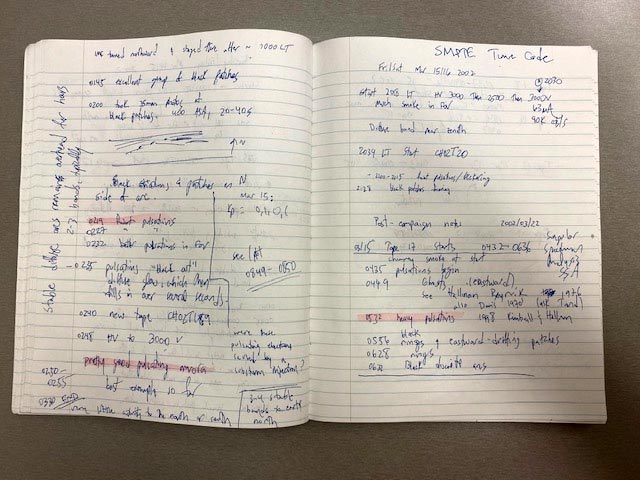
“What surprised me, and what made me write it in the notebook, is when a patch brightened and turned off, the background diffuse aurora was erased. It went away,” says Knudsen, a Fort Dodge, Iowa, native who has studied aurora for more than 35 years and is a co-author on the study. “There was a hole in the diffuse aurora. And then that hole would fill back in after a half-minute or so. I had never seen something like that before.”
The note lay dormant, and the video unstudied, until Iowa’s Jaynes handed it to graduate student Riley Troyer to investigate. Jaynes learned about Knudsen’s recording at a scientific meeting in 2010 and referenced the eraser note in her doctoral thesis on diffuse aurora a few years later. Now on the faculty at Iowa, she wanted to learn more about the phenomenon.
“I knew there was something there. I knew it was different and unique,” says Jaynes, assistant professor in the Department of Physics and Astronomy. “l had some ideas how it could be analyzed, but I hadn’t done that yet. I handed it to Riley, and he went much further with it by figuring out his own way to analyze the data and produce some significant conclusions.”
Troyer, from Fairbanks, Alaska, took up the assignment with gusto.
“I’ve seen hundreds of auroras growing up,” says Troyer, who is in his third year of doctoral studies at Iowa. “They’re part of my heritage, something I can study while keeping ties to where I’m from.”
Timing and Patterns of Eraser Events
Troyer created a software program to key in on frames in the video when the faint erasers were visible. In all, he cataloged 22 eraser events in the two-hour recording.
“The most valuable thing we found is showing the time that it takes for the aurora to go from an eraser event (when the diffuse aurora is blotted out) to be filled or colored again,” says Troyer, who is the paper’s corresponding author, “and how long it takes to go from that erased state back to being diffuse aurora. Having a value on that will help with future modeling of magnetic fields.”
Jaynes says learning about diffuse auroral erasers is akin to studying DNA to understand the entire human body.
“Particles that fall into our atmosphere from space can affect our atmospheric layers and our climate,” Jaynes says. “While particles with diffuse aurora may not be the main cause, they are smaller building blocks that can help us understand the aurora system as a whole, and may broaden our understanding how auroras happen on other planets in our solar system.”
Reference: “The Diffuse Auroral Eraser” by R. N. Troyer, A. N. Jaynes, S. L. Jones, D. J. Knudsen and T. S. Trondsen, 18 February 2021, JGR Space Physics.
DOI: 10.1029/2020JA028805
Study co-authors are Sarah Jones, from NASA Goddard Space Flight Center and who was part of Knudsen’s team in Churchill, and Trond Trondsen, with Keo Scientific Ltd., who built the camera that filmed the diffuse aurora.
Never miss a breakthrough: Join the SciTechDaily newsletter.
Follow us on Google and Google News.