
Close Menu
    Facebook X (Twitter) Instagram
    SciTechDaily
    • Biology
    • Chemistry
    • Earth
    • Health
    • Physics
    • Science
    • Space
    • Technology
    Facebook X (Twitter) Pinterest YouTube RSS
    SciTechDaily
    Home»Science»Newly Discovered Quasicrystal – “Magnificent in Its Complexity” – Was Created by the First Nuclear Explosion at Trinity Site
    Science

    Newly Discovered Quasicrystal – “Magnificent in Its Complexity” – Was Created by the First Nuclear Explosion at Trinity Site

    By Los Alamos National LaboratoryMay 18, 20211 Comment4 Mins Read
    Facebook Twitter Pinterest Telegram LinkedIn WhatsApp Email Reddit
    Share
    Facebook Twitter LinkedIn Pinterest Telegram Email Reddit
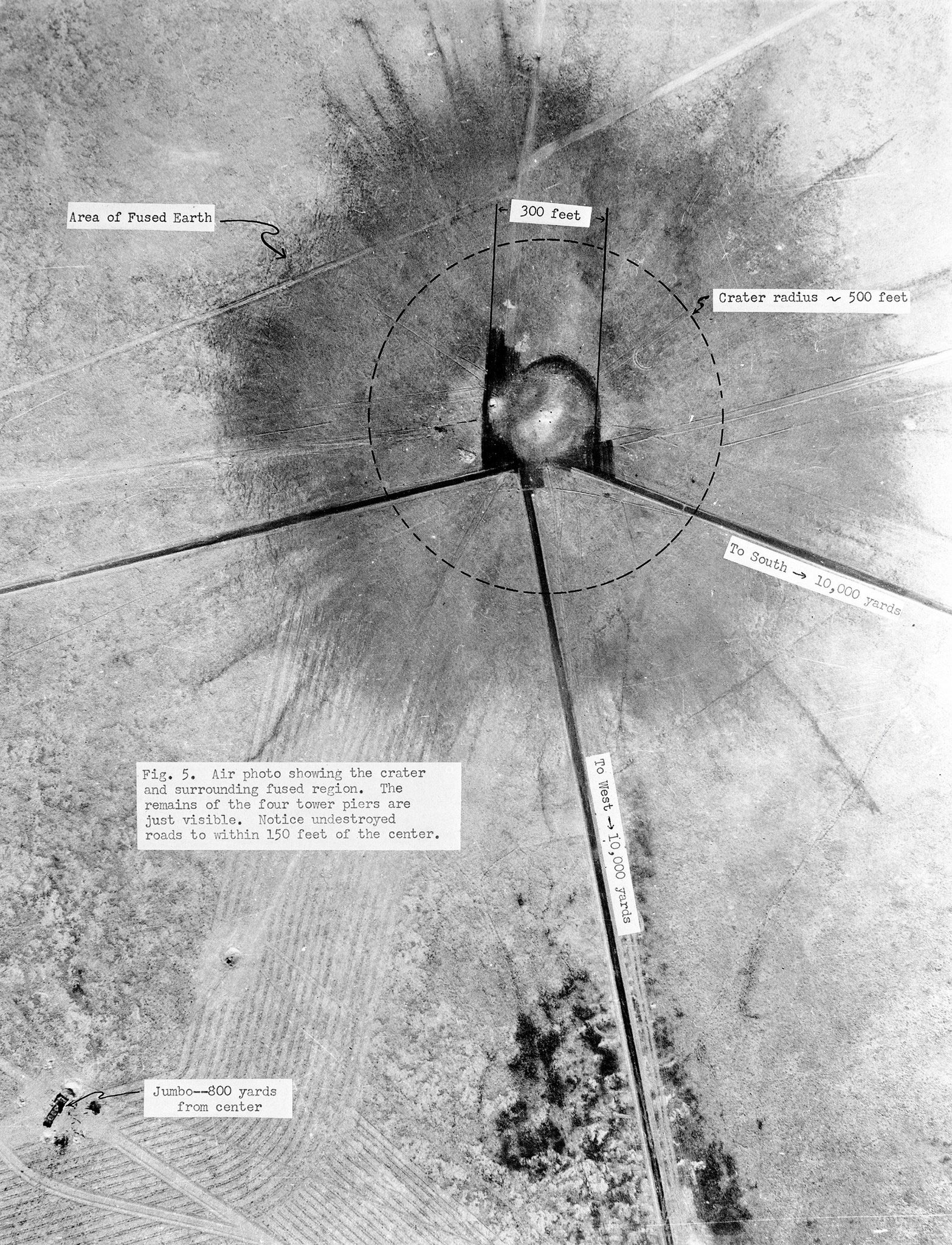
    Ground Zero Trinity Test Site
    An aerial view of ground zero 28 hours after the Trinity Test on July 16, 1945. The nuclear blast created a newly discovered quasicrystal that was formed in the fusion of surrounding sand, the test tower, and copper transmission lines.

    Discovery of new material could someday aid in nuclear nonproliferation.

    A newly discovered quasicrystal that was created by the first nuclear explosion at Trinity Site, N.M., on July 16, 1945, could someday help scientists better understand illicit nuclear explosions and curb nuclear proliferation.
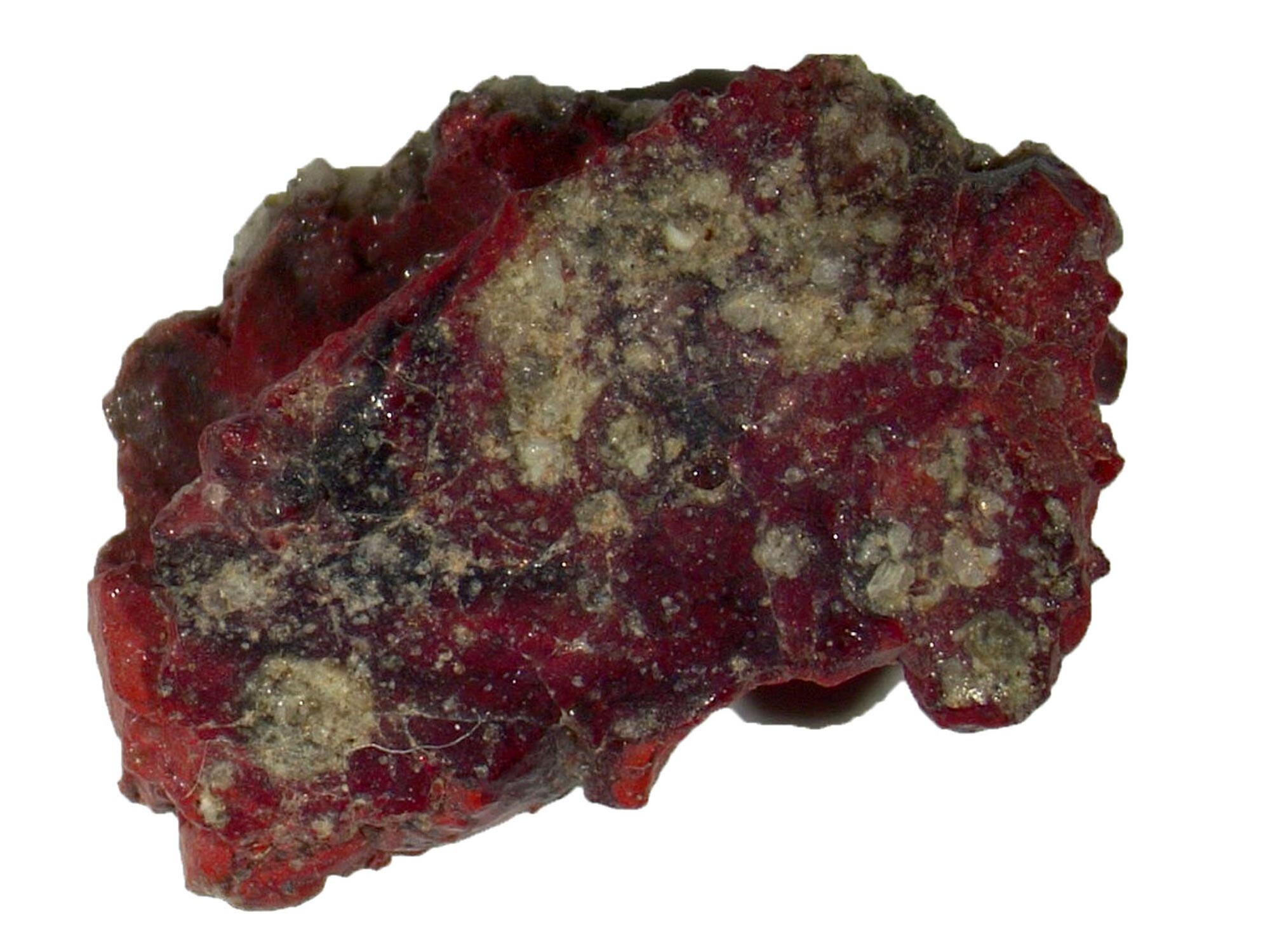
    Red Trinitite Sample Containing Quasicrystal
    Image of red trinitite sample which contained the quasicrystal. Credit: Luca Bindi and Paul J. Steinhardt.

    “Understanding another countries’ nuclear weapons requires that we have a clear understanding of their nuclear testing programs,” said Terry C. Wallace, director emeritus of Los Alamos National Laboratory and co-author of the paper about the discovery, which was published yesterday in PNAS. “We typically analyze radioactive debris and gases to understand how the weapons were built or what materials they contained, but those signatures decay. A quasicrystal that is formed at the site of a nuclear blast can potentially tell us new types of information—and they’ll exist forever.”

    The newly discovered material was formed accidentally in the blast of the first atomic bomb test, which resulted in the fusion of surrounding sand, the test tower, and copper transmission lines into a glassy material known as trinitite. Quasicrystals are exotic material that break the rules of classical crystalline materials. Materials such as sugar, salt, or quartz form crystals with what is known as a periodic order: the atoms are arranged in a pattern that repeats itself in three dimensions. Quasicrystals, first discovered in the 1980s, have an atomic structure of the constituent elements, but the pattern is not periodic. The quasicrystal, created by the Trinity explosion in a sample of red trinitite, has 5-fold rotational symmetry, which is not possible in a natural crystal. The symmetry group of the quasicrystal is the same as that of the regular 20-sided solid known as an icosahedron, and the chemistry is given by the formula Si61Cu30Ca7Fe2. This new quasicrystal is now the oldest known human-made quasicrystal, with an unmistakable timestamp (through its composition, discovery location, and radioactivity), indicating its moment of origin.
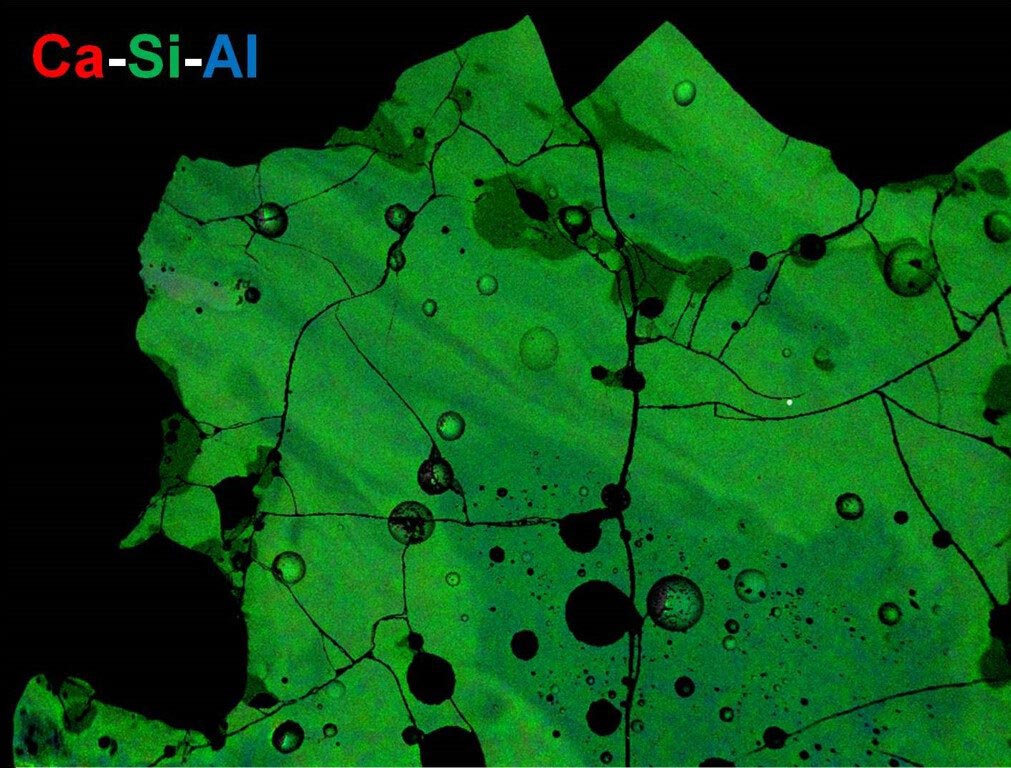
    Polished Surface of Quasicrystal Sample
    Combined X-ray maps of the polished surface of the sample studied which indicates the Ca-Si-Al chemical compositional variation. Credit: Luca Bindi and Paul J. Steinhardt.

    “Quasicrystals are formed in extreme environments that rarely exist on Earth,” said Wallace, who is a geophysicist. “They require a traumatic event with extreme shock, temperature, and pressure. We don’t typically see that, except in something as dramatic as a nuclear explosion.” The thermodynamic/shock conditions under which this quasicrystal formed are roughly comparable to those that formed the natural quasicrystals discovered in the Khatyrka meteorite, which dates back at least hundreds of millions of years and perhaps as far back as the beginning of the solar system.
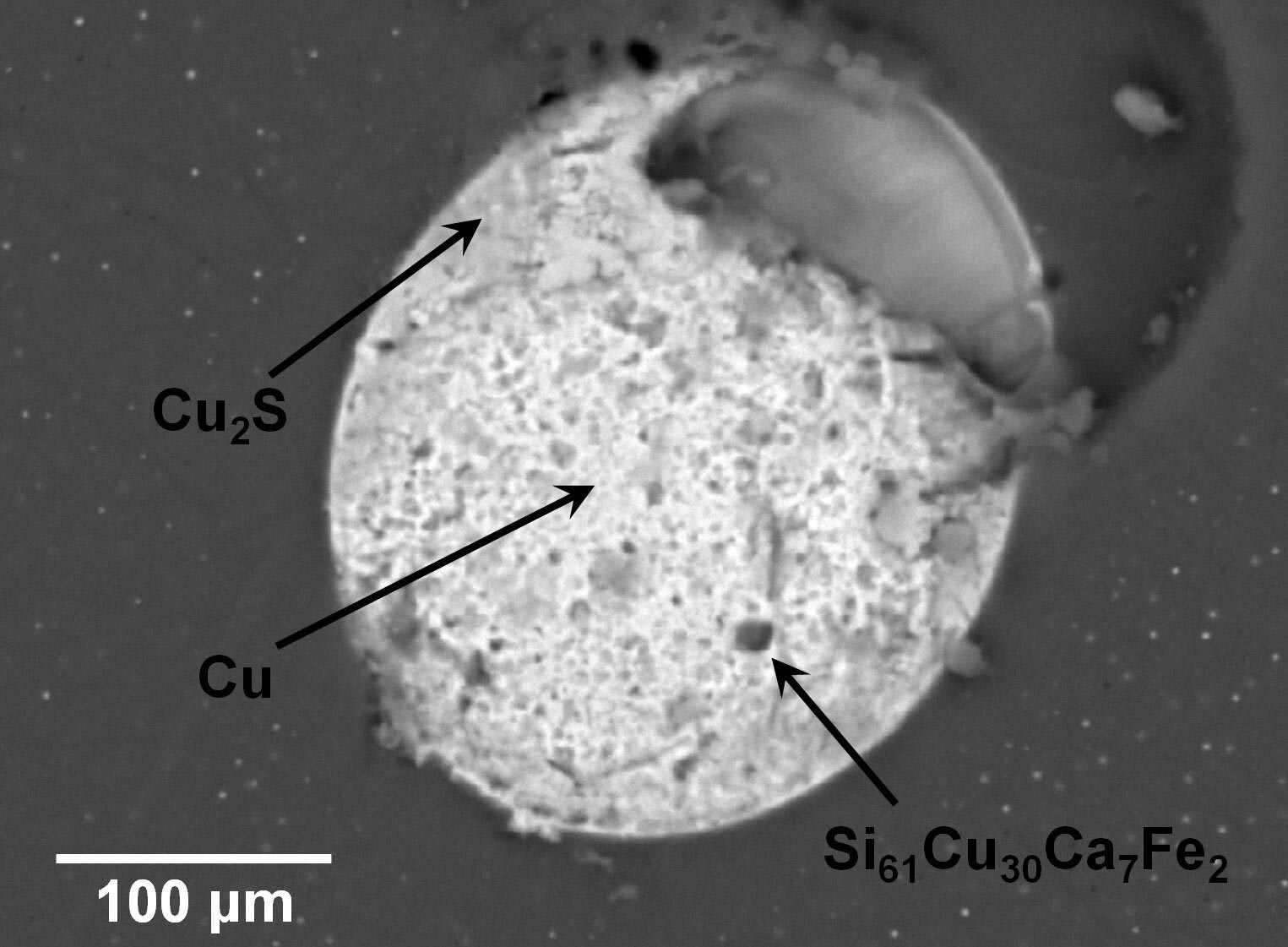
    Metal Droplet Containing Quasicrystal
    Back-scattered scanning electron microscope image of the studied metal droplet containing the quasicrystal, with Cu, Cu2S, and Si61Cu30Ca7Fe2 features labeled. Credit: Luca Bindi and Paul J. Steinhardt

    “This quasicrystal is magnificent in its complexity—but nobody can yet tell us why it was formed in this way. But someday, a scientist or engineer is going to figure that out and the scales will be lifted from our eyes and we will have a thermodynamic explanation for its creation. Then, I hope, we can use that knowledge to better understand nuclear explosions and ultimately lead to a more complete picture of what a nuclear test represents,” said Wallace.

    Reference: “Accidental synthesis of a previously unknown quasicrystal in the first atomic bomb test” by Luca Bindi, William Kolb, G. Nelson Eby, Paul D. Asimow, Terry C. Wallace and Paul J. Steinhardt, 17 May 2021, Proceedings of the National Academy of Sciences.
    DOI: 10.1073/pnas.2101350118

    The paper was written in collaboration with the University of Florence, Italy, the University of Massachusetts, Caltech, and Princeton University.

    Never miss a breakthrough: Join the SciTechDaily newsletter.
    Follow us on Google and Google News.

    Crystals DOE Los Alamos National Laboratory Popular
    Share. Facebook Twitter Pinterest LinkedIn Email Reddit

    Related Articles

    Powerful X-rays of the Advanced Photon Source Reveal 1,900-Year-Old Egyptian Mummy’s Secrets

    Efficient AC Use: Building Scientist’s Tips on Keeping Cool During Heat Waves

    Heavy Metal Psyche: Biggest Main Belt Asteroid Might Be Planet Remnant

    Butterfly Effect in Quantum Realm Disproven by Simulating Quantum ‘Time Travel’

    New Atomtronic Device to Probe Weird Boundary Between Quantum and Everyday Worlds

    Artificial Brains Need Sleep Too – Desperate AI Researchers Discover Way to Stabilize Neuromorphic Processors

    Reinventing the Mirror to Transform Antennas, Wireless and Cell Phone Communications

    Testing the Laws of Physics With Ultra-High Energy Gamma Rays From the Far Reaches of the Galaxy

    Researchers Develop Method for Making High-Temperature Photonic Crystals

    1 Comment

    1. cyril boudreaux on May 19, 2021 4:41 am

      I love science, If they ever take the poison out of a bomb explosion, we will all die.

      Reply
    Leave A Reply Cancel Reply

    • Facebook
    • Twitter
    • Pinterest
    • YouTube

    Don't Miss a Discovery

    Subscribe for the Latest in Science & Tech!

    Trending News

    Largest-Ever Study Finds Medicinal Cannabis Ineffective for Anxiety, Depression, PTSD

    250-Million-Year-Old Egg Solves One of Evolution’s Biggest Mysteries

    Living With Roommates Might Be Changing Your Gut Microbiome Without You Knowing

    Century-Old Cleaning Chemical Linked to 500% Increased Risk of Parkinson’s Disease

    What if Your Memories Never Happened? Physicists Take a New Look at the Boltzmann Brain Paradox

    One of the Universe’s Largest Stars May Be Getting Ready To Explode

    Scientists Discover Enzyme That Could Supercharge Ozempic-Like Weight Loss Drugs

    Popular Sweetener Linked to DNA Damage – “It’s Something You Should Not Be Eating”

    Follow SciTechDaily
    • Facebook
    • Twitter
    • YouTube
    • Pinterest
    • Newsletter
    • RSS
    SciTech News
    • Biology News
    • Chemistry News
    • Earth News
    • Health News
    • Physics News
    • Science News
    • Space News
    • Technology News
    Recent Posts
    • Scientists Prove There Are Just Six Degrees of Separation in a Social Network
    • Bee Bacteria Could Fix a Major Flaw in Plant-Based Milk
    • Scientists Discover a Surprising Way To Make Bread Healthier and More Nutritious
    • Natural Compounds Boost Bone Implant Success While Killing Bacteria and Cancer Cells
    • After 60 Years, Scientists Uncover Unexpected Brain Effects of Popular Diabetes Drug Metformin
    Copyright © 1998 - 2026 SciTechDaily. All Rights Reserved.
    • Science News
    • About
    • Contact
    • Editorial Board
    • Privacy Policy
    • Terms of Use

    Type above and press Enter to search. Press Esc to cancel.