

Researchers have identified shared biological changes across different genetic forms of autism, despite the disorder’s extensive genetic diversity.
Hundreds of genes have been associated with autism, but scientists still do not fully understand the molecular and cellular processes that drive the condition. A new study published in Nature, led by Gaia Novarino at the Institute of Science and Technology Austria (ISTA), takes a major step toward explaining those processes and could help guide the development of future treatments.
“Autism spectrum conditions, often abbreviated as ASD in scientific and medical literature, are, for example, neurodevelopmental disorders such as epilepsy or intellectual disability. The underlying changes begin during early brain development, while the first signs often become apparent in early childhood and can persist throughout life,” explains Gaia Novarino, Professor and Executive Vice President at the Institute of Science and Technology Austria (ISTA).
Searching for Shared Autism Mechanisms
One of the biggest questions in autism research is whether the many genetic causes of ASD ultimately produce the same biological changes in the brain. Lena Schwarz, an ISTA alum, worked with researchers from the Novarino group at ISTA, the Medical University of Vienna, the University of Vienna, and CeMM to investigate that question.

Autism has a highly complex genetic basis. Some cases result from rare mutations in single genes, while others arise from a combination of many genetic factors. “That makes the biology much more complex,” Schwarz said.
As part of her PhD research, Schwarz examined whether different autism-related mutations influence brain development in similar ways. By comparing molecular changes across multiple genetic models and stages of development, the team looked for shared biological pathways as well as changes unique to each mutation.
“With such an overview, we wanted to understand whether different genetic causes of autism might still lead to overlapping effects—and where their effects differ.” Answering that question required analyzing an enormous amount of data.
Single-Nucleus Multi-Omics Reveals Brain Cell Changes
A decade ago, this type of study would not have been possible. Advances in technology allowed the researchers to use single-nucleus multi-omics sequencing, a technique that examines several layers of information within individual brain cells.
The “single nucleus” part refers to studying the nucleus, the part of a cell that contains its DNA. Because the brain is made up of many different cell types, examining individual nuclei lets researchers identify specific cell types and better understand what is happening inside each one.
The “multi-omics” approach combines several kinds of biological information, including DNA, RNA activity, and the epigenome, which consists of chemical modifications that determine whether genes are switched on or off.
This method gave the team a much clearer picture than traditional bulk tissue analysis. By studying individual cells, they could identify which mutations affected particular cell types and how autism-related genes behaved throughout the brain.
Shared Developmental Patterns Across Autism Models
Schwarz analyzed more than 250 samples representing high-risk ASD genes from two brain regions in both male and female mice at different stages of development.
Although each genetic model affected different genes, the researchers found that many disrupted the same brain cell types and molecular pathways, especially during early brain development. At the same time, every model retained its own distinct molecular signature.
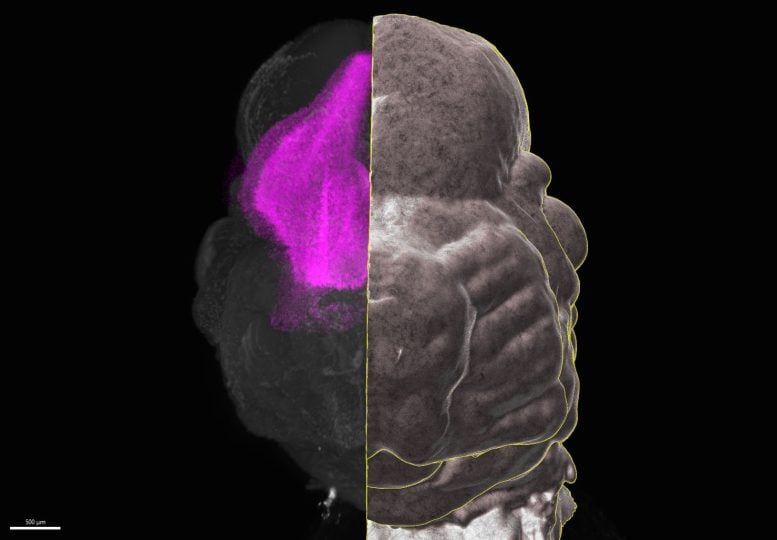
Video representation of a cleared mouse brain. The turquoise signal marks proliferating nerve cells in the brain. The color gradient, ranging from green and blue to yellow, represents the Z-position of each cell. Since the image was acquired across different focal planes, the Z-position reflects the depth at which each cell is located within the brain sample. Credit: Mohammad Goudarzi / ISTA
Most of the differences appeared as temporary delays in cell maturation and the formation of neural connections rather than permanent damage. Many of these changes began to disappear about two weeks after birth.

The researchers also observed that changes in brain activity reflected the molecular changes they measured. In addition, female mice responded differently to autism-linked mutations than male mice.
Stage-Specific Autism Therapies Show Promise
The wide range of genetic causes behind ASD makes it unlikely that a single treatment will work for everyone. The Novarino group’s findings reveal common changes in brain cells across different forms of autism, highlighting shared developmental pathways that could become targets for early therapies.
“Our findings advocate for therapeutic approaches that are stage-specific, sex-specific, and trajectory-specific. Rather than looking for a single universal intervention, we need to account for when in development we intervene, the biological sex of the individual, and the specific genetic and molecular trajectory that person is on,” explains Novarino.
“Autism spectrum conditions affect many children and families around the globe. Understanding what is happening in their brains matters on two levels: it deepens our knowledge of human brain development more broadly, and it brings us closer to being able to meaningfully support these individuals.”
Reference: “Cortical development dynamics across autism spectrum disorder mouse models” by Lena A. Schwarz, Christoph P. Dotter, Sergey Isaev, Michela Lisi, Daniel Malzl, Christoph Büschl, Sabrina Ladstätter, Bárbara Oliveira, Matteo Barel, Bernadette Basilico, Chaitanya Chintaluri, Sarah Gorkiewicz, Mohammad Goudarzi, Tereza Belinova, Stephan Reichl, Gintarė Sendžikaitė, Satish Arcot Jayaram, Peter Koppensteiner, Christoph Sommer, Tim P. Vogels, Jörg Menche, Igor Adameyko, Peter V. Kharchenko, Christoph Bock and Gaia Novarino, 17 June 2026, Nature.
DOI: 10.1038/s41586-026-10679-1
This project was supported by funding from the European Research Council (ERC) Consolidator Grant (PR1028ERC02), SFARI (PR1028SIM02), and the Austrian Science Fund (FWF) (PE1028W1232 and PR1028FG1803).
Never miss a breakthrough: Join the SciTechDaily newsletter.
Follow us on Google and Google News.
1 Comment
These scientists seem to forget the whole subject of epigenetics, which is the study of all of those things in the external and internal environment that influence a gene to turn on or off. “Epi” means above.
“Epigenetic patterns can be influenced by environmental factors, lifestyle choices, and aging, and they play a critical role in development, disease prevention, and the interaction between genes and the environment.”