
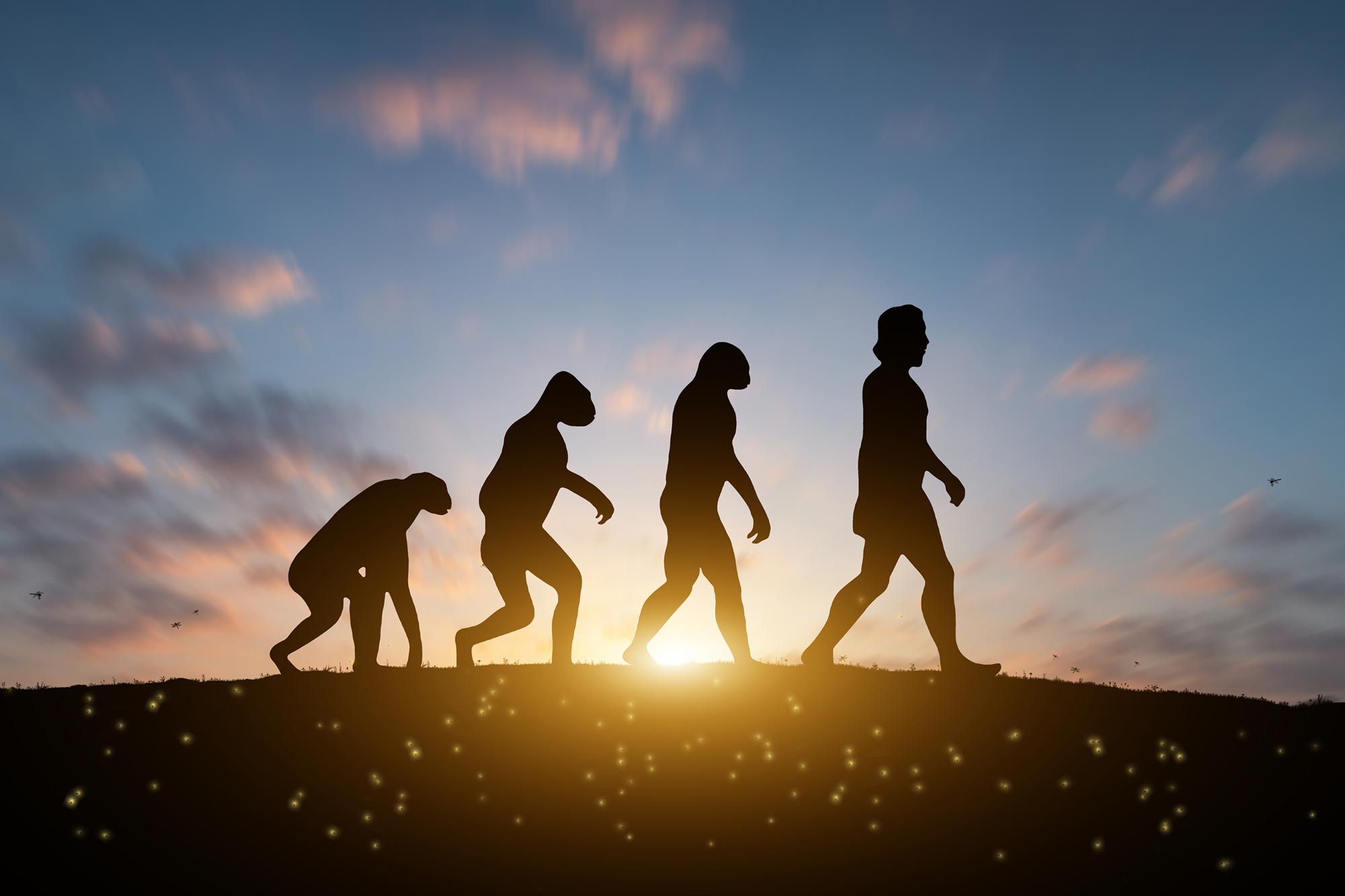
Human body size evolution was shaped by both gradual change and a major later growth spurt within Homo.
When did our ancestors become human-sized? Scientists have debated for decades whether the human lineage gradually grew larger over millions of years or experienced a dramatic leap in body size. A new study suggests the answer is more complicated than either idea alone, identifying a major evolutionary jump around 2 to 2.5 million years ago, near the emergence of Homo rudolfensis or Homo erectus/ergaster.
The research, published in PNAS, shows that some hominin species moved in a very different direction. Homo floresiensis and Homo naledi remained small, while the early hominin Australopithecus averaged about 40 kg and stood roughly the height of a child. Other branches of Homo became larger, with Homo erectus/ergaster becoming the first hominins to average around 60 kg or more, a body weight comparable to many modern humans.
The findings from the University of Reading and the University of Oxford challenge the familiar idea that human ancestors steadily became bigger over time in a single, straightforward line.
Growth was not a straight line
Dr Jacob Gardner, lead author at the University of Reading, said: “For years, different studies have come to different conclusions about whether our ancestors steadily grew bigger over time or jumped in size at some key point in our Homo ancestors. We think that’s because everyone was looking at slightly different pieces of a much bigger puzzle. When you put all the fossils together, examine multiple competing ideas, and account for how species are related to each other, a clearer picture emerges. The answer is most likely a combination of these ideas.
“The human story is not simply one of constant growth, but also of a major change that happened later, within our own genus, while other branches of the family, including some surprisingly small relatives, went their own way entirely.”
Piecing together the human puzzle
To trace the pattern, researchers analyzed estimated body weights from 386 fossils representing 21 hominin species, the group that includes modern humans and their extinct relatives. They used statistical models to follow how body size shifted across millions of years.
Earlier studies often reached different conclusions because they focused on different parts of the fossil record. Some emphasized early relatives such as Australopithecus, while others concentrated on later members of Homo. Researchers also used different methods to estimate body mass from fossil bones.
Those studies also often did not fully account for how hominin species were related to one another or for uncertainties in the fossil record, including questions about which fossils belong to which species. When those factors were brought into one model, the apparent disagreements began to make more sense. The studies were not necessarily contradicting each other. They were capturing different pieces of a more complicated evolutionary pattern.
The new analysis suggests that body weight increased steadily among earlier hominins such as Australopithecus, then rose sharply later within Homo.
Larger bodies matched new lives
The timing of that increase lines up with broader changes in how later Homo species lived. These ancestors were walking on two legs more efficiently than earlier hominins, eating more meat, and traveling over larger areas to find food and suitable habitats.
A larger body may have supported that way of life. Bigger bodies could have helped early humans move across longer distances and survive on a more varied diet. The results suggest that increasing body size was closely tied to a broader ecological shift in how these ancestors used their environments.
Dr Thomas Puschel, co-author from the School of Anthropology and Museum Ethnography, University of Oxford, said: “Our results suggest that human body size evolution was not simply a story of steady growth over time. Although body mass generally increased throughout our evolutionary history, the most significant shift occurred later within the genus Homo. This change coincided with broader developments in how our ancestors moved across landscapes and exploited their environments, pointing to a close relationship between body size and major ecological and behavioral transitions.”
Reference: “Competing models of hominin body size evolution” by Jacob D. Gardner, Thomas A. Püschel, Suzy White, Manabu Sakamoto and Chris Venditti, 22 June 2026, Proceedings of the National Academy of Sciences.
DOI: 10.1073/pnas.2521732123
Never miss a breakthrough: Join the SciTechDaily newsletter.
Follow us on Google and Google News.
2 Comments
Please be more careful with comparatives. “Australopithecus averaged about 40 kg and stood roughly the height of a child” but how old a child? Why not 1.2 meters or whatever?
Interestingly the megafauna threshold is about 40 kg. (45 in Wikipedia.)
But if there was an evolutionary article that cried out for not using the erroneous -and quite frankly tiresome – “ladder of descent” cartoon of human evolution, this would be one example. Hominins diversified from something like the second shadow image and the Pan genera likely had many branches too (even if their fossil record is less well preserved). Knuckle walking is a late evolutionary trait and not robustly tied to our common ancestor,