
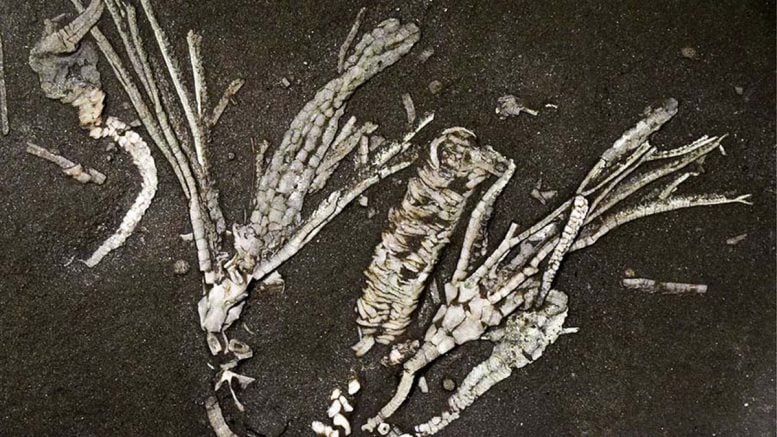
A rare 450-million-year-old fossil with preserved soft tissue is revealing how some of Earth’s earliest reef animals lived and evolved.
More than 450 million years ago, long before dinosaurs appeared or forests covered the continents, Earth’s shallow seas were already filled with complex animal communities.
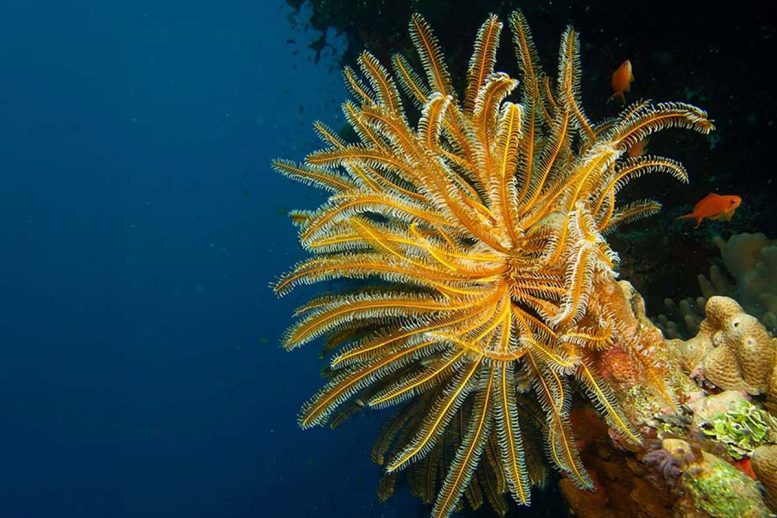
Among the most striking inhabitants were crinoids, relatives of starfish and sea urchins that often resembled flowers rooted to the ocean floor. Their branching arms captured food from passing currents, allowing them to thrive in some of the planet’s earliest reef ecosystems.
Crinoid fossils are abundant, but they usually reveal only part of the animal. Their hard skeletal plates can survive for hundreds of millions of years, while delicate structures involved in feeding and movement typically disappear soon after death.
An exceptionally preserved fossil has now given paleontologists a rare view of that missing anatomy.
One-in-a-Million Soft Tissue Preservation
Researchers from the University of Oklahoma identified fossilized tube feet in Dendrocrinus simcoensis, a crinoid that lived more than 450 million years ago. It is the oldest-known example of preserved crinoid soft tissue and only the second ever documented.
“After an animal dies, soft tissues like skin, eyes, or internal organs are the first things to decay,” said Dr. Lena Cole, an OU paleontologist and assistant curator of invertebrate paleontology at the Sam Noble Oklahoma Museum of Natural History. “Most fossils are only made up of hard parts like bones, teeth, or shells. Soft tissues are only preserved when the environment acts almost like a natural refrigerator or vacuum-sealer, conditions that are incredibly rare.”
For soft tissue to fossilize, decay must be interrupted almost immediately. Oxygen levels, sediment chemistry, burial speed, and microbial activity all need to align before scavengers and bacteria destroy the remains. That makes fossils like this far more than anatomical curiosities. They are brief snapshots of biological features that are normally erased from the fossil record.
“Preservation like this is truly one in a million,” Cole said. “Crinoid fossils number in the millions, and this is only the second time soft tissues have ever been found.”
“It’s incredible these soft tissues have survived more than 450 million years,” said Dr. David Wright, an OU paleontologist and assistant curator of invertebrate paleontology at the museum, who co-authored the study with Cole. “For reference, these soft tissues are more than 200 million years older than the oldest dinosaur.”
What Ancient Tube Feet Reveal About Evolution
The tube feet are especially informative because they were central to how crinoids lived. Modern crinoids extend these small structures along their arms to trap food particles and move them toward the mouth. Their arrangement can reflect the strength of local currents, the size of available food, and the feeding strategy of the animal.
“Since crinoid tube feet are used for feeding, you can think of them in a similar way to how we think about teeth in mammals,” Wright explained. “Differences in their structure tell us about what kinds of environments a species lived in and how it fed.”
When the researchers compared the fossil with living crinoids, they found that the ancient species had a notably different arrangement. That suggests early crinoids may have occupied ecological roles or collected food in ways that have no exact equivalent today.
“Comparisons with living crinoids show that the anatomy of this ancient species was very different,” Cole said. “This gives us new insight into how crinoids evolved and how their feeding strategies changed over hundreds of millions of years.”
Clues to Early Reef Ecosystems
Such differences matter because living species represent only the surviving branches of evolution. Extinct animals often possessed combinations of features that vanished entirely, meaning modern organisms cannot provide a complete guide to how ancient ecosystems worked.
“Fossilized remains of long-extinct species can show features well outside the range of variation we see in living species,” Wright said.
“By comparing ecological ways of life for extinct and modern species, we can understand how patterns of adaptive evolution have changed through time and what factors shaped the modern biosphere.”
The discovery may therefore reveal more than the anatomy of one crinoid. It could help researchers reconstruct how some of the earliest reef animals divided resources, responded to ocean currents, and developed increasingly specialized feeding strategies during the early Paleozoic.
Hidden Discoveries Inside Museum Collections
Remarkably, the fossil was not newly excavated. It had already been collected and stored at Montréal’s Musée de paléontologie et de l’évolution, a small institution supported entirely by community donations.
Its importance became clear only when Cole and Wright, both crinoid specialists, examined it during a research visit. Their expertise allowed them to recognize structures that could easily have been overlooked or mistaken for marks in the surrounding rock.
The story highlights an often underappreciated side of paleontology. Fieldwork brings fossils out of the ground, but museum collections give scientists the time and access needed to understand what those fossils actually preserve. A specimen may remain scientifically quiet for decades until new technology, a new question, or the right specialist reveals its significance.
“New fossil discoveries ultimately come from fieldwork, but museum collections play a significant role in this kind of integrative research,” Wright said. “We don’t always know the full significance of the specimens we collect. New technologies, ideas, or expertise often find surprising ways to utilize existing specimens to make new discoveries.”
Why Museum Collections Still Transform Science
“This discovery highlights the importance of museum collections and the community support that keeps them alive,” Cole added. “Without the dedication of many people caring for these collections, this research would never have been possible.”
Cole and Wright help oversee more than one million invertebrate fossils at the Oklahoma Museum of Natural History, with additional specimens arriving each year. Many have never received the level of detailed study needed to uncover every feature they contain.
“This is why we work to make our collections accessible to researchers around the world,” Wright said. “There are simply too many fossils to study over one person’s career. There’s more than a lifetime’s worth of discoveries waiting to be found.”
Never miss a breakthrough: Join the SciTechDaily newsletter.
Follow us on Google and Google News.