
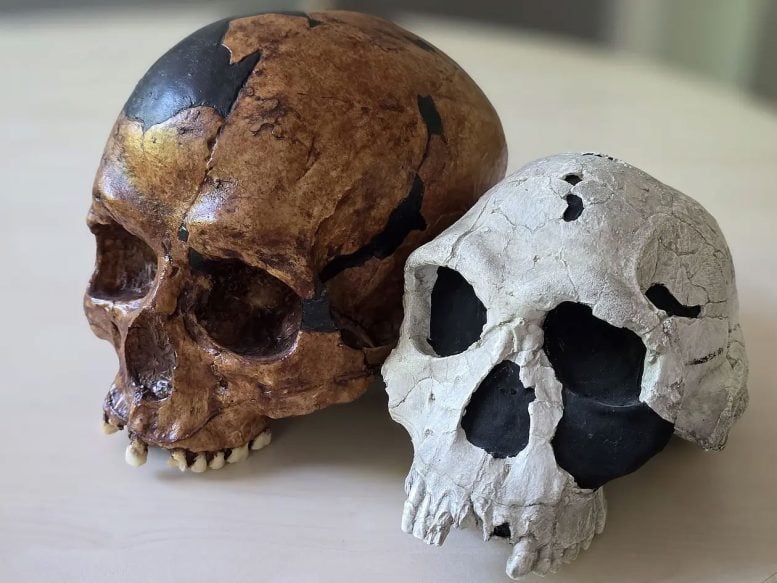
Scientists say some of the traits that define modern humans may have evolved only after long-standing biological and cultural barriers were broken.
Human evolution is often presented as a clear progression: brains grew larger, faces became smaller, tools improved, and our ancestors gradually became more like us. A new study suggests that this familiar story may be too simple.
Researchers found that two of the most recognizable changes in the genus Homo, increasing brain size and shrinking faces and jaws, do not closely match the pattern expected from continuous natural selection. Instead, human anatomy may have remained relatively stable for long stretches, with important changes emerging only when biological, environmental, or cultural barriers weakened.
The study, published in Nature Communications, was led by Mark Hubbe of the University of Tennessee-Knoxville and Katerina Harvati of the Senckenberg Centre for Human Evolution and Palaeoenvironment (SHEP) at the University of Tübingen.
The genus Homo, whose only surviving member is Homo sapiens, emerged about 2.5 million years ago. “With few exceptions, the evolution of the various Homo species was characterized by an increase in brain size as well as a decrease in the size and robustness of the face and jaws,” explains Harvati.
These physical changes unfolded alongside major shifts in behavior. “At the same time, significant behavioral changes occurred: stone tools were used more intensively, food was obtained and processed in increasingly diverse ways, populations spread across significantly larger geographic areas, and more complex social structures presumably emerged.”
The Traditional Natural Selection Model
Scientists have often connected these trends through natural selection. Bigger brains may have supported more advanced thinking, while tools, cooking, and food processing could have reduced the need for large teeth, powerful chewing muscles, and heavily built faces.
Under that interpretation, individuals with traits closer to the modern human condition repeatedly gained an advantage, causing those features to become more pronounced over time. But the fossil record does not appear to follow such a smooth trajectory.
Testing Evolution With Fossil Evidence
Hubbe and Harvati studied three-dimensional measurements from 87 fossil skulls representing much of the known history of the genus Homo. The sample included early species such as Homo habilis and Homo rudolfensis, along with Homo erectus, Homo heidelbergensis, Neanderthals, and early and modern populations of Homo sapiens. It covers most of the well-preserved hominin skull fossils available from the past two million years.
“We compared this exceptional dataset with six different evolutionary models using statistical analyses to assess which model most accurately explains the observed changes in head and facial morphology within the genus Homo,” says Harvati.
The models represented several possible evolutionary patterns. These included sustained natural selection in a particular direction, random or neutral change, stabilizing selection that keeps traits within a limited range, and punctuated equilibrium, in which species change little for extended periods before evolving more rapidly.
The researchers found limited support for the idea that directional selection steadily pushed the entire genus toward larger brains and smaller faces. Models involving neutral processes, evolutionary constraints, and long periods of minimal change generally explained the differences more effectively.
“While our analyses confirm the well-known evolutionary trends of cranial growth and facial reduction, they show that the differences within our genus can be explained much more effectively by neutral evolutionary processes and long periods of evolutionary stasis,” explains Hubbe.
Why Evolution Is Not a Straight Line
The findings challenge the impression that earlier humans were incomplete stages on a predetermined path toward Homo sapiens.
Evolution does not plan for a future outcome. A larger brain, smaller face, or lighter jaw does not inevitably replace an older form simply because it appears more modern. Traits spread only when the genetic variation exists and the surrounding biological and environmental conditions allow change to occur.
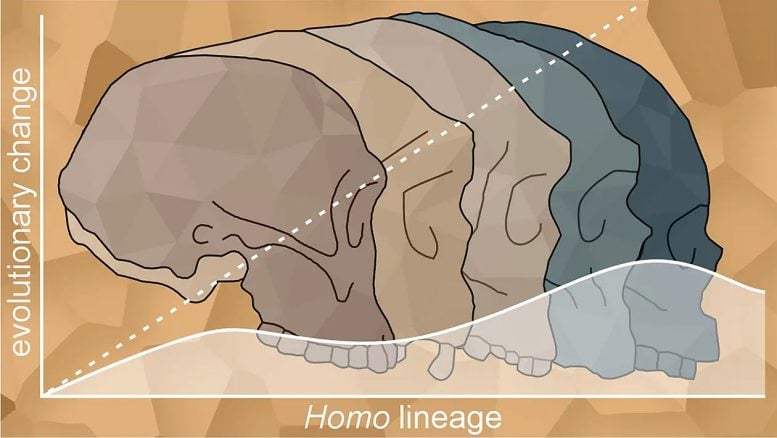
Random genetic mutations may introduce new variation, while genetic drift can make some traits more common without providing a clear survival advantage. Stabilizing selection can also preserve an effective body plan instead of pushing it continuously in a new direction.
Development places additional limits on what evolution can alter. The brain, skull, teeth, airways, muscles, and face grow as an interconnected system. Changing one part can affect several others, meaning evolution cannot redesign each feature independently.
This may help explain why the major trends are visible across millions of years even though the individual species do not form a simple sequence of steadily improving anatomy.
What Made Bigger Brains Possible
The researchers suggest that dramatic increases in brain size may have occurred when long-standing constraints temporarily eased. Notable periods of brain expansion appeared in Homo heidelbergensis and later among Neanderthals and Homo sapiens. These shifts may have depended on several factors coming together, including development, metabolism, access to energy-rich food, and advances in technology and culture.
Brains are expensive organs to maintain. Supporting a larger one requires a reliable supply of calories and nutrients, as well as changes in growth, reproduction, and the distribution of energy throughout the body. A large brain would offer limited benefit if a population could not consistently meet those demands.
Cultural advances may have changed that equation.
“In many ways, culture acts as a buffer: It enables us to utilize new habitats and access more resources. This reduces the pressure on certain physical structures because they need to be less strictly adapted to environmental conditions,” explains Hubbe, and he continues, “In this way, periods of intensified technological and cultural innovation can trigger rapid evolutionary changes. Such changes were clearly of great significance for the evolution of the genus Homo, as they enabled our ancestors to meet the nutritional demands of larger brains and to fully exploit the benefits of higher cognitive abilities.”
How Culture May Have Shaped Human Anatomy
Tools, food processing, cooperation, shelter, and shared knowledge can allow a population to survive challenges that would otherwise require new physical adaptations. Culture can therefore change the environment in which natural selection operates, opening evolutionary possibilities that were previously restricted. The same framework may help explain why modern humans look so different from other members of the genus.
Neanderthal faces remained comparatively large and robust for long periods. Modern humans, by contrast, developed substantially smaller and more lightly built faces than other human lineages.
Those differences may not have emerged from a slow, universal tendency toward facial reduction. Instead, the modern human face could reflect a later period of major behavioral, dietary, developmental, or social change.
“It is possible that these later changes were also linked to particularly profound behavioral shifts that accompanied the emergence of our species,” adds Harvati.
A New Way to Think About Human Origins
The study argues that modern facial anatomy emerged not from a single cultural innovation, but when several evolutionary constraints eased at once. Natural selection still mattered, though human evolution likely unfolded through pauses, inherited limits, random shifts, and occasional rapid change rather than a steady trend toward larger brains and smaller faces.
“Our findings shift the focus,” Harvati concludes. “Instead of asking why humans have continuously evolved toward larger brains and smaller faces, it would make more sense to investigate under what conditions human populations were able to break free from existing constraints and develop new traits. This approach could be particularly well-suited toward better understanding the evolution of our genus.”
Reference: “Evolutionary drivers of encephalization and facial reduction in the genus Homo” by Mark Hubbe and Katerina Harvati, 6 July 2026, Nature Communications.
DOI: 10.1038/s41467-026-74739-w
Never miss a breakthrough: Join the SciTechDaily newsletter.
Follow us on Google and Google News.
21 Comments
I think we are in one of those pivotal times when cultural frictions are triggered by climate stresses while the economic and social competitions ramp up to fever pitch, forcing us all to make choices to formulate our own political survival strategies that will inevitably affect our inner and exterior compositions and appearances. Choosing to be empathetic, compassionate, and cooperative will freeze our facial expressions and body language postures in much different configurations than those that choose to be ruthless and relentless in the quest to maintain dominance and not only enhance survival but also enjoy the hormonal high of that brutish domination. Evolution may not plan itself out, but the individuals making those choices attempt to exert some control over the environment that we find ourselves in when the results of those choices sort themselves out for another period of status quo. Will the ugly ones write the near future, or will the beautiful people? It is interesting to note that our collective prescience anticipating the most challenging resource conflicts and our political alignments are preceding the actual desperate survival challenges. Maybe in such a way as to cause the worst-case scenarios to manifest because we are planning for the conflicts rather than planning to mitigate the actual challenges.
It is the dawning of a New Divine Civilization promised in all the books of the past as early as script could record. The maturity of mankind. The Dawn of the Bahai Era year 183 B.E.
Humans were externally corrected 66 times over 10000 years ago…this is why modern science (except those in the know) can’t figure this out and wont. Humans are not a random creation but an evolved species which was tampered with over time.
Nicholas: Cultural evolution is not biological evolution (but it can affect the latter).
Maia: Please, no organized superstition comments under a science article.
Buronson: The evidence is that did not happen. The only tampering in putative evidence is our own self domestication the last 100 kyrs.
The switch from Neanderthal to Sapiens dominant genetics may have originated in brain energy savings. Neanderthal brains may have required up to 30% energy, much more than Sapiens 20%. Clothes and other tech and cultural advances made Neanderthal genetics costly overkill…
(On the understanding that when you used the word, ‘tampering’, you were referring to genetic modifications caused by something akin to aliens) You’re falsely implying that science does not move in a straight line towards empirical knowledge but rather in a more circular fashion leading nowhere. In this way of thinking, you’re due to doubt the Earth’s roundness because you are under the impression that “science always changes, no matter what”. This is simply not how science works. Science does not change its mind simply because it can’t get to the bottom of something, but rather bravely corrects itself. This is a sign of honesty, not dishonesty. As for your hypothesis that we were genetically modified by some being, that is supported by no evidence. Instead, evidence such as DNA and fossil records reveal a clear linear path leading to the current Homo sapiens, with no serious evolutionary gap suggesting genetic modifications, or, “tampering”. The more evidence we find, the clearer it gets, not the messier.
Just clarifying that my previous comment against being genetically tampered with was directed to Buronson. I clicked ‘reply’, but the system does not show that it was in fact directed to that person.
Second crucial correction, I just realised that when Buronson said, “Humans were externally corrected 66 times over 10000 years ago”, he was referring to being genetically corrected and not that scientists were correcting their understanding of humans. I realise that the original comment no longer served as the perfect counter argument I thought it would be, but let it stand on its own. And while I’m at it correcting myself, I’d also like to point out that by ‘linear path’, I meant to say, clear, or well documented. Not at all suggesting the misconception that we gradually went from chimp to higher beings. Evolution functions more like branches rather than a gradual path marching towards something greater.
The main factor in human evolution particularly pertaining to size of any living organism, anumal or human is the orbital distance of our planet and its surroundings. Our atmospheric preasure due to spatial conditions and elemental inclusion or removal. Such as the amount of helium in our atmosphere. The concentration of helium (or any other element) directly effects our genetical evolution. Australia is the proof. They are not one of our “sister” countries and their elevation as a whole is greatly higher than ours and we know that helium is prominent the further we rise.
The suns position and moons tidal pull all also need to be taken into account but the main varient in size is definitely helium. The size of their animals and the pitch of the natives voices are evident of this finding. The atmospheric river and its individual measurments of “periodic” elements, is ever changing as we are. Evolution is from direct adaptation. We do not need to guess when the historical evidence is visable still to this day. Yours truly – Individual researcher and Aspiring Author of educational editing, Shaunda Moore
Do your research and/or education: Helium is a chemically inert noble gas, nothing that affects biology.
Oh, I see that you invoked more unsupported factors. Disregarding sun positions and tidal pull (which hasn’t had time to change during hominid evolution), you imply that helium affects sound frequencies. But helium is about 5 parts per million in the atmosphere, produced by radioactive decays, so cannot make audible effects and affect evolution that circuitous route either.
Or survival of the fittest!
Also nicholas yes, that is a factor. Testosterone, the identifying factor for those behaviors listed, is also measurable by the size of a feline head. Since we all evolved the same i beleive it is safe to say that as humans we can also corrolate barbaric behavior to skull size. Now dont take the evolution statement from its validity, because its true, but yes we all did start at different evolutionary periods which means our lineal decent can be mapped to a particular genus and it may not be all the way back to that tutrle/bird pivot we began with. Some came in as the plant variant and some animal.
Hah, I read this article just after our local newspaper and national scientists remarked on how idiotic US war minister Hegseth is. You cannot tie testosterone levels to human behavior in healthy subjects, but it is a social media craze.
All extant life has evolved for 4 billion years, and there are many plant clades and other clades that you didn’t mention – half of the biosphere diversity is unicellular clades.
Dagens Nyheter on Hegseth:
“”The idiocy within the US administration has reached unexpected heights. This is yet another populist move with no basis in science,” says Stefan Arver, an endocrinologist.”
“In short, testosterone levels alone have nothing to do with athletic performance. How you feel and how you perform are linked to your overall lifestyle. People also possess different androgen receptors that bind testosterone with varying degrees of strength. Simply put, it is impossible to distinguish between those who can perform well and those who cannot by measuring testosterone levels.
“Countless studies have been conducted on this. Men do not even become more aggressive from having high testosterone levels—a fact demonstrated in a major study as early as 1994. Rats, on the other hand, do become more self-centered and aggressive,” explains Stefan Arver.”
TV4 Nyheterna on the testosterone craze:
“It often involves men who want to look more muscular, but according to Mikael Lehtihet, an associate professor specializing in hormonal disorders, only a tiny fraction actually need the supplements.
He also warns that the black market trade is not without risk. You never know what you are actually getting, and in a worst-case scenario, bacteria, viruses, and dust particles may have found their way into the products during manufacturing.
“It’s a huge risk.””
“Several myths about testosterone persist, including the idea that levels drop sharply with age or that it makes the user aggressive.
“Most studies show that levels don’t actually drop with age, if you take weight into account,” says Lehtihet.”
I may have missed this in this article. I was taught to believe that bipedalism affected the size and shape at the human skull as well.
The shape, certainly, the place where it attach to the spinal cord moved so bipedal apes heads are better balanced. Head size is an open question (see the research paper), but being bipedal has contributed to hominids dispersing into diverse environments, which could have helped brain evolution.
So long as it contradicts the out of Africa theory, I agree.
Nice look at the past here’s a look at the future, human beings are driven by myths every culture theologic and secular uses myths to indoctrinate and to Drive growth. Now we have ai that can introduce actionable myths that is to say myths that cause Behavior that are unlikely to be prosocial. The danger of AI is already present and we’re totally ignorant of how we’re driven by myths and AI is a myth making machine.
Hominid evolution has long been associated with mosaic evolution, so the better data that the paper presents is no surprise. But the evidence they present for stabilizing selection is also fragmentary, so once again the results seem to conform with the expected null hypothesis of near neutral evolution.
More interesting is that they confirm that the hominid lineage became megafauna – around 40+ kg (45+ in Wikipedia) in mass – with Erectus.
Isn’t this just punctuated equilibrium as proposed a generation (roughly) ago?
So now that we have AI and powerful computers to do our thinking the human brain will not need to be so big so the human race as a whole will become less intelligent. Evolution in action.