

A virus that can remain hidden in the body for years may leave a lasting mark on the brain.
In a new study, researchers found that herpesvirus infection intensified memory problems and other Alzheimer’s-related changes in mice already vulnerable to the disease. The damage appeared to be driven not simply by the virus itself, but by the immune system’s prolonged attempt to control it.
The findings offer a possible biological explanation for years of research linking common viral infections with an increased risk of dementia.
How Herpesviruses Could Accelerate Alzheimer’s
Herpesviruses are a large family that includes viruses associated with cold sores, childhood infections, and glandular fever. After the initial illness passes, some can remain dormant inside the body and reactivate later, repeatedly drawing the immune system into action.
Scientists from Cardiff University’s School of Medicine, Systems Immunity Research Institute, and Dementia Research Institute investigated whether that persistent immune activity could influence the progression of Alzheimer’s disease.
Their results suggest that T cells, immune cells that identify and attack infected cells, can enter the brain during herpesvirus infection and accelerate cognitive decline.
Dr. Mathew Clement of Cardiff University School of Medicine said, “Infections, including chronic human herpesviruses, which can be associated with cold sores, have long been suspected as increasing the risk of developing Alzheimer’s disease. However, the mechanisms underlying this association have remained largely unknown.”
Testing Infection and Immune Activity
The researchers used 3xTg-AD mice, which carry genetic changes that cause them to develop several features associated with Alzheimer’s disease. The animals were infected with murine cytomegalovirus, a β-herpesvirus used to study persistent herpesvirus infection.
Some mice received the antiviral medication valganciclovir hydrochloride. Others were treated with antibodies that targeted CD4 and CD8 T cells, allowing the team to test whether the immune response was contributing to the neurological damage.
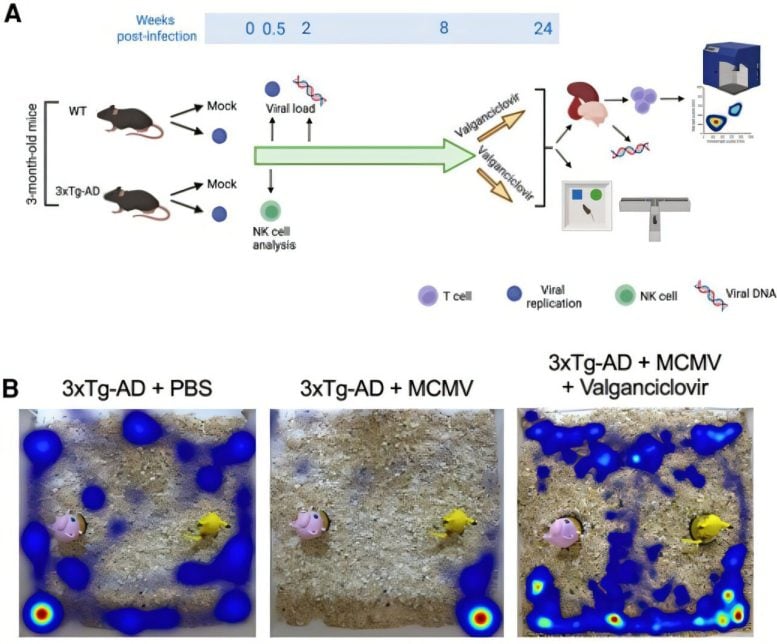
The scientists then measured memory and cognitive performance, the loss of cells in the hippocampus, and the accumulation of amyloid and tau proteins (indicative of Alzheimer’s disease). The hippocampus is a brain region central to learning and memory and is among the areas affected early in Alzheimer’s disease.
Virus-Fighting T Cells Enter the Brain
Following infection, large numbers of immune cells moved into the brain. Most were CD8+ T cells that specifically recognized the virus, showing that they had entered the tissue as part of the body’s attempt to contain the infection.
Similar T cells have previously been found in the brains and spinal fluid of people with Alzheimer’s disease, although their exact role has remained uncertain.
Antiviral Treatment Improves Cognition
The most important finding came when the immune response was disrupted. Mice treated with antiviral drugs, or those whose white blood cells were removed, performed better on cognitive tests.
The results indicate that a virus-driven immune response can actively speed the progression of Alzheimer’s-like disease rather than merely appearing alongside it.
Professor Ian Humphreys, Professor of Viral Pathogenesis and Lead Co-Director of Cardiff University’s Systems Immunity Research Institute, said, “It remains unclear how virus-induced T cell presence in the brain leads to disease progression, and understanding this may lead to new insights into Alzheimer’s Disease development.”
Infection Prevention and Dementia Risk
One possibility is that immune cells fighting a persistent infection also trigger inflammation that harms nearby neurons or disrupts the brain’s normal defenses. The study did not establish the precise chain of events, but it narrows the search to a specific interaction among infection, T cells, and vulnerable brain tissue.
Dr. Clement added, “Not only does this research broaden the understanding of the link between herpesviruses and Alzheimer’s disease and further strengthen the link between viruses and dementia more generally, but it raises the importance of prevention of infectious disease and how this, in the long term, may prevent or delay dementia onset.
“This study bolsters the argument that dementia risk is not as simple as genetic predisposition, but that environmental factors play an important part. By preventing disease through vaccines, antiviral treatments, and immune support, we can not only be treating and preventing us from getting short-term illnesses—such as cold sores – but those same disease preventions are playing an important role in reducing dementia risk for the later parts of our lives as well.”
Reference: “Cytomegalovirus-induced T cell responses accelerate Alzheimer’s disease progression in mice” by Morgan Marsden, James E McLaren, Ryan J Bevan, Daisy Penn-Ripley, Michelle Somerville, Sarah N Lauder, Manon H Jones, Lila-Blythe Maros, Matthew R McGurk, Awen Gallimore, David A Price, Kelly L Miners, Kristin Ladell, Florian A Siebzehnrubl, Timothy R Hughes, Ian R Humphreys and Mathew Clement, 13 July 2026, Brain.
DOI: 10.1093/brain/awag043
This work was supported by the Hodge Centre for Neuropsychiatric Immunology, the Medical Research Council, and the Wellcome Trust.
Never miss a breakthrough: Join the SciTechDaily newsletter.
Follow us on Google and Google News.