
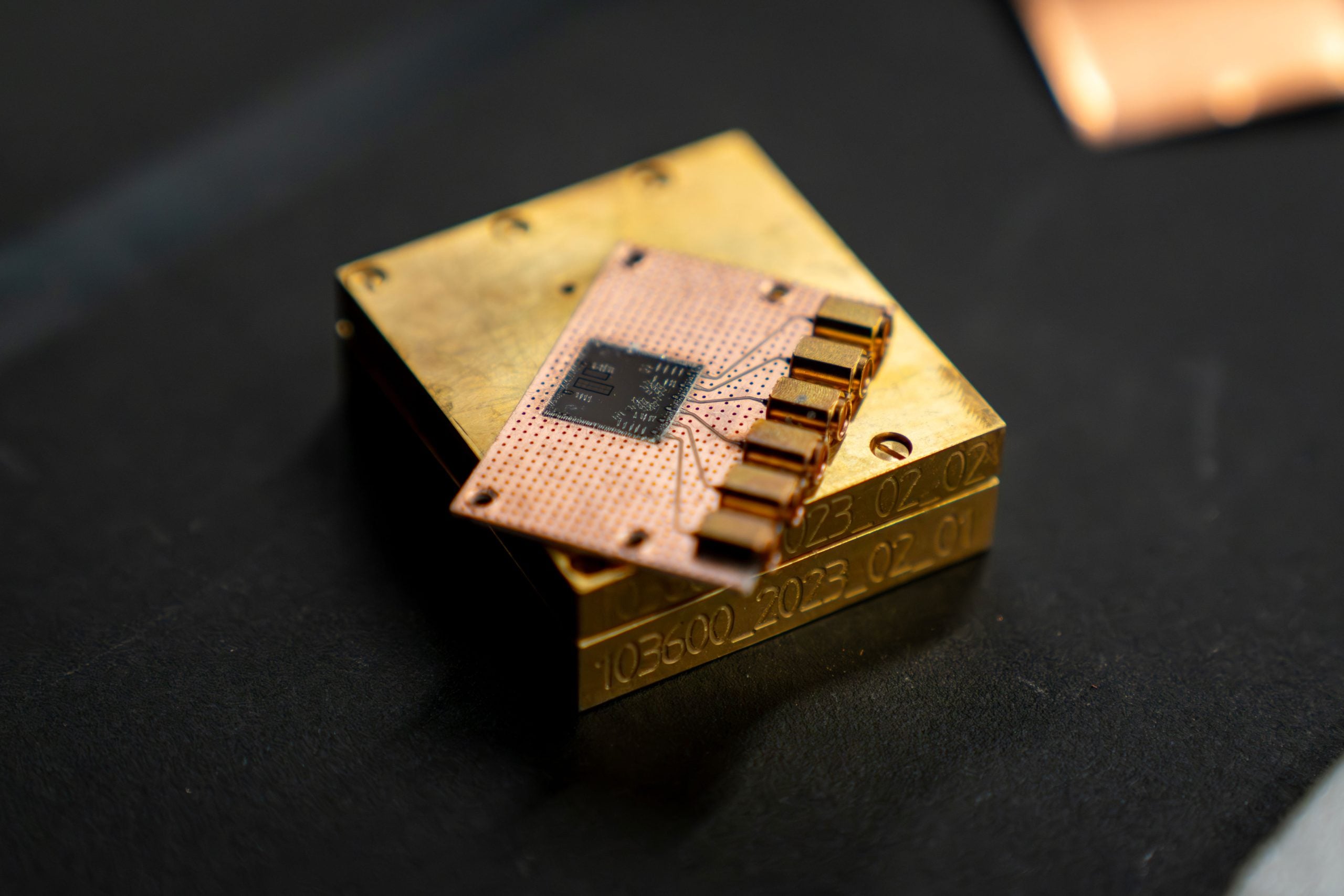
ISTA physicists have confirmed a theory proposed 20 years ago that could advance quantum technology.
A future quantum computer may need separate modules to behave as one machine, even when they are physically apart. That requires distributed entanglement, a quantum connection between distant components that has typically depended on active control and repeated measurements.
Physicists at the Institute of Science and Technology Austria (ISTA) have now demonstrated an autonomous alternative. Their system uses a “quantum bath” made from correlated particles of light to create distributed entanglement without constant intervention. Reported in Physical Review X, the experiment confirms a theoretical prediction made 20 years ago and may provide a foundation for future quantum technologies.
Entanglement is a defining property of quantum physics in which particles share correlations that cannot be explained by classical theories. Extending those correlations across physically separated qubits (quantum bits) could help researchers build larger quantum computers and connect them through quantum networks.
Previous efforts to entangle distant qubits have generally followed two routes. One sends a carefully controlled photon from one qubit to another. The other requires each qubit to emit a photon, which researchers then match to establish entanglement. Although work involving the second approach contributed to the 2022 Nobel Prize in Physics, the method depends on repeated measurements and post-selection and does not produce entanglement every time.
A quantum bath replaces active control
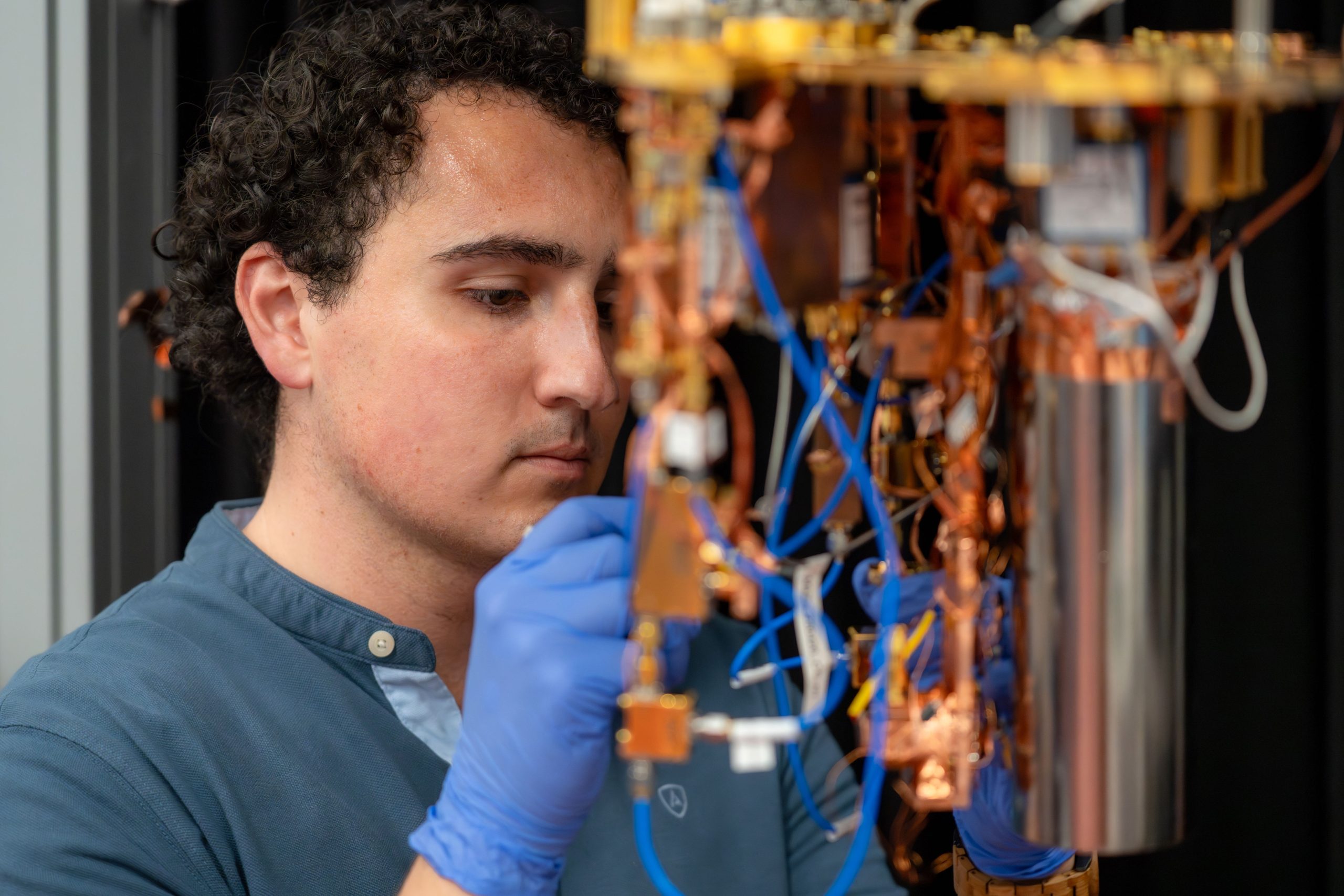
PhD student Alejandro Andrés-Juanes and Professor Johannes Fink at ISTA worked with international collaborators to create an environment that automatically brings distant qubits into sync. Their prototype directs correlated light particles from a shared source toward two separated qubits, providing the first experimental demonstration of a proposal introduced more than two decades ago.
Not all entanglement takes the same form. Continuous variable entangled states are relatively easy to generate because their properties can vary smoothly, much like the continuously changing position and momentum of a pendulum. Most practical quantum devices, however, rely on discrete variable systems, where the relevant states behave more like an all-or-nothing choice that stationary qubits can use.
The challenge was to convert the more readily produced continuous form into the discrete entanglement needed by the qubits.
“In this work, we aimed to overcome this mismatch between the readily available and the practically useful forms of entanglement,” says Andrés-Juanes. “By stabilizing the entangled states remotely, our approach is fully autonomous and requires no active control or measurement.”
Entanglement outlasts the qubits themselves
Keeping qubits coherent and entangled for long enough to perform useful calculations remains one of the central obstacles in quantum computing.
“In our method, the quantum bath—meaning the qubits’ environment—is the source of entanglement. It creates a new ground state through a continuous stream of correlated photons,” says Fink. “This way, the entangled qubit state is stabilized, even beyond the qubits’ own ‘lifetime’, and remains always available as a resource for further quantum processing. This makes the approach conceptually significant.”
Because the bath continually maintains the shared state, researchers can access the entanglement when needed. Conventional short-lived entanglement must instead be used during the brief period when it exists.
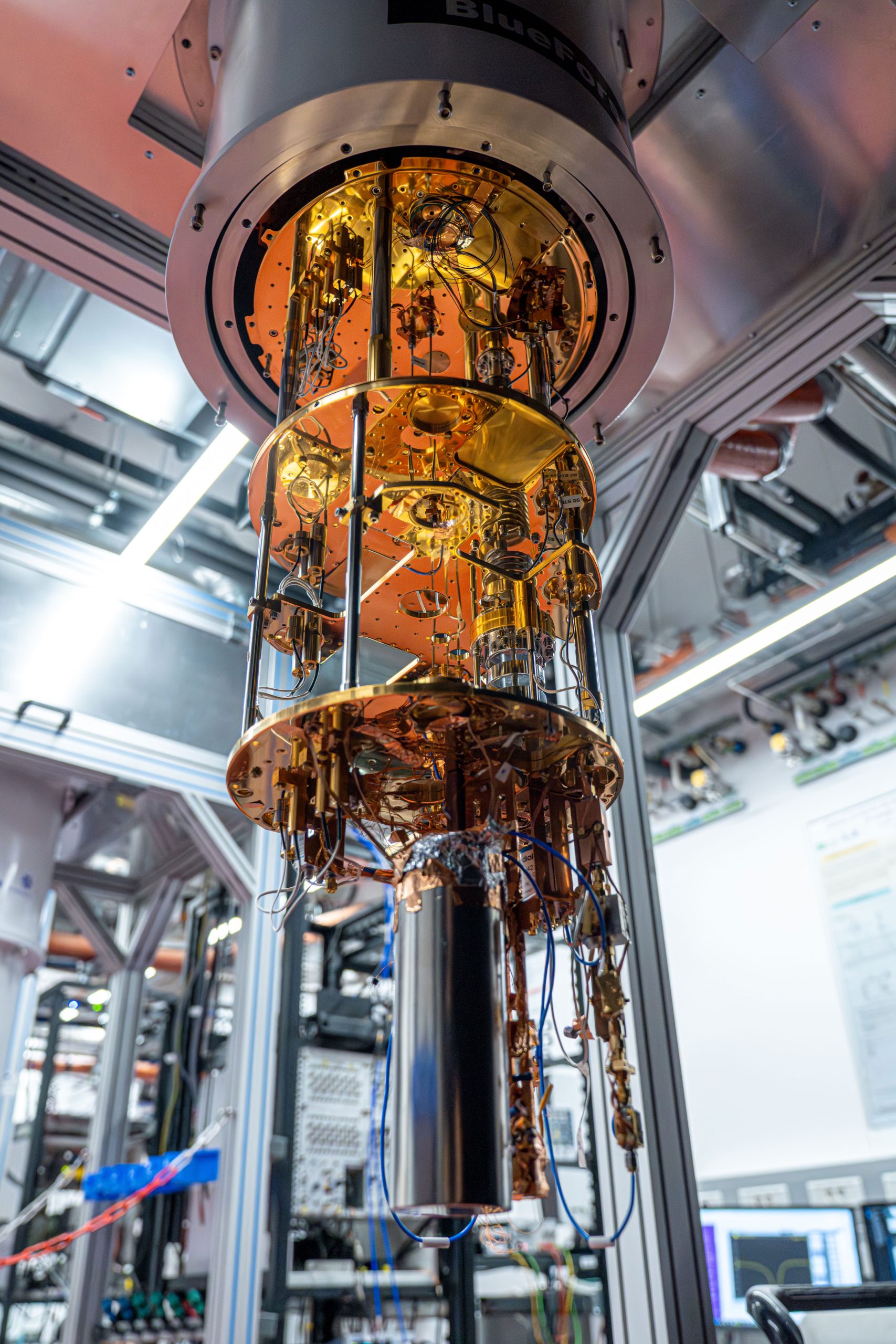
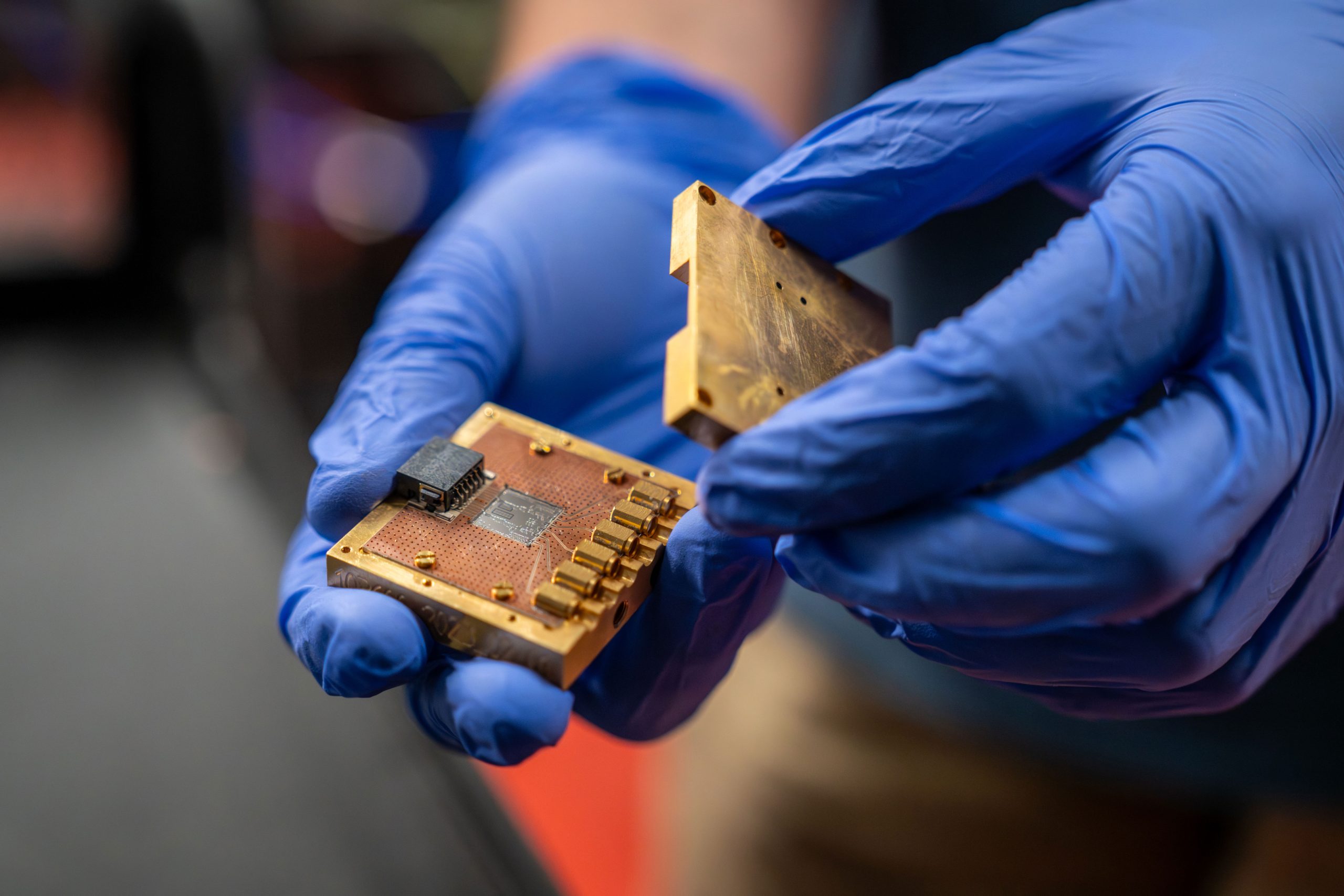
The researchers linked the qubits to the entangled light source with microwave photons. These low-energy particles are especially useful for controlling quantum information and already underpin leading superconducting qubit systems.
Optical photons are more commonly used in atomic physics and optics. They may also make it possible to carry quantum information between separated computers through fiber optic cables, another area under investigation by Fink’s group at ISTA.
Tests confirm a promising but limited prototype
The researchers verified that the two qubits had become entangled by using quantum tomography, a method that reconstructs a quantum system from many separate measurements.
“Qubits can be in a superposition of states, but all these states collapse when we measure them, leaving us with a 0 or 1 state,” says Andrés-Juanes.
To uncover the underlying quantum state before that information was lost, the researchers collected measurements lasting only 20–80 nanoseconds. One nanosecond is one billionth of a second.
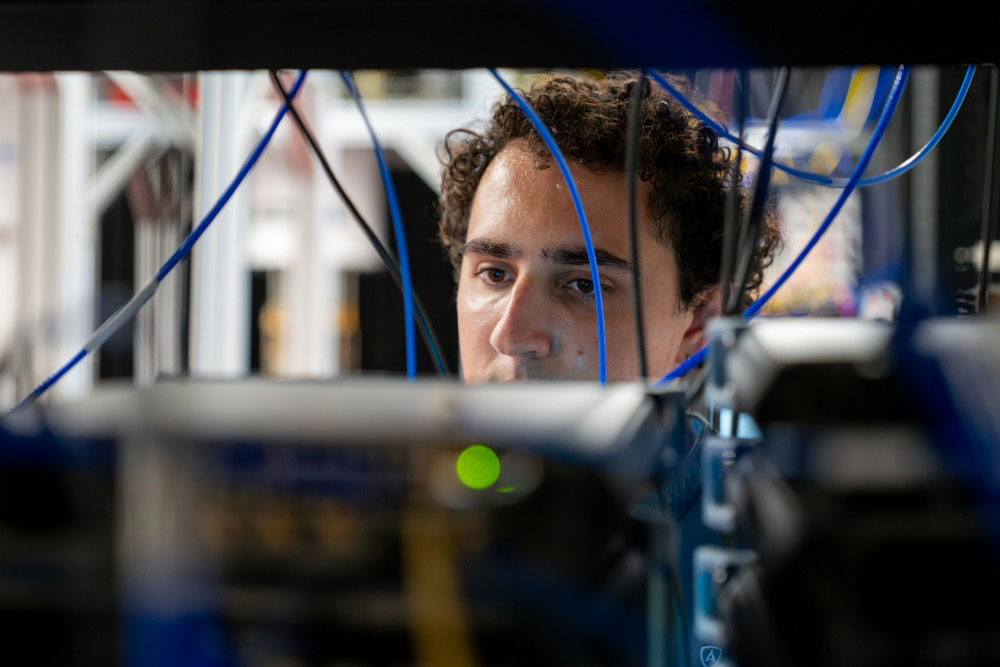
The result is a proof of concept showing that a shared quantum bath can entangle two otherwise isolated qubits. “We present a relatively simple method that could be scaled up to synchronize multiple distant qubits,” says Andrés-Juanes.
The autonomous process is not yet as efficient as approaches that actively control qubit states. “Our method currently transfers about 10% of the bath’s available entanglement.”
The original prediction assumed ideal conditions that are difficult to reproduce experimentally, which may help explain why confirmation took more than 20 years. “Our experiments helped us reveal several factors that may have prevented scientists from designing a functional quantum bath using a single source of correlated photons for distributed entanglement,” says Fink.
The ISTA prototype may support new quantum optics experiments and future efforts to expand quantum processors toward fault-tolerant operation.
Reference: “Distributing Stationary Qubit Entanglement through a Nonlocal Squeezed Reservoir” by A. Andrés-Juanes, J. Agustí, R. Sett, E. S. Redchenko, L. N. Kapoor, S. Hawaldar, P. Rabl and J. M. Fink, 13 July 2026, Physical Review X.
DOI: 10.1103/r4jt-j39w
This work was funded in part by the Austrian Science Fund (FWF) through the excellence cluster quantA 10.55776/COE1 and the SFB BeyondC 10.55776/F71, as well as the European Union – NextGenerationEU, and ISTA. Further funding sources include the Horizon Europe Program HORIZON-CL4-2022-QUANTUM-01-SGA via Project No. 101113946 OpenSuperQPlus100, the European Research Council no. 101089099 (ERC CoG cQEO), and the QUANTERA project MOLAR with reference PCI2024-153449, funded by MICIU/AEI/10.13039/501100011033 and the European Union. This research is part of the Munich Quantum Valley, which is supported by the Bavarian state government with funds from the Hightech Agenda Bayern Plus.
Never miss a breakthrough: Join the SciTechDaily newsletter.
Follow us on Google and Google News.
3 Comments
The challenge was to convert the more readily produced continuous form into the discrete entanglement needed by the qubits.
VERY GOOD.
Please ask researchers to think deeply:
From continuous to discrete, do its need topological transitions?
The physical phenomena directly observed in scientific experiments are always superficial and not the essence of things. The “history of the solution” to the ultraviolet catastrophe profoundly reveals a fork in the road for the evolution of theoretical physics: should we “pile patches upon patches” within the old paradigm, or bravely dig deeper and replace the “physical substrate” of the theory? Those recent works attempting to patch the Rayleigh-Jeans formula or its quantum extensions with more sophisticated mathematical techniques, even if they achieve phenomenological success, remain lingering on the wrong path.
—— Excerpted from https://zhuanlan.zhihu.com/p/2062808500313626237.
Quantum entanglement is facing the same challenge.
This experiment actually provides a brilliant real-world answer to Schrödinger’s cat paradox.
For decades, the standard interpretation implied that a closed system exists in a mathematical “ghost state” (superposition) until a human opens the box to collapse the wave function. But what this ISTA experiment proves is that systems don’t wait for an observer—they interact continuously with their surrounding background medium.
By showing that qubits entangle and stabilize completely autonomously simply by sharing a ambient wave-stream (“quantum bath”), it demonstrates that:
Reality is Continuous: Systems settle into concrete physical states on their own through environmental field interactions, not because a human looked at them.
No “Observer Magic”: The “cat in the box” was never simultaneously alive and dead. It was simply finding mechanical equilibrium with its environment along a natural path of least resistance.
My degree is in the social sciences. So, bear with me. From my non-physics trained mind a question pops up about what you call “entanglement.” Could this not be one particle that is in two places at one time. I have discussed this with others in my field, and all suggest that this question should at least be addressed.