
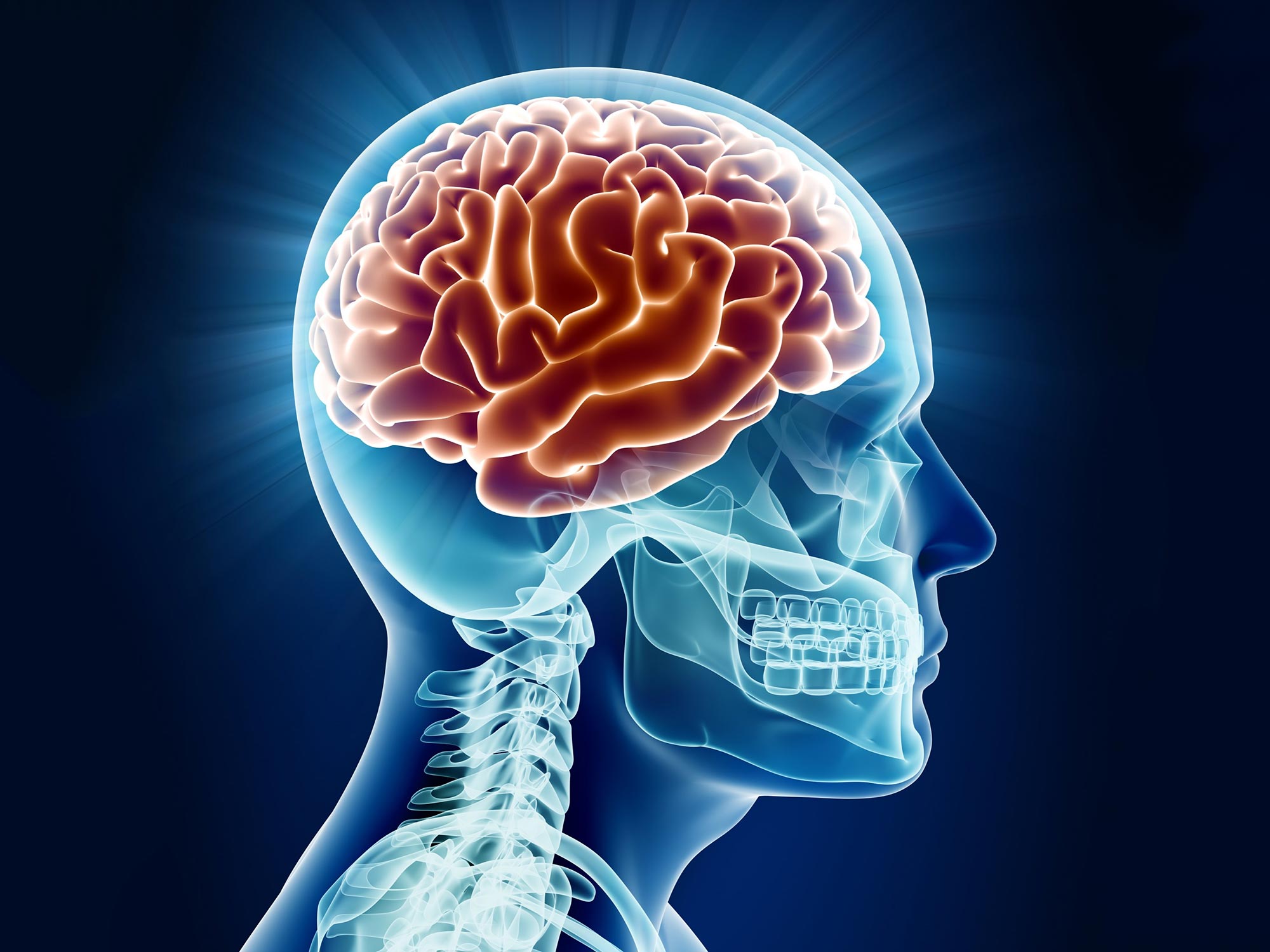
A single-cell study reveals major changes in immune cells, genome organization, and gene regulation within the aging human hippocampus, offering important insights into brain aging and dementias associated with age.
Between roughly ages 50 and 75, the cellular landscape of the human hippocampus begins to shift. Immune cells change, the genome’s physical organization weakens, and patterns of gene regulation are reshaped across multiple cell types.
These widespread changes begin in midlife and may help explain why advancing age is the strongest risk factor for neurodegenerative conditions such as Alzheimer’s disease.
To trace this process, researchers analyzed individual cells from human hippocampal tissue collected across the adult lifespan. The hippocampus is a brain region essential for learning and memory. Using advanced single-cell methods, they mapped both gene regulation and three-dimensional genome architecture, producing one of the most detailed accounts yet of how these features change as the human brain ages.

Midlife brings a major immune shift
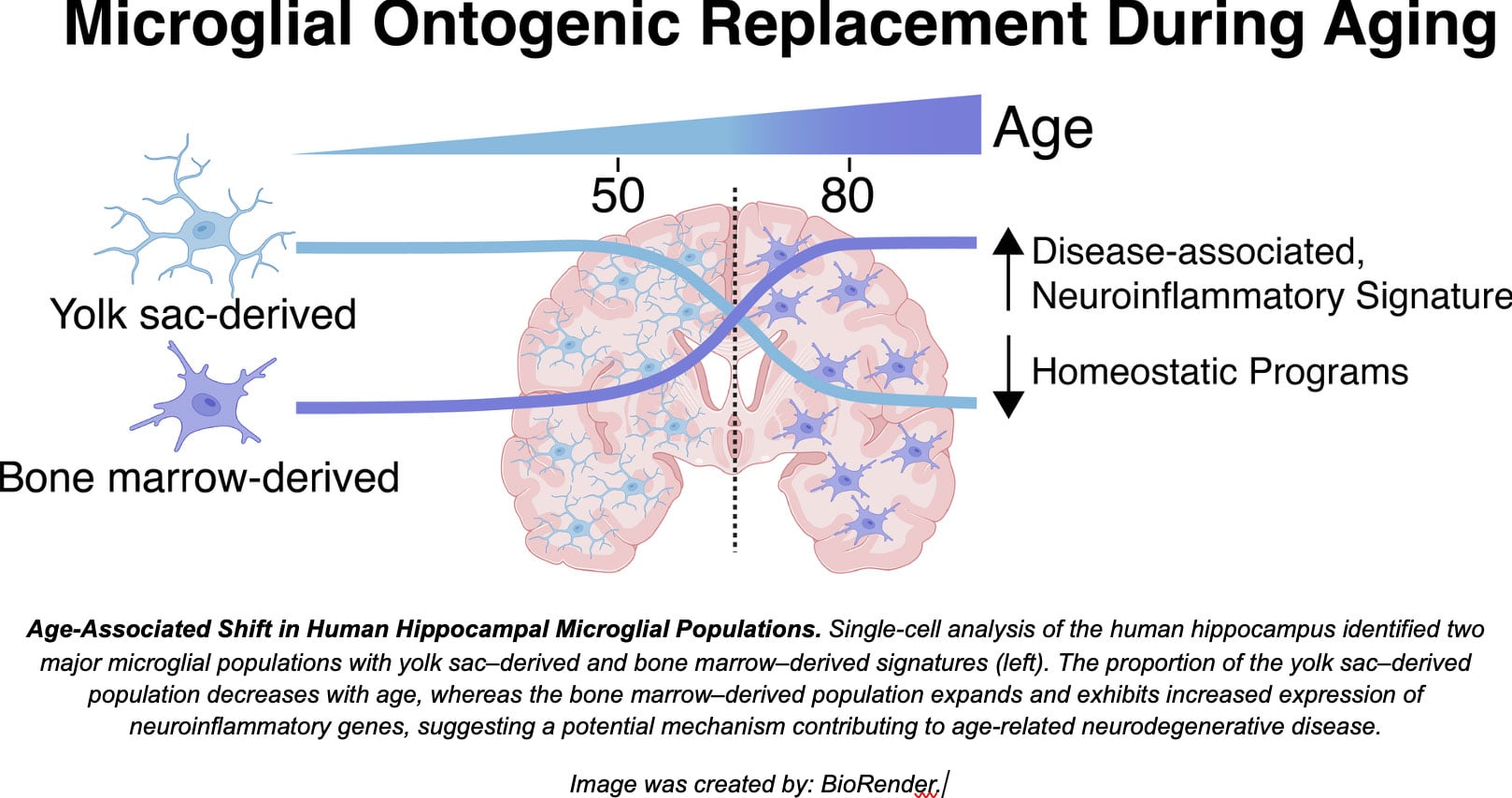
The clearest transition appeared in microglia, the immune cells that help maintain and protect the brain. Between approximately ages 50 and 75, microglia formed during embryonic development declined sharply. In their place, researchers detected cells whose molecular profiles resembled immune cells circulating in the blood.
This turnover challenges the long-held assumption that microglia established before birth remain in the brain throughout a person’s life. The replacement microglia-like cells also carried stronger inflammatory signatures, raising the possibility that they contribute to the persistent neuroinflammation associated with brain aging.
The analysis revealed another important loss. Cell populations involved in maintaining the blood-brain barrier declined substantially. This protective boundary helps prevent harmful substances in the bloodstream from entering brain tissue.
“Microglia are critical for maintaining brain homeostasis,” said Bing Ren, PhD, a corresponding author of the study, Scientific Director and CEO of the New York Genome Center, Professor of Genetics and Development, Biochemistry and Molecular Biophysics, and Systems Biology at Columbia University, and Associate Director in the Vagelos Institute for Basic Biomedical Science (Vagelos Institute) in VP&S, Columbia University, “When these cells fail to perform their housekeeping duties, toxic materials accumulate that can trigger inflammatory processes that may contribute to neurodegenerative diseases.”
Genome organization weakens with age
The changes extended beyond immune and vascular cells. Across several types of brain cells, researchers found that the genome’s three-dimensional structure became progressively less organized.
DNA is not stored inside the nucleus as a loose strand. It folds into a carefully arranged structure that helps determine which genes a cell can use. The widespread erosion of that architecture suggests that declining genome organization may be a basic feature of brain aging.
“This work represents a major step forward in understanding how aging reshapes the human genome in brain cells,” said Nathan Zemke, Director of Single-cell Genomics at the Center for Epigenomics at UC San Diego. “These findings demonstrate a critical need for studying gene regulation and genome organization to gain a mechanistic understanding of the aging process.”
The results indicate that brain aging involves more than a slow accumulation of damage. Instead, immune, vascular, and neuronal systems appear to undergo coordinated changes as people grow older.
“Importantly, this study reveals that aging is not simply a gradual decline, but involves coordinated and dynamic remodeling of immune, vascular, and neuronal systems. These findings open the door to identifying new therapeutic targets aimed at preserving circuit integrity and brain function across the lifespan,” said Xiangmin Xu, PhD, Chancellor’s Professor and Director of the Center for Neural Circuit Mapping at the University of California, Irvine, and a co-corresponding author of the study.
A broader map of genome change
The research is one of six studies published in Science through the National Institutes of Health’s 4D Nucleome (4DN) Common Fund program. The decade-long initiative was created to map how the genome’s architecture changes across both space and time.
From 2015 to 2025, the program united interdisciplinary research groups from across the United States to examine how the spatial arrangement of the genome shapes biological activity. Ren also served as a co-corresponding author or co-author on three other Science papers that investigated genome architecture across different cell types and timescales.
Together, the studies establish a broad resource for researchers investigating how failures in genome organization relate to development, aging, and disease, including neurodegenerative disease.
Reference: “Epigenetic and 3D genome reprogramming during the aging of the human hippocampus” by Nathan R. Zemke, Seoyeon Lee, Sainath Mamde, Bing Yang, Nicole Berchtold, B. Maximiliano Garduño, Hannah S. Indralingam, Weronika M. Bartosik, Pik Ki Lau, Keyi Dong, Emily Hsu, Amanda Yang, Yasmine Tani, Chumo Chen, Qiurui Zeng, Varun Ajith, Liqi Tong, Chanrung Seng, Daofeng Li, Ting Wang, Jingtian Zhou, Joseph R. Ecker, Christopher K. Glass, Carl W. Cotman, Xiangmin Xu and Bing Ren, 23 July 2026, Science.
DOI: 10.1126/science.adt8307
Never miss a breakthrough: Join the SciTechDaily newsletter.
Follow us on Google and Google News.
2 Comments
A quick scan of the article and the abstract of the reference article for “diet,” “allergy” and “MSG” failed to find even one of them. So, how can a study that completely ignores common factors of chronic low-grade inflammation and gradual brain damage even be worth the pixels it’s displayed on? Mainstream medicine and government funding methods are still so “dark-ages.”
Interesting