
P2RX7 may be linked to severe suicidal thoughts and recovery, but researchers still need to confirm the pattern in living people.
Severe suicidal thoughts may leave a detectable biological signal in the brain, and that signal could also change when people recover. Researchers at the Netherlands Institute for Neuroscience have identified a receptor that may be linked to these shifts, providing a possible new direction for studying resilience and suicide prevention.
In the Netherlands, nearly five people die by suicide each day, and there may be about twenty suicide attempts for every death. Despite the enormous consequences for individuals and families, scientists still understand relatively little about the biological processes associated with suicidal thoughts. Effective medications specifically targeting suicidal thoughts are also urgently needed.
“We have found indications that the human brain not only changes during severe suicidal thoughts, but may also have mechanisms that help some people recover from them,” Zhang says. “We want to understand what happens when someone feels suicidal,” she adds. “But it may be even more important to understand what helps someone to be resilient to these thoughts.”
Zhang began by examining tissue from brain donors in the Netherlands Brain Bank. Her initial comparison separated people with mood disorders from those without them, but that approach did not reveal an obvious biological distinction in the brain region being studied.
“In the beginning we just had two groups: those with mood disorders, and those without,” Zhang begins. “But we did not find a clear difference in the area we studied.”
A biological signal emerged beyond depression
A clearer pattern appeared after Zhang reorganized the donors according to how they had died. Tissue from people who died by suicide or euthanasia differed from tissue from those who died of natural causes, and the distinction appeared regardless of whether the donor had been diagnosed with a mood disorder.
“This suggests that the biological processes linked to severe suicidal thoughts may be partly separate from those linked to depression,” Zhang explains.
P2RX7 levels were higher in nerve cells
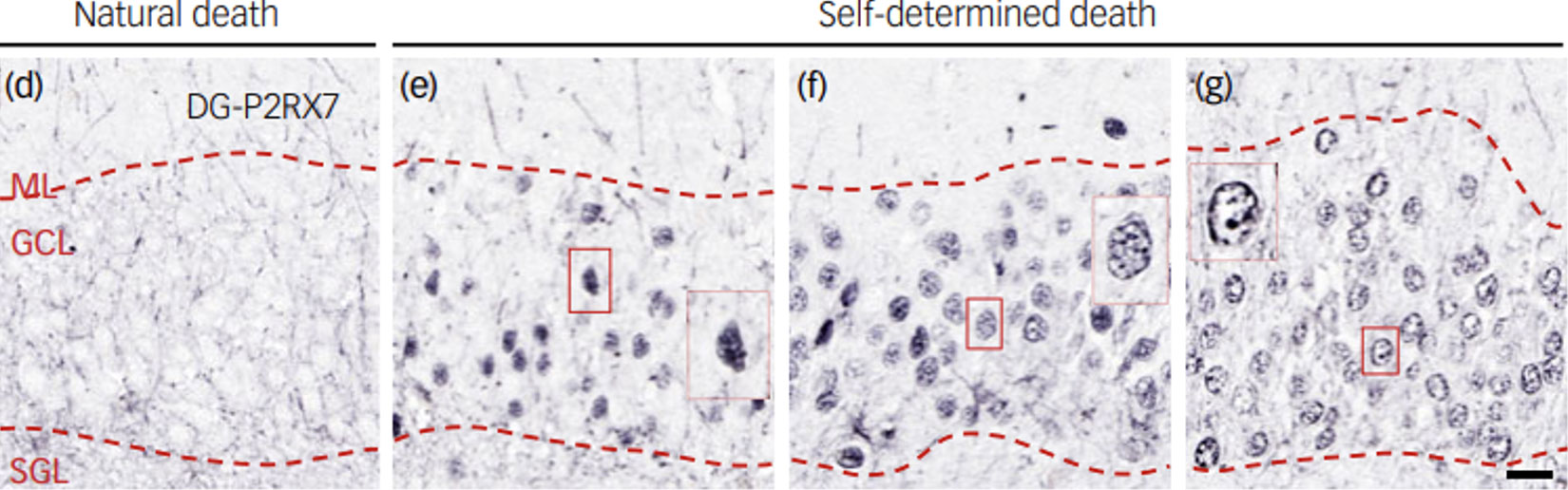
The investigation then focused on a receptor called P2RX7, which plays a role in how cells respond to stress, inflammation, and energy metabolism. Zhang illustrates the difference using four figures. One image, from a donor who died naturally, contains almost no markings. Three others are scattered with dark blue dots. “These donors died by suicide or euthanasia.”
Those dots indicate the presence of P2RX7. Donors who died by suicide or euthanasia had significantly higher levels of the receptor in their nerve cells, raising the possibility that neurons expressing more P2RX7 behave differently during periods of severe suicidal thoughts. The researchers do not yet know precisely what the difference represents.
Recovery may leave a different signature
The apparently quiet image from the natural death group turned out to contain another important clue. Medical histories showed that some of these donors had previously experienced suicidal thoughts or attempted suicide, despite not showing the same elevated P2RX7 pattern at death.
“Some of these donors had experienced suicidal thoughts or had attempted suicide earlier in their lives as well,” she says.
That finding raises the possibility that P2RX7 levels are not permanently elevated after someone experiences suicidal thoughts.
“These donors experienced suicidal thoughts at some point, so it is possible that their P2RX7 levels were once higher,” Zhang explains. “But because they recovered, those levels may have fallen again. Unfortunately, we cannot yet confirm this using brain tissue collected at only one point in time.”
If P2RX7 rises and falls alongside the intensity of suicidal thoughts, tracking it over time could eventually provide researchers with a biological window into those changes.
“If we can follow a biological marker like this over time, it may help us better understand how suicidal thoughts change as well,” Zhang says. “That could eventually be valuable in clinical practice.”
Living brains will provide the next test
The critical next step is to determine whether the same pattern can be detected in people who are alive and currently experiencing suicidal thoughts. Researchers at Amsterdam UMC plan to use positron emission tomography, commonly known as PET imaging, to measure brain signals associated with P2RX7.
For now, the research remains preliminary. Scientists do not yet know whether P2RX7 can reliably indicate either the presence or severity of suicidal thoughts.
“I hope it could eventually become a useful biomarker,” Zhang says. “But first, we need to find out whether we can observe the same pattern in living people.”
The work also has a personal dimension for Zhang, who receives messages from people who have experienced suicidal thoughts themselves. Her response emphasizes the possibility of recovery.
“Your brain loves you more than you imagine. Every cell in your body is trying to fight against your suicidal ideation. Even when it does not feel that way, recovery remains possible.”
Reference: “N-terminal epitope of P2X purinoceptor 7 in the human hippocampal dentate gyrus differs in suicide and resilience for suicide” by Lin Zhang, J. Alexander Heimel and Dick F. Swaab, 23 July 2026, The British Journal of Psychiatry.
DOI: 10.1192/bjp.2026.10717
This research was supported by funding from Stichting Aan Boord by de Stichting Vrienden van het Herseninstituut, awarded to D.F.S. and L.Z.
Never miss a breakthrough: Join the SciTechDaily newsletter.
Follow us on Google and Google News.