
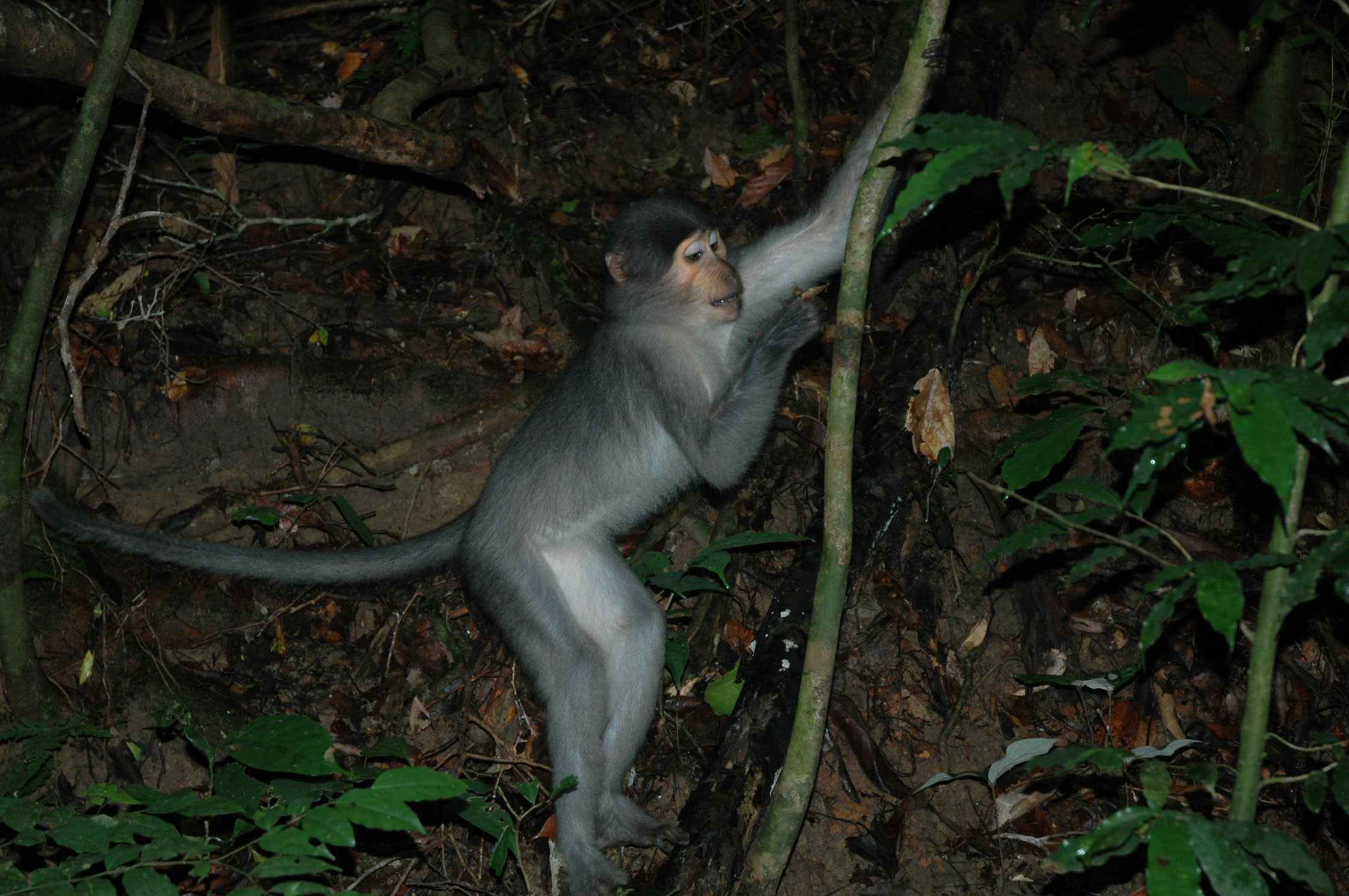
A study shows that monkeys use their feet to climb trees as skillfully as chimpanzees.
The way a primate climbs a tree can offer clues about how our own ancestors once moved. New research suggests that whatever scientists eventually determine about the last common ancestor of humans and chimpanzees, that ancestor was almost certainly capable of climbing trees.
Humans and chimpanzees began following separate evolutionary paths roughly 6 to 7 million years ago after diverging from their shared last common ancestor (LCA). Reconstructing how the LCA lived partly depends on understanding its relationship with trees, including whether it routinely moved along high horizontal branches, climbed trunks from the ground, or, more likely, did both.
Chimpanzees are accomplished vertical climbers because their ankles can flex considerably. Monkeys, by contrast, have often been thought to move through trees primarily with help from their arms. That distinction matters when researchers try to determine whether the LCA was adapted for climbing trunks or spending most of its time in the canopy.
Monkey feet can match ape climbing
Evidence recorded in West Africa now suggests foot anatomy may not create such a clear divide. Researchers from The Ohio State University filmed wild sooty mangabey monkeys and measured their movements, finding that although their feet lack the highly flexible ankles of chimpanzees, their midfoot bones can flex enough to support vertical climbing on narrow trunks when the animals hide, search for food, or sleep.
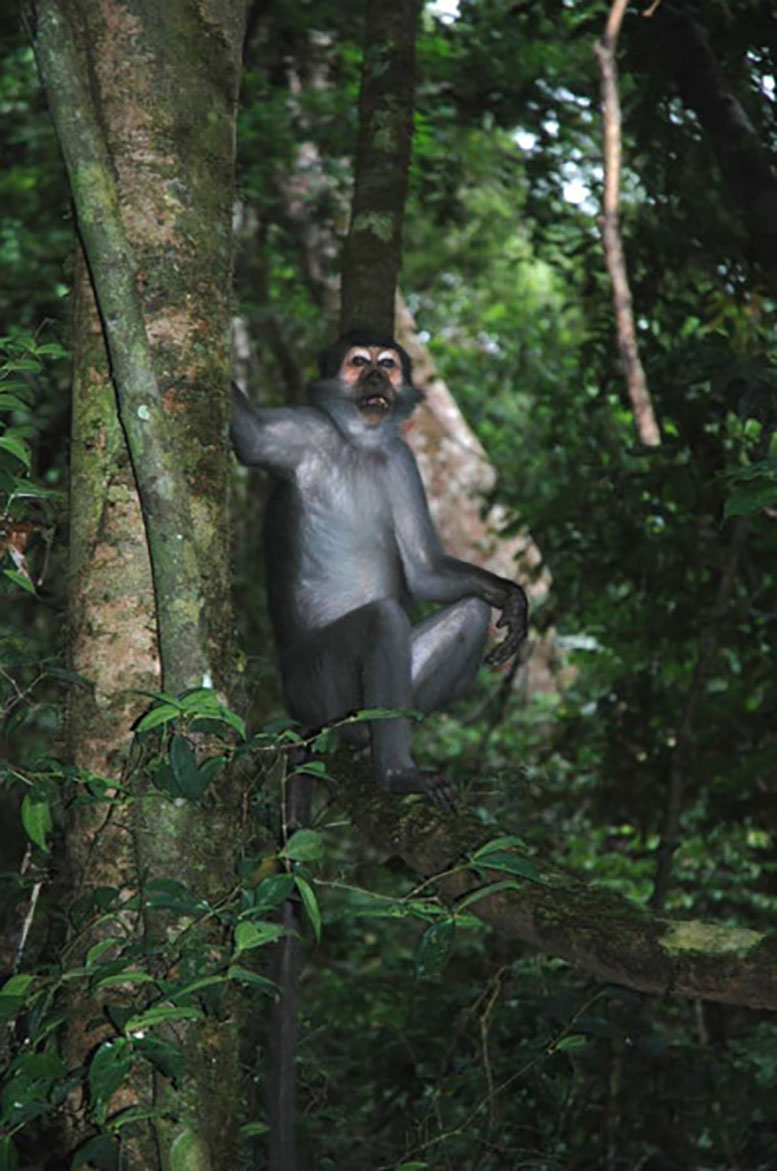
“People are making behavioral inferences from fossils, and some say a monkey can’t vertically climb as well as an ape can,” said first study author Luke Fannin, assistant professor of anthropology at Ohio State. “We’re saying there’s a functional equivalence here. So you can’t rule out vertical climbing just because something doesn’t have a chimpanzee-like foot.”
The findings were published in Proceedings of the National Academy of Sciences.
Determining what the last common ancestor looked like and how it moved could help explain the emergence of bipedalism, the habitual use of two-legged walking that distinguishes humans. Humans are apes, but the study shows that even an ancestor with a foot shaped more like a monkey’s might still have climbed as effectively as an ape.

“Part of paleoanthropology is understanding how our evolution happened, and it’s often through the hallmark of how we move because modern humans move quite differently than our cousins, the chimpanzees, do, and they’re the living primate we’re most closely related to,” Fannin said. “And we’re trying to understand why that is.”
Fannin captured the mangabeys on video at the Taï Forest Monkey Project field station in Ivory Coast, which is co-directed by W. Scott McGraw, professor and chair of anthropology at Ohio State and senior author of the study.
“The great thing about having the video is that it allows us to capture exactly what the monkey is doing in a high-resolution manner. So we can actually say how the joint is loaded. Before, we had hunches, but in this way, it’s far more precise,” McGraw said.
During a vertical climb, a chimpanzee ankle can flex upward to about 45 degrees, while most human ankles can manage roughly 20 degrees. Fannin’s measurements showed that the mangabey midfoot could flex by 46 degrees while climbing vertically.
Foot shape may not reveal ancestry
That result complicates competing ideas about how the LCA moved through forests and what kind of foot anatomy it required. Some hypotheses favor a more chimpanzee-like foot, while others point toward a more monkey-like structure.
“What’s neat about this paper is it adds clarity, but it also makes the broader picture more fuzzy,” McGraw said. “Because this notion that you have to have a foot like an advanced ape to vertically climb, which is a difficult task, is not true. You’ve got a bunch of monkeys that aren’t extinct – and which can be filmed – that are very competent at performing a biomechanically challenging behavior right now in a forest in West Africa.
“The videos that Luke made in Taï are particularly important because they provide some of the first kinematic documentation of a locomotor behavior in a monkey that has largely been unrecognized or underappreciated.”
Vertical climbing extends beyond apes
Some modern hunter-gatherers and human foragers are also skilled vertical climbers. Their ability is thought to depend more on flexibility in muscles, tendons, and ligaments than on the structure of their foot bones.
Fannin and McGraw note that although modern humans are strongly associated with walking on two feet, climbing remains part of human behavior. That continued connection with trees, or arboreality, reflects a legacy that influenced both primate anatomy and movement.
“Arboreality is fundamental to understanding primates – including ourselves – because it has shaped our body to a large degree: hands and feet, wrists and ankles, nails instead of claws, etc.,” McGraw said.
Added Fannin, “Regardless of where you’re starting from, which we don’t know yet, vertical climbing is universal and the anatomy is going to perform that behavior. So I think that to get at the question of a monkey-like or ape-like last common ancestor, we need more fossils.”
Reference: “A kinematic convergence in ape and monkey vertical climbing informs debates on early hominin arborealism” by Luke D. Fannin, Carmen Pape and W. Scott McGraw, 17 August 2026, Proceedings of the National Academy of Sciences.
DOI: 10.1073/pnas.2608183123
This work was supported by Dartmouth College, the Explorer’s Club, the U.S. National Science Foundation, the Emory National Primate Research Center, the Primate Society of Great Britain and a Schmidt Sciences Postdoctoral Fellowship.
Never miss a breakthrough: Join the SciTechDaily newsletter.
Follow us on Google and Google News.