
Close Menu
    Facebook X (Twitter) Instagram
    SciTechDaily
    • Biology
    • Chemistry
    • Earth
    • Health
    • Physics
    • Science
    • Space
    • Technology
    Facebook X (Twitter) Pinterest YouTube RSS
    SciTechDaily
    Home»Science»Baboons With Stable Relationships Are Nicer and Live Longer
    Science

    Baboons With Stable Relationships Are Nicer and Live Longer

    By SciTechDailyOctober 3, 2012No Comments2 Mins Read
    Facebook Twitter Pinterest Telegram LinkedIn WhatsApp Email Reddit
    Share
    Facebook Twitter LinkedIn Pinterest Telegram Email Reddit
    female-baboons-grooming
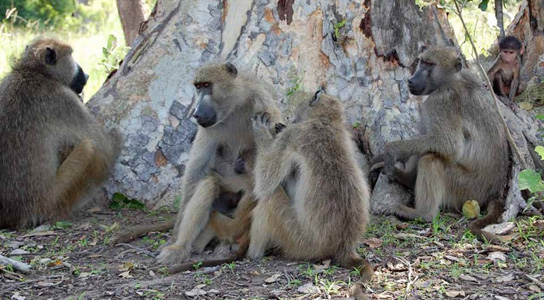
    Female baboons grooming each other

    In humans, people with strong social ties live longer, and have healthier lives, whereas hostile tendencies can lead to an early death. In animals, this seems to be the case as well. Strong social networks contribute to longer lives and healthier offspring. Personality might also be a factor in other primates’ longevity.

    The scientists published their findings in the journal Proceedings of the National Academy of Sciences. Baboons that had the most stable relationships with other females weren’t always highest up in the dominance hierarchy, but they were the nicest.
    baboons-grooming

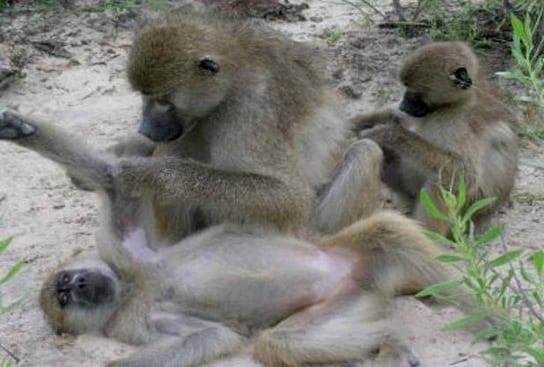
    Personality isn’t an easy factor to study scientifically in primates since it isn’t clear how human traits apply to animals. The wild baboons were studied at the Moremi Game Reserve in Botswana for almost 20 years. This study therefore also provides detailed, long-term observation of the behavior of several generations of baboons, as well as biological and genetic data.

    It was previously shown that females lived longer, had lower stress hormone levels, and had more surviving offspring when they had close, long-lasting relationships with other females. Dominance rank is significant for males, with alpha-males living longer than some lower-ranking males, but this wasn’t true for females.

    The researchers characterized the baboon behavior as nice, aloof, or loner from well-known character traits. They also tested the baboons for levels of glucocorticoid stress hormones.

    Females who scored high on the nice meter were friendly to all females. They were the most often approached by other females and were the most sociable in general. Aloof females, though less sociable than their nice counterparts, still maintained stable relationships. Loner animals were less stable and had higher stress hormone levels than the other two groups.

    Reference: “Variation in personality and fitness in wild female baboons” by Robert M. Seyfarth, Joan B. Silk and Dorothy L. Cheney, 1 October 2012, Proceedings of the National Academy of Sciences.
    DOI: 10.1073/pnas.1210780109

    Never miss a breakthrough: Join the SciTechDaily newsletter.
    Follow us on Google and Google News.

    Behavioral Science Primates Primatology Survival
    Share. Facebook Twitter Pinterest LinkedIn Email Reddit

    Related Articles

    Kissing Likely Began 20 Million Years Ago With Ape Ancestors and Neanderthals

    The Myth of Universal Male Dominance in Primates Challenged by New Study

    If It Pays To Be a Jerk, Why Isn’t Everyone That Way? Unraveling the Evolutionary Puzzle

    First Lethal Attacks by Chimpanzees on Gorillas Observed in the Wild

    Primates Change Their “Accent” in Shared Territory to Avoid Conflict

    Survey Shows Great Apes Also Have Mid-Life Crisis

    Helium Reveals Gibbons’ Developed & Far Ranging Vocalizations

    Bonobo Great Apes Are Domesticating Themselves

    The Less Birds Know, The Better

    Leave A Reply Cancel Reply

    • Facebook
    • Twitter
    • Pinterest
    • YouTube

    Don't Miss a Discovery

    Subscribe for the Latest in Science & Tech!

    Trending News

    New Study Reveals Why Ozempic Works Better for Some People Than Others

    Climate Change Is Altering a Key Greenhouse Gas in a Way Scientists Didn’t Expect

    New Study Suggests Gravitational Waves May Have Created Dark Matter

    Scientists Discover Why the Brain Gets Stuck in Schizophrenia

    Scientists Engineer “Tumor-Eating” Bacteria That Devour Cancer From Within

    Even “Failed” Diets May Deliver Long-Term Health Gains, Study Finds

    NIH Scientists Discover Powerful New Opioid That Relieves Pain Without Dangerous Side Effects

    Collapsing Plasma May Hold the Key to Cosmic Magnetism

    Follow SciTechDaily
    • Facebook
    • Twitter
    • YouTube
    • Pinterest
    • Newsletter
    • RSS
    SciTech News
    • Biology News
    • Chemistry News
    • Earth News
    • Health News
    • Physics News
    • Science News
    • Space News
    • Technology News
    Recent Posts
    • Household Cats Could Hold the Secret to Fighting Breast Cancer
    • Scientists Say This Natural Hormone Reverses Obesity by Targeting the Brain
    • This 15,000-Year-Old Discovery Changes What We Know About Early Human Creativity
    • 35-Million-Year-Old Mystery: Strange Arachnid Discovered Preserved in Amber
    • Revolutionary Gas Turbine Generates Power Without Air Compression
    Copyright © 1998 - 2026 SciTechDaily. All Rights Reserved.
    • Science News
    • About
    • Contact
    • Editorial Board
    • Privacy Policy
    • Terms of Use

    Type above and press Enter to search. Press Esc to cancel.