
Close Menu
    Facebook X (Twitter) Instagram
    SciTechDaily
    • Biology
    • Chemistry
    • Earth
    • Health
    • Physics
    • Science
    • Space
    • Technology
    Facebook X (Twitter) Pinterest YouTube RSS
    SciTechDaily
    Home»Space»Asteroid Dust Could Shield Earth From Harmful Solar Radiation
    Space

    Asteroid Dust Could Shield Earth From Harmful Solar Radiation

    By SciTechDailyOctober 3, 20123 Comments3 Mins Read
    Facebook Twitter Pinterest Telegram LinkedIn WhatsApp Email Reddit
    Share
    Facebook Twitter LinkedIn Pinterest Telegram Email Reddit
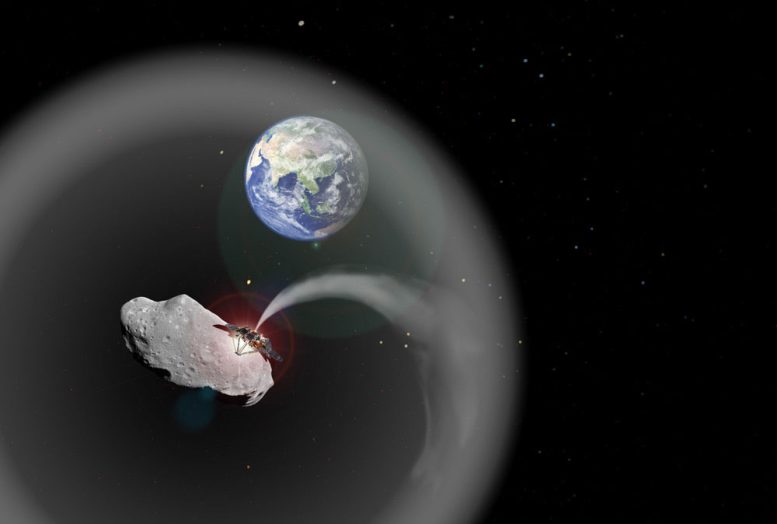
    dust cloud made of asteroid material could help to cool Earth
    Scientists propose a dust cloud made of asteroid material could help to cool Earth. Here is an artist’s depiction of what a spacecraft spewing asteroid dust might look like. Credit: Charlotte Lücking, based on images from ESA and NASA

    Scottish scientists have proposed to use a giant space-based dust cloud, blasted off an asteroid, to shade the Earth from the sun. Deliberately manipulating the Earth’s climate with large-scale engineering projects is called geoengineering and these proposals are always controversial because of the risk that they entail.

    The scientists will publish their findings in the journal Advances for Space Research on November 12. Instead of altering the climate by targeting the oceans or the atmosphere, these types of geoengineering projects would affect the entire Earth from space.
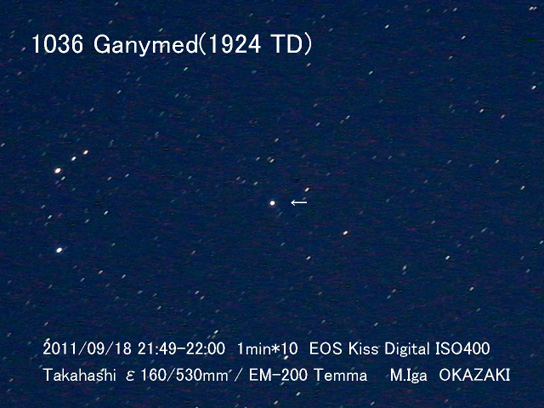
    ganymed-1036-asteroid
    1036 Ganymed asteroid.

    A cloud of dust could be obtained by gravitationally anchoring an asteroid to block sunlight and cool the Earth. The dust cloud wouldn’t be a permanent solution, but it could offset the effects of climate change for some time and allow slower-acting measures like carbon capture to take effect.

    The asteroid would be placed at Lagrange point L1, where the gravitational pull of the Sun and Earth are canceled out. L1 is 1.5 million kilometers (930,000 miles) away from Earth. The asteroid could be fitted with a “mass driver,” which could hurl asteroid-derived matter away from the rock. It could also serve as a rocket to push the asteroid to the L1 point.

    The nearest large near-Earth asteroid is 1036 Ganymed, and this asteroid could maintain a dust cloud large enough to block out 6.58% of solar radiation that would normally reach Earth. This would be more than enough to combat any current global warming trends. The cloud would be about 5 quadrillion kilograms (11 quadrillion pounds) in mass and about 2,600 km (2,600 mi) in width. Ganymed has a mass of 130 quadrillion kilograms (250 quadrillion pounds).

    The challenging part of this proposal would be how to push an asteroid of this size into L1. However, smaller asteroids could be moved and clustered together at L1 instead.

    Like many geoengineering schemes, there’s no way of fully testing this dust cloud’s effectiveness before implementing it.

    Reference: “Gravitationally bound geoengineering dust shade at the inner Lagrange point” by R. Bewick, J. P. Sanchez and C. R. McInnes, 14 July 2012, Advances for Space Research.
    DOI: 10.1016/j.asr.2012.07.008

    Never miss a breakthrough: Join the SciTechDaily newsletter.
    Follow us on Google and Google News.

    Asteroid Astrophysics Dust Cloud Geoengineering Global Warming Popular
    Share. Facebook Twitter Pinterest LinkedIn Email Reddit

    Related Articles

    Mysterious Voyagers: Are We Drinking Water Delivered by Dark Comets?

    Webb Telescope Captures Massive Asteroid Collision in Neighboring Star System

    From the Abyss of Space: Webb Observes 3 Dwarf Planets in the Kuiper Belt

    Blocking the Sun: A Solar “Umbrella” Tethered to Asteroid To Help Mitigate Climate Change

    Cracking the ’Oumuamua Code: Alien Spaceship or Natural Phenomenon?

    Astronomers Identify Unknown Class of Water-Rich Asteroids

    A New Explanation for the Mystery of Jupiter’s Asymmetrical Asteroid Swarms

    Ancient Asteroid Provides Insight Into the Evolution of Our Solar System

    Groundbreaking Findings: New Analysis Unveils True Nature of Ancient Asteroid

    3 Comments

    1. N. Coppedge on October 6, 2012 12:17 pm

      Of course, we know that the rays that do reach the earth could still cause harmful effects like gradual evolutionary morphization. In light of that comment, it doesn’t seem like “dust” is very protective at all.

      Who would say we don’t react to light? For example.

      Reply
      • kwoolf on April 17, 2013 2:09 pm

        “gradual evolutionary morphization” What is that supposed to mean? Morphization is not even a word.

        Reply
        • pizzaman on April 10, 2014 4:37 pm

          This apparently is an example of the continued evolution of language,in this case English,to allow the conveyance of meaning by synthesizing a word which,by its structure,can be deciphered as to its meaning by using familiarity with the components which comprise it.To wit:the base morph,indicating “to change”,and the ending “zation”,indicating a process.Admittedly,it may not be accepted usage,but like slang,manages to be meaningful.

          Reply
    Leave A Reply Cancel Reply

    • Facebook
    • Twitter
    • Pinterest
    • YouTube

    Don't Miss a Discovery

    Subscribe for the Latest in Science & Tech!

    Trending News

    Millions Take These IBS Drugs, But a New Study Finds Serious Risks

    Scientists Unlock Hidden Secrets of 2,300-Year-Old Mummies Using Cutting-Edge CT Scanner

    Bread Might Be Making You Gain Weight Even Without Eating More Calories

    Scientists Discover Massive Magma Reservoir Beneath Tuscany

    Europe’s Most Active Volcano Just Got Stranger – Here’s Why Scientists Are Rethinking It

    Alzheimer’s Symptoms May Start Outside the Brain, Study Finds

    Millions Take This Popular Supplement – Scientists Discover a Concerning Link to Heart Failure

    The Universe Is Expanding Too Fast and Scientists Can’t Explain Why

    Follow SciTechDaily
    • Facebook
    • Twitter
    • YouTube
    • Pinterest
    • Newsletter
    • RSS
    SciTech News
    • Biology News
    • Chemistry News
    • Earth News
    • Health News
    • Physics News
    • Science News
    • Space News
    • Technology News
    Recent Posts
    • Simple Blood Test May Predict Alzheimer’s Years Before Brain Scans Show Signs
    • Scientists Say Adding This Unusual Seafood to Your Diet Could Reverse Signs of Aging
    • U.S. Waste Holds $5.7 Billion Worth of Crop Nutrients
    • Scientists Say a Hidden Structure May Exist Inside Earth’s Core
    • Doctors Surprised by the Power of a Simple Drug Against Colon Cancer
    Copyright © 1998 - 2026 SciTechDaily. All Rights Reserved.
    • Science News
    • About
    • Contact
    • Editorial Board
    • Privacy Policy
    • Terms of Use

    Type above and press Enter to search. Press Esc to cancel.