
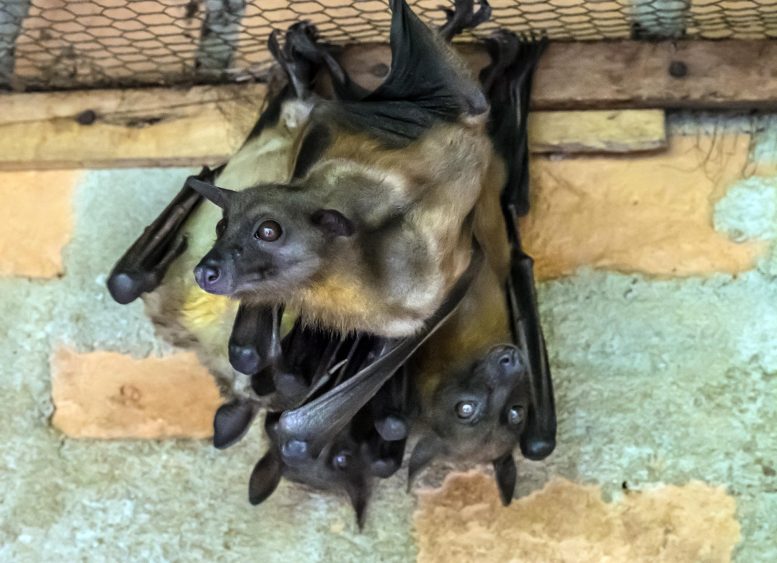
It starts with a gradual buildup of trust, study finds.
We humans can explain how our relationships with college roommates and co-workers have formed over the years, but scientists haven’t had a good grip on how friendly connections among strangers are made between animals — until now.
A new study of vampire bats living in captivity with strangers supports the “raising-the-stakes” model of the development of cooperative relationships, which suggests that trust builds over time through the gradual acceleration of smaller mutual investments in each other’s well-being.
Researchers studied vampire bats in captivity over 15 months that were brought together from two geographically separate roosts. They considered a cooperative relationship to be formed when the previously unfamiliar bats shared food with each other, and found that any relationships that reached that point began with increases in grooming, a lower-cost behavior.
After researchers created thousands of opportunities for the animals to interact over the course of the study, almost 15 percent of the possible food-sharing relationships between previously unfamiliar female adult bats materialized.
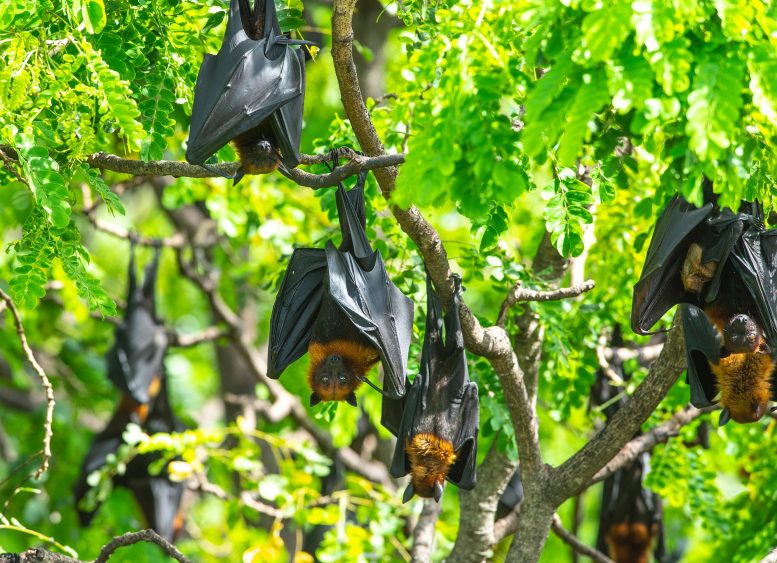
That might seem like a small percentage, but that the relationships formed at all shows that even unfamiliar adult bats can gradually develop strong bonds, said Gerald Carter, lead author of the study and assistant professor of evolution, ecology and organismal biology at The Ohio State University. When they do develop, they follow a pattern that looks like a series of conditional and increasing investments.
And though previous research has shown that people don’t like to think of their friendships as strategic, Carter said this finding suggests that human relationships might be more conditional than we want to admit.
“I don’t think you can understand human relationships that well by just asking people to reflect on them,” Carter said. “It may often be subconscious, but I think both human and nonhuman relationships have a lot of little conflicts that are negotiated and navigated in a subtle way.”
The study is published today (March 19, 2020) in the journal Current Biology.
Efforts to test the raising-the-stakes idea to date have focused on the duration of stretches of grooming behavior among familiar primates — which tells scientists nothing about what happened when they first met.
Carter and his colleagues at the Smithsonian Tropical Research Institute (STRI) collected vampire bats, a very social species, from two roosts hundreds of miles apart in Panama. After initially setting up introductions of strangers in isolated groups of two or four for several months, the researchers put all 39 adult and juvenile bats together in a single roost for a year.
Over all of that time, the researchers measured different kinds of behavior, including grooming and food sharing. Vampire bats commonly regurgitate their blood meals to feed roostmates that have been unsuccessful at getting their own meal of live animal blood. The scientists repeatedly fasted the unfamiliar bats after introducing them to each other to test whether bats would make the food-sharing sacrifice for an individual they don’t know — a big, costly investment.
After the bats spent 15 months together, the researchers found that a lot of grooming connections were made between strangers, but relatively few food-sharing relationships formed — however, seeing one bat feed an unfamiliar bat and then receive food from that same bat in return happened much more frequently than would be expected by chance, Carter said.
Several of the scientists’ predictions were on target: Grooming preceded food sharing among strangers, the frequency of grooming ramped up before food sharing and then leveled off, and relationships between strangers were more likely to form when familiar bats weren’t around.
“We predicted that when we introduced them as isolated pairs, like in a college dorm room, they would form relationships faster and more frequently, and that was true,” Carter said. “When we put the two large groups together, there’s this strong in-group and out-group bias that prevents relationships from forming within unfamiliar pairs.”
The raise-the-stakes model of relationships was published in 1998, and it was based on mathematical game theory: The idea is that because cooperation among strangers can be risky, individuals can avoid that risk by making incrementally increasing investments in each other with the expectation of reciprocity. If those conditions aren’t met, no relationship forms — and individuals haven’t threatened their own survival by spending too much time and energy on a connection that doesn’t work out.
“The theory hasn’t garnered much support over time, probably because we’re not testing for it in the right way,” Carter said. “I think it is generally true that this is how relationships build up.”
A good next step, he said, would be studying the transitions between behaviors that come at a higher cost.
“It could be that first you tolerate each other, then cluster together, then groom each other and then share food. Maybe then you do something even more risky, like defending each other from harm,” he said.
Reference: “Development of New Food-Sharing Relationships in Vampire Bats” by Gerald G. Carter, Damien R. Farine, Rachel J. Crisp, Julia K. Vrtilek, Simon P. Ripperger and Rachel A. Page, 19 March 2020, Current Biology.
DOI: 10.1016/j.cub.2020.01.055
This work was supported by a Smithsonian Postdoctoral Fellowship, a Humboldt Research Fellowship, a Smithsonian Institution Scholarly Studies Grant, and the National Geographic Society Committee for Research and Exploration.
Co-authors include Ohio State postdoctoral researcher Simon Ripperger (also affiliated with STRI and the Museum of National History in Berlin, Germany); Rachel Crisp, Julia Vrtilek and Rachel Page of STRI; and Damien Farine of the Max Planck Institute of Animal Behavior and the University of Konstanz in Germany.
Never miss a breakthrough: Join the SciTechDaily newsletter.
Follow us on Google and Google News.