
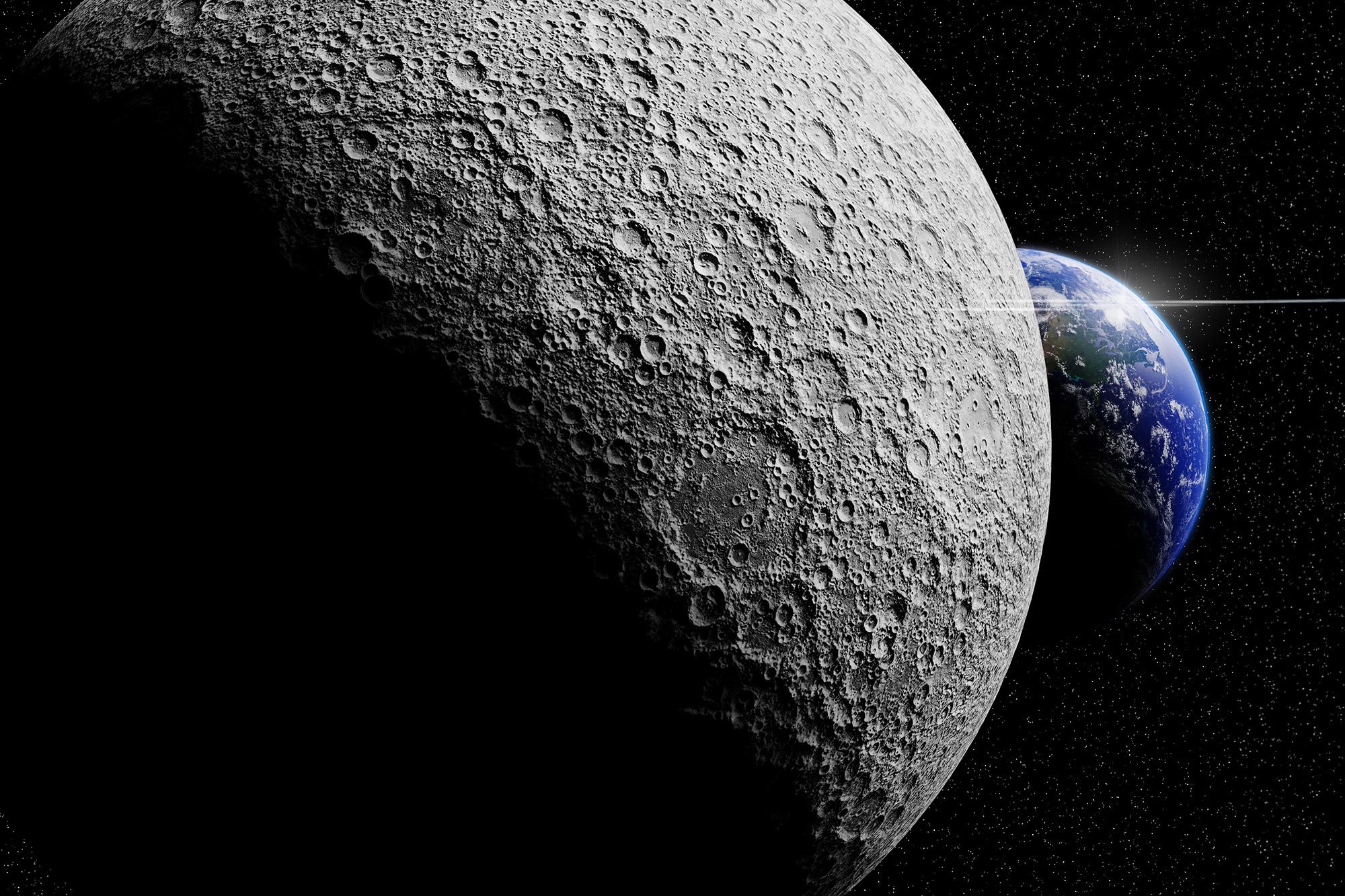
Chang’e-6 samples suggest the Moon’s two very different sides may have formed when uneven heating drove magma from one hemisphere to the other.
The Moon presents two dramatically different faces. Its Earth-facing hemisphere is rich in dark volcanic plains, while the farside is dominated by older highlands and a much thicker crust. New analyses of material returned by Chang’e-6 (CE6) suggest that this contrast may trace back to enormous flows within the Moon’s early magma ocean after it became tidally locked to Earth.
Led by Professor Hejiu Hui of Nanjing University, the research team carried out detailed geochemical analyses of anorthosites, Mg-suite rocks, and mare basalts collected from the lunar farside. They then compared those samples with material from the nearside returned by the Apollo and Chang’e-5 missions.
Their results point to lateral thermal convection within the lunar magma ocean (LMO) as a possible origin of the Moon’s nearside-farside dichotomy.
The contrast between the two hemispheres is evident in both landscape and composition. The nearside contains extensive mare basalts and elevated concentrations of potassium, rare earth elements, and phosphorus (KREEP). The farside, by comparison, consists mostly of ancient highlands terrain, has a thicker crust, and contains relatively few mare basalts.
Scientists have proposed several explanations for this divide, including asymmetric magma ocean convection, a giant impact, tidal dissipation, and uneven crustal growth. None has settled the debate.
Most evidence for nearside-farside differences has also come from the surface and crust. Whether the same asymmetry extends deeper into the lunar mantle has remained uncertain.
The mantle appears similar on both sides
Chang’e-6 changed what researchers could test directly. In 2024, the mission returned the first samples ever collected from the lunar farside, allowing material from the Moon’s two hemispheres to be compared in the laboratory.
CE6 basalts preserve signs of a depleted mantle source similar to those found in Apollo low-Ti basalts. That similarity indicates that mantle cumulates, the minerals that crystallized and accumulated as the lunar magma ocean cooled, do not show a major compositional difference between the nearside and farside.
Mg-suite rocks provided another line of evidence. These rocks form through crust-mantle interactions involving partial melting of mantle cumulates, making their magnesium number (Mg#) useful as an indicator of mantle composition.
The comparable Mg# values measured in CE6 and Apollo Mg-suite rocks support the same conclusion: mantle cumulates beneath the two hemispheres are compositionally similar.
Taken together, the samples indicate that mantle cumulates produced as the LMO crystallized do not preserve a significant nearside-farside compositional asymmetry.
The crust preserves a stronger divide
CE6 anorthosites reach higher peak Mg# values than Apollo anorthosites, indicating that the farside crust is more magnesium-rich. That result agrees with remote-sensing observations of the Moon.
The CE6 Mg-suite rocks also contain extremely low concentrations of rare earth elements and lower Th/Sm ratios than comparable Apollo samples.
Those differences point to two possibilities. Mg-suite magmatism on the farside may have developed independently of KREEP, or the KREEP-rich layer itself may have been distributed unevenly between the Moon’s hemispheres.
Tidal locking may have reshaped the crust
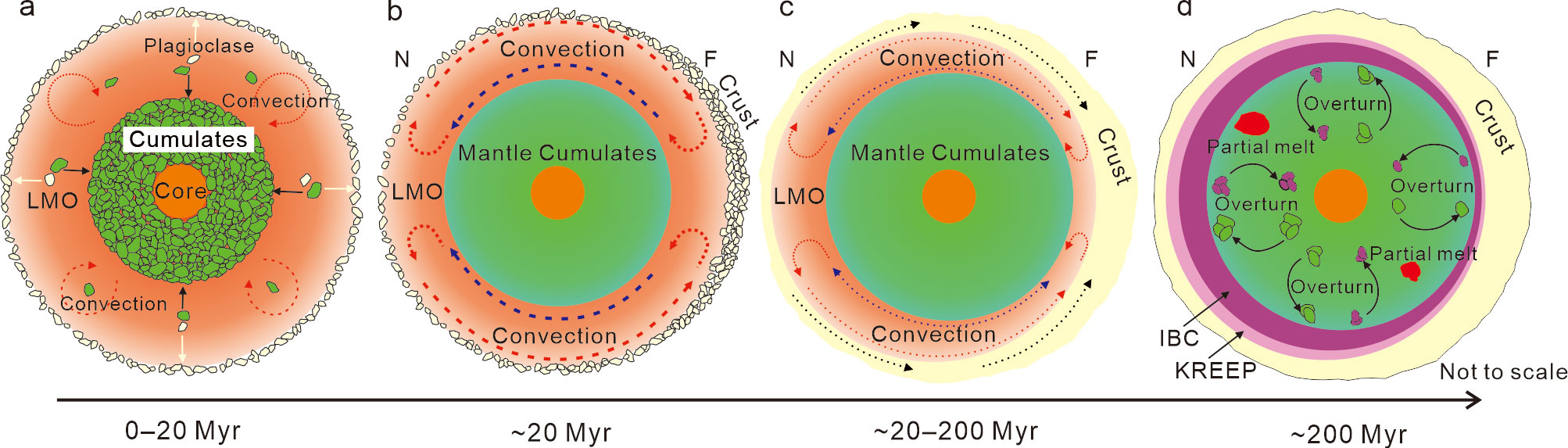
Using these mantle-to-crust comparisons, the researchers developed a model that could explain how the lunar dichotomy emerged.
Before the Moon became tidally locked, they propose, its early magma ocean cooled and solidified relatively symmetrically. This stage produced the first mantle cumulates and anorthositic crust.
The situation changed after tidal locking, when Earth and the Moon were much closer together. According to the model, tidal heating became stronger on the nearside than on the farside.
That imbalance created an inter-hemispheric temperature gradient powerful enough to drive large-scale lateral thermal convection. Hot magma moved from the nearside toward the farside, carrying early-formed, magnesium-enriched anorthosites with it.
Over time, that transport could have built the thicker, more magnesian crust now found on the farside.
At the same time, residual melts were pushed toward the nearside. The process would have left only thin KREEP and ilmenite-bearing cumulates (IBC) layers on the farside.
By linking a largely similar mantle with a strongly asymmetric crust, the lateral thermal convection model provides a self-consistent explanation for how the Moon’s two hemispheres may have evolved so differently during its earliest history.
Reference: “Lunar farside-nearside asymmetry formation during magma ocean solidification” by Yuantao Gu, Yue Zhang, Wenxin Ouyang, Hejiu Hui, Kai Zhao, Yongli Xue, Ziyan Han, Yuxin Chen, Zhuqi Yang, Yutao Lin, Yue Guan, Qiuli Li, Tao Yang, Gang Zeng, Huan Hu, Zongjun Yin, Suping Wu, Nan Zhang, Xiaolei Wang, Xiancai Lu and Rucheng Wang, 13 July 2026, National Science Review.
DOI: 10.1093/nsr/nwag424
This work was supported by the National Natural Science Foundation of China (42125303 and 42530210).
Never miss a breakthrough: Join the SciTechDaily newsletter.
Follow us on Google and Google News.