
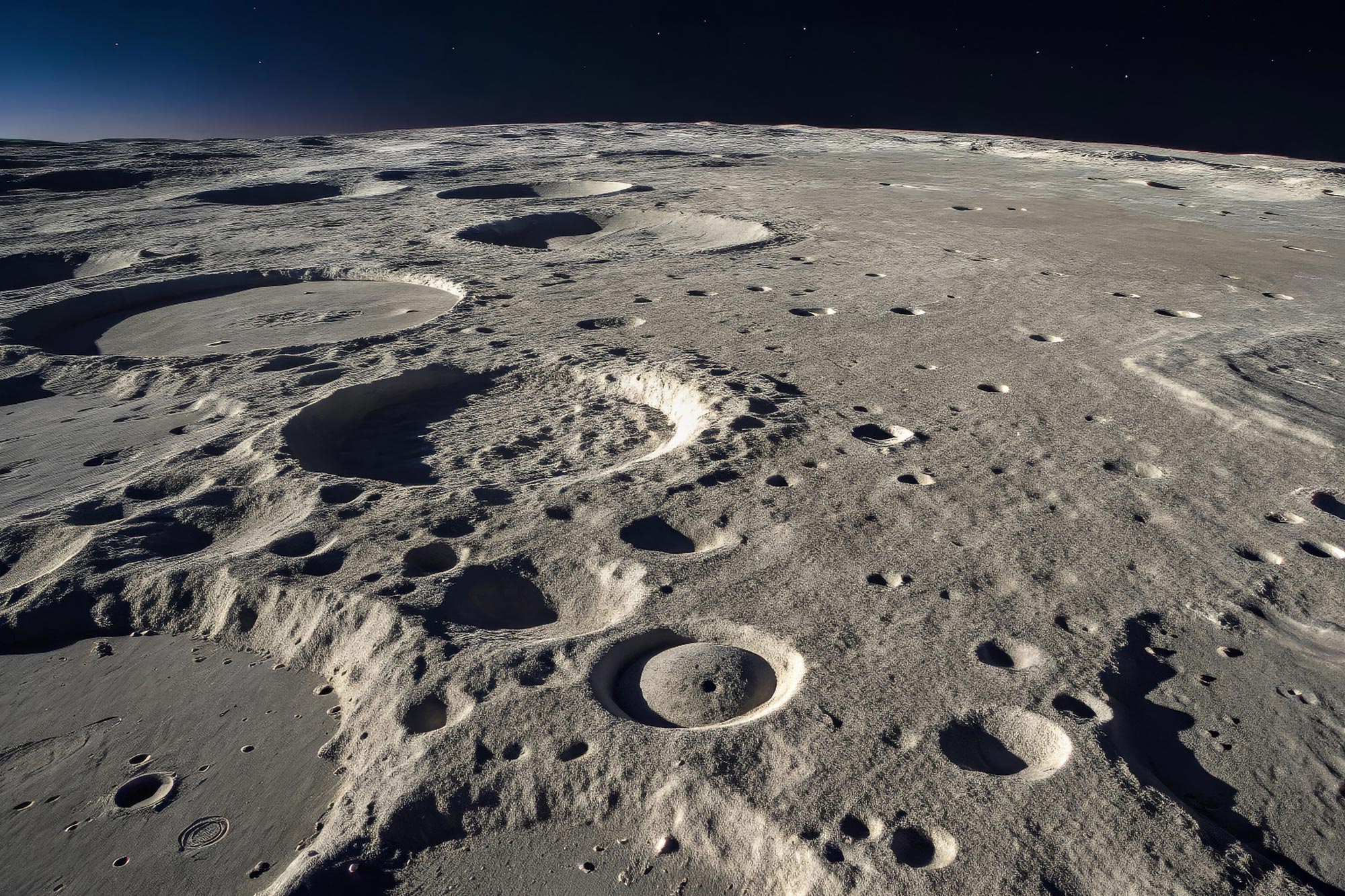
Unusual potassium isotope signatures in Chang’e-6 lunar samples point to extreme conditions created by the impact that formed the South Pole–Aitken Basin.
Since the Moon formed, asteroid impacts have been the main external force shaping its surface. These collisions carved out craters and massive basins while dramatically altering the Moon’s landscape and chemical makeup. Even so, scientists have remained uncertain about how deeply these large impacts affected the Moon’s interior.
To investigate, a research team led by Prof. Hengci Tian of the Institute of Geology and Geophysics at the Chinese Academy of Sciences (IGGCAS) analyzed lunar basalts returned by China’s Chang’e-6 (CE6) mission. The samples came from the South Pole–Aitken (SPA) Basin, one of the largest impact structures in the solar system. Researchers found that these rocks contain unusually heavy potassium (K) isotopes compared with all previously studied lunar basalts from the Apollo missions and lunar meteorites.
Potassium Isotopes as Tracers of Impact Processes
The scientists focused on potassium because it is a moderately volatile element that can easily vaporize at the extremely high temperatures generated during large impacts. When this happens, isotopic fractionation can occur, changing the relative abundance of different potassium isotopes.
Because of this behavior, potassium isotopes can preserve clues about the conditions present during an impact. Their composition can reveal information about temperature, pressure, and the materials involved in the collision. This record can also help scientists reconstruct the scale of the impact, its thermal history, and how it altered the Moon’s crust and mantle.
With this in mind, the team closely examined the potassium isotopic composition of the CE6 basalt samples.
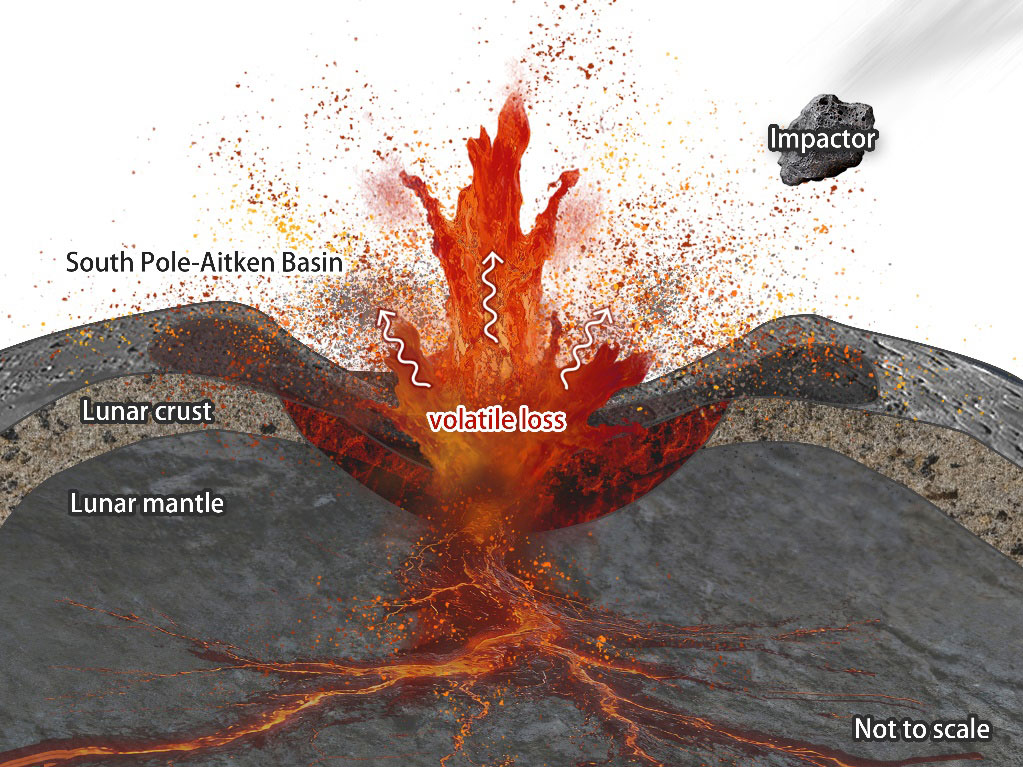
The study, published in the Proceedings of the National Academy of Sciences, links the unusual isotopic signature to the massive impact that created the SPA Basin.
Researchers measured potassium isotopes in four basalt clasts using sapphire collision cell multicollector inductively coupled plasma mass spectrometry (MC-ICP-MS). The CE6 samples consistently showed elevated δ41K values ranging from 0.001 ± 0.028‰ to 0.093 ± 0.014‰ (mean: 0.038 ± 0.044‰, 2SE). On average, this value is about 0.16‰ higher than that of Apollo lunar basalts (-0.13 ± 0.06‰, 2SE). Apollo samples are widely considered representative of the lunar mantle and the Bulk Silicate Moon.
Eliminating Alternative Explanations
To determine why the potassium isotopes were unusually heavy, the researchers evaluated three possible explanations: long-term cosmic ray irradiation, magmatic differentiation, and contamination from meteorites. Their results showed that these processes have only minor effects that fall within analytical uncertainty and cannot account for the observed enrichment of heavy potassium isotopes.
Further analysis indicates that the giant impact that formed the SPA Basin caused extensive loss of volatile elements, particularly through potassium evaporation. This depletion may have reduced magma production and volcanic activity on the Moon’s far side. Such a process could help explain the long-observed difference in volcanic activity between the near and far sides of the Moon.
Computer simulations also support this interpretation. The models show that the giant impact likely excavated deep crustal material and possibly even mantle material. At the same time, it generated enough heat to trigger convection within the lunar mantle.
Overall, the results suggest that the impact responsible for the South Pole–Aitken Basin significantly influenced the Moon’s deep interior. The findings also highlight how large impacts can play a key role in shaping the chemical evolution of planetary crusts and mantles.
Reference: “Isotopic evidence for volatile loss driven by South Pole-Aitken basin–forming impact” by Heng-Ci Tian, Chi Zhang, Wen-Jun Li, Dingshuai Xue, Jing Wang, Wei Yang, Yan-Hong Liu, Yangting Lin, Xian-Hua Li and Fu-Yuan Wu, 12 January 2026, Proceedings of the National Academy of Sciences.
DOI: 10.1073/pnas.2515408123
This research was supported by the National Natural Science Foundation of China, the CAS Youth Innovation Promotion Association, and other sources.
Never miss a breakthrough: Join the SciTechDaily newsletter.
Follow us on Google and Google News.