
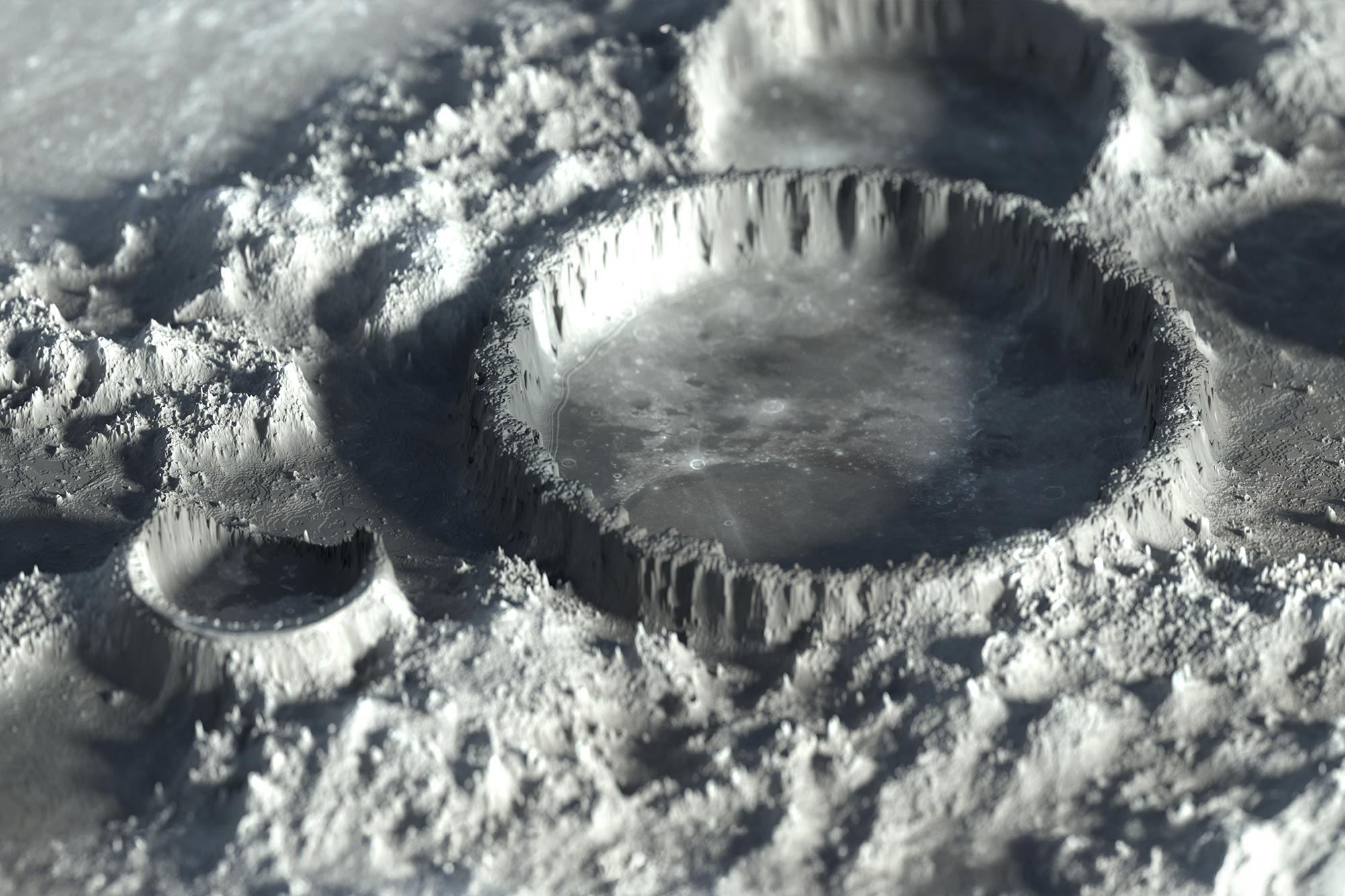
A study using Chang’e-5 mission data revealed how solar wind irradiation and micrometeorite impacts independently contribute to the formation of different-sized metallic iron nanoparticles on the Moon.
This differentiation in formation processes is crucial for interpreting the varying optical effects observed on the lunar surface.
Metallic Iron Nanoparticles on the Moon
In a study published in Nature Astronomy, Profs. Laiquan Shen, Haiyang Bai, et al. from Prof. Weihua Wang’s group at the Institute of Physics of the Chinese Academy of Sciences have clarified the respective effects of irradiation and impacts on the formation of metallic iron nanoparticles (npFe0).
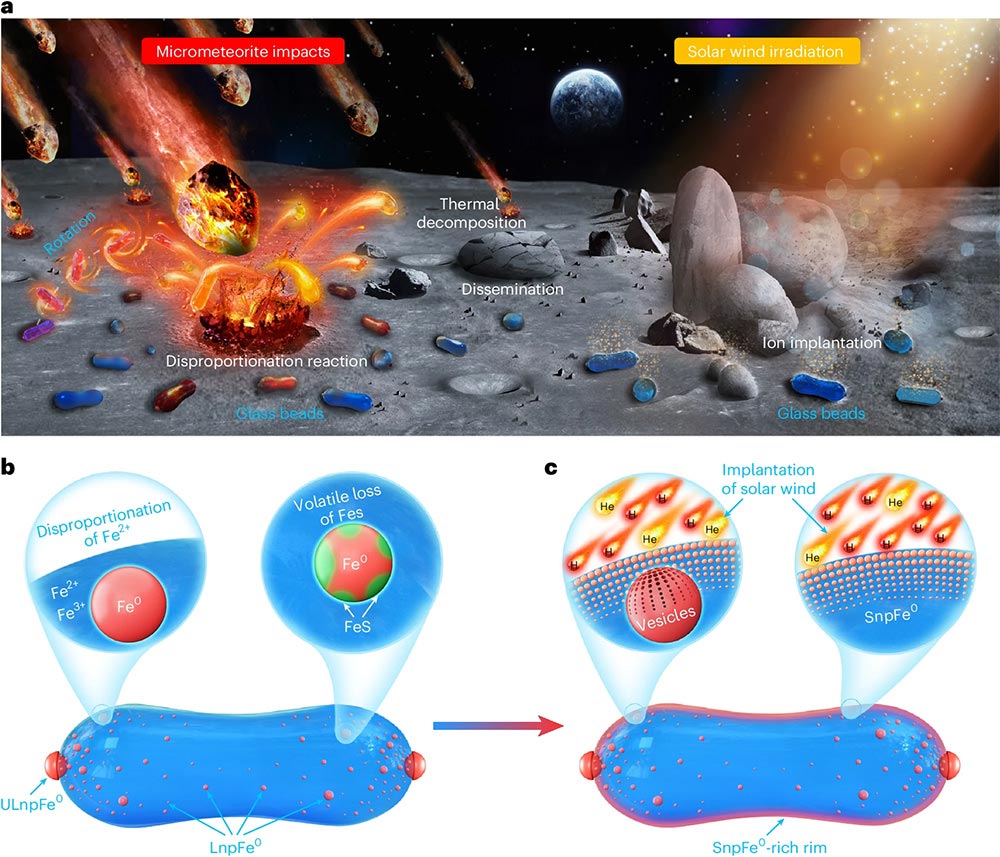
Based on precise observations of glass beads returned by the Chang’e-5 mission, they showed that the formation of small and large npFe0 with distinct optical effects is independently controlled by solar wind irradiation and micrometeorite impacts.
Impact of npFe0 on Lunar Surface Optical Properties
npFe0 are widely distributed on the Moon, and their accumulation changes the optical spectrum of the lunar surface over time. How the surface color changes depends largely on the size of the npFe0: Smaller npFe0 redden the reflectance spectra, while larger npFe0 cause darkening. The resultant color variations greatly complicate remote sensing studies, posing long-term puzzles to astronomers. Furthermore, the origin of npFe0 of different sizes was not well understood before this study.
npFe0 are known as products of space weathering, which includes the two main agents: micrometeorite impacts and solar wind irradiation. Yet the specific roles of these two agents in the formation of different-sized npFe0 have been unclear, hindering our understanding of color variations of the lunar surface or asteroids in complex space environments.
Distinguishing npFe0 Origins in Lunar Soil
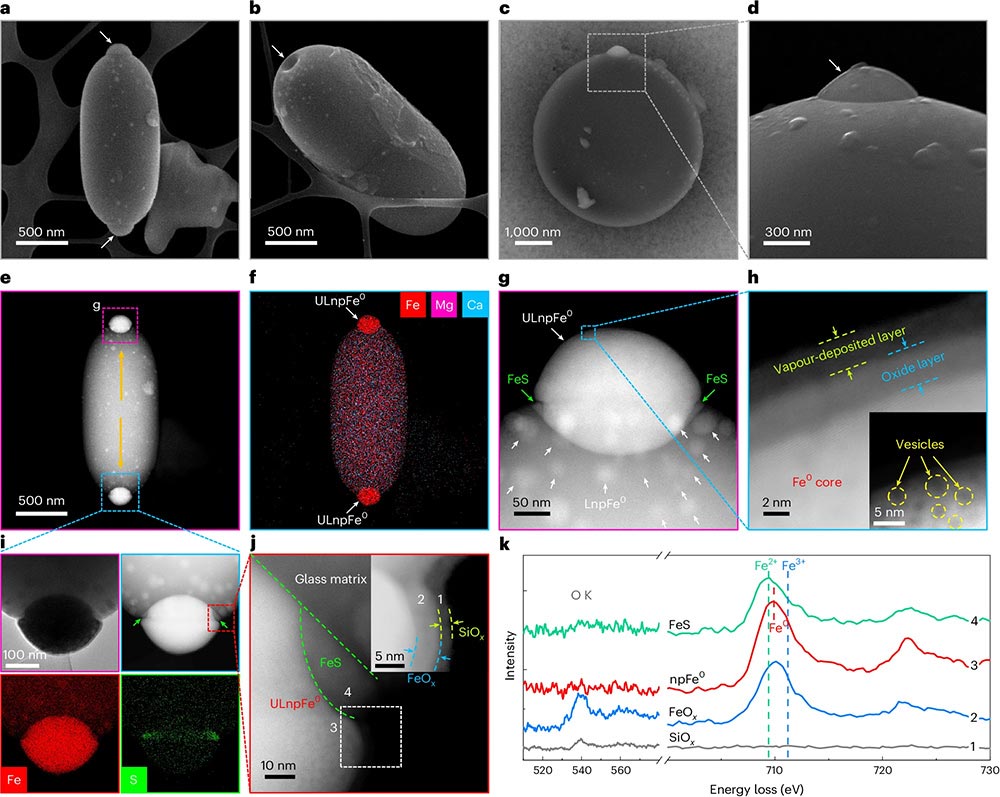
“We discovered that the glass beads in the Chang’e-5 lunar soil can preserve iron particles of different sizes, from about 1 nanometer to 1 micrometer,” said Prof. Bai. “It is generally difficult to distinguish npFe0 of different origins observed together in single samples. Here we used the rotation feature of the impact glass beads to clearly distinguish npFe0 formed before and after the solidification of the host glass beads.”
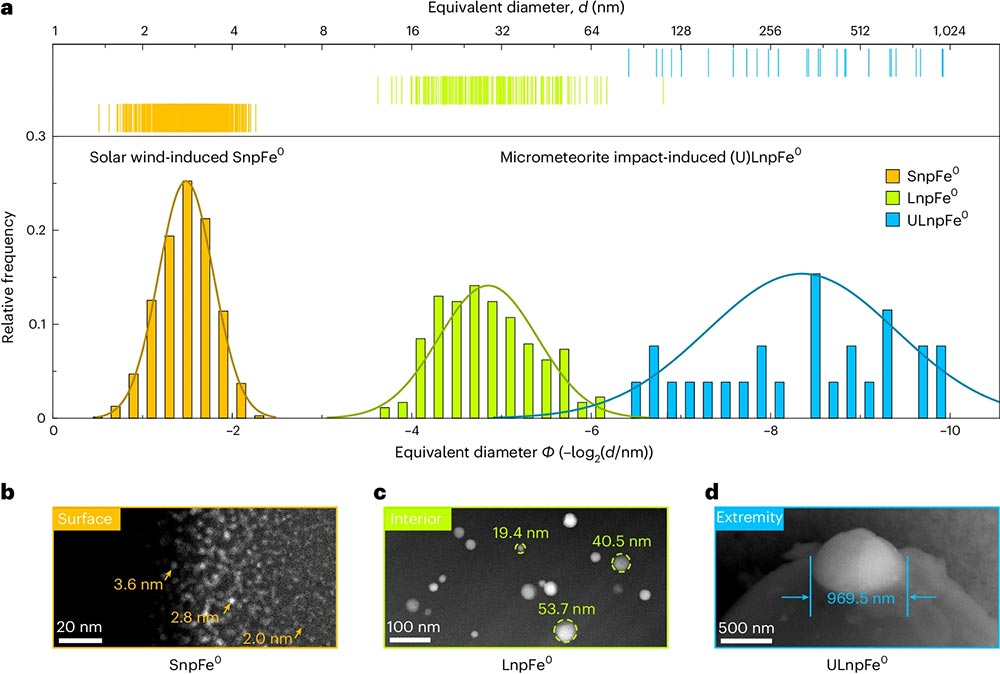
In this study, the scientists found numerous discrete large npFe0, tens of nanometers in size, which tended to concentrate towards the extremities of the glass beads. This concentration effect can cause ultralarge npFe0 to protrude from the extremities. Such a feature is exactly consistent with the migration phenomenon occurring in rotational glass-forming droplets triggered by hypervelocity impacts. In such scenarios, Fe0 with higher density than the matrix migrates to the extremities driven by centrifugal forces, indicating that these large npFe0 were formed in impact-derived melts before the glass beads solidified.
Role of Solar Wind in Forming Small npFe0
In contrast, they also identified abundant small npFe0, several nanometers in size, densely populating the surfaces of the glass beads. These small npFe0 exhibit distribution characteristics similar to irradiation-induced vesicle damage. Along the depth direction of the glass beads, both small npFe0 and vesicles gradually decrease in size and abundance, corresponding to the decreasing amount of implanted solar wind ions with increasing depth. Furthermore, when the size of the lunar grains is smaller than twice the penetration depth of the solar wind ions, small npFe0 can completely fill up the tiny grains. These results emphasize that solar wind irradiation is the primary driver of the observed small npFe0.
Implications for Space Environment Studies
The study demonstrates that solar wind irradiation and micrometeorite impacts both play important but distinct roles in npFe0 formation. The independent growth of small and large npFe0 revealed in this research matches well with many remote sensing measurements, providing valuable insights for understanding and predicting the optical properties of airless bodies exposed to different space environments.
Reference: “Separate effects of irradiation and impacts on lunar metallic iron formation observed in Chang’e-5 samples” by Laiquan Shen, Rui Zhao, Chao Chang, Jihao Yu, Dongdong Xiao, Haiyang Bai, Zhigang Zou, Mengfei Yang and Weihua Wang, 20 June 2024, Nature Astronomy.
DOI: 10.1038/s41550-024-02300-0
The study was supported by the National Natural Science Foundation of China, the Chinese Academy of Sciences, and the National Natural Science Foundation of Guangdong Province, among others.
Never miss a breakthrough: Join the SciTechDaily newsletter.
Follow us on Google and Google News.