
Close Menu
    Facebook X (Twitter) Instagram
    SciTechDaily
    • Biology
    • Chemistry
    • Earth
    • Health
    • Physics
    • Science
    • Space
    • Technology
    Facebook X (Twitter) Pinterest YouTube RSS
    SciTechDaily
    Home»Space»Astronomers Discover a Fifth Moon Orbiting Pluto
    Space

    Astronomers Discover a Fifth Moon Orbiting Pluto

    By NASAJuly 11, 20121 Comment4 Mins Read
    Facebook Twitter Pinterest Telegram LinkedIn WhatsApp Email Reddit
    Share
    Facebook Twitter LinkedIn Pinterest Telegram Email Reddit
    Fifth Moon Orbiting Pluto
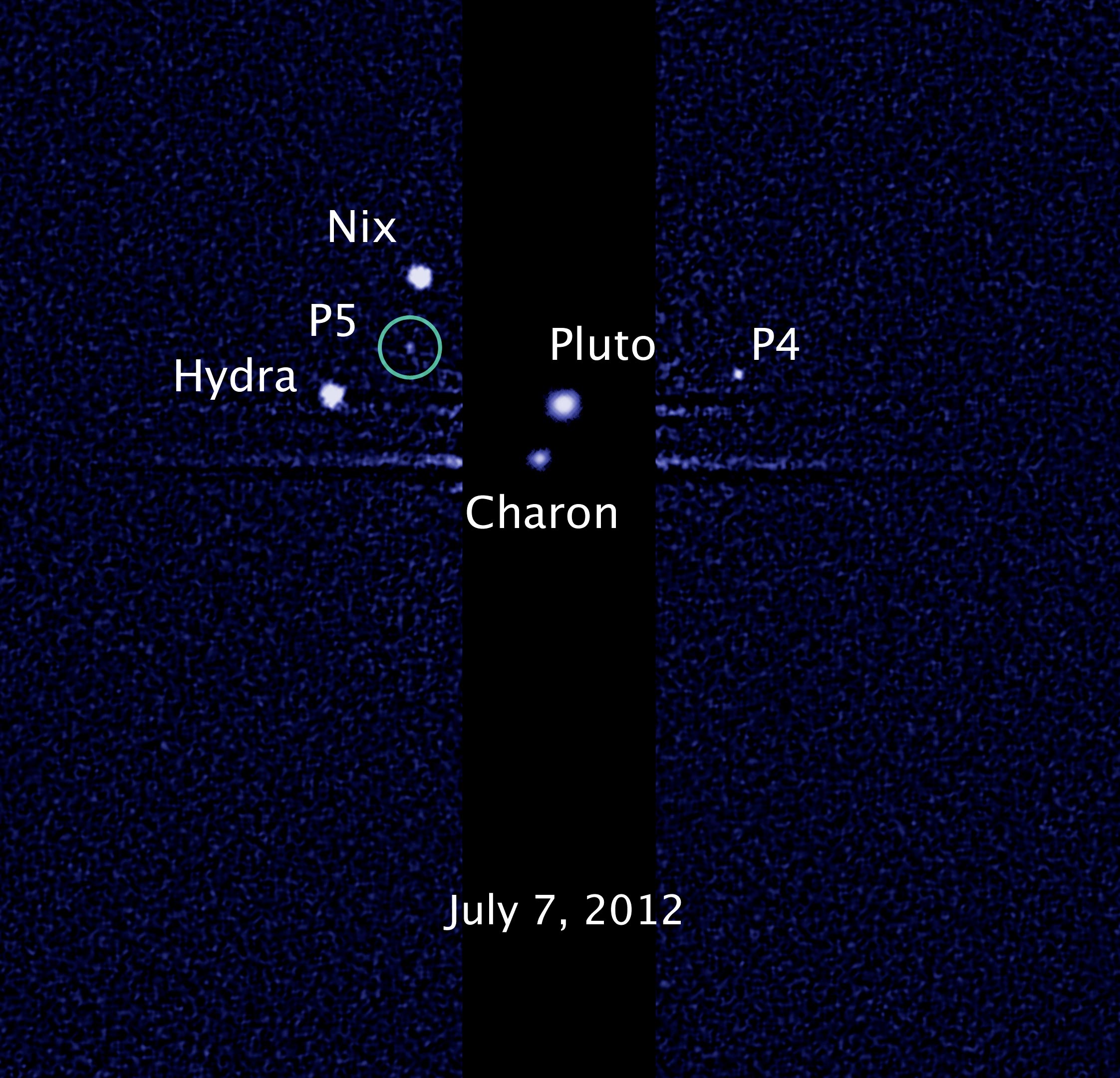
    This image, taken by NASA’s Hubble Space Telescope, shows five moons orbiting the distant, icy dwarf planet Pluto. The green circle marks the newly discovered moon, designated P5, as photographed by Hubble’s Wide Field Camera 3 on July 7. The observations will help scientists in their planning for the July 2015 flyby of Pluto by NASA’s New Horizons spacecraft. P4 was uncovered in Hubble imagery in 2011. Credit: NASA; ESA; M. Showalter, SETI Institute

    Using NASA’s Hubble Space Telescope, astronomers discovered a fifth moon, designated P5, orbiting Pluto that is irregular in shape and 6 to 15 miles across.

    A team of astronomers using NASA’s Hubble Space Telescope is reporting the discovery of another moon orbiting the icy dwarf planet Pluto.

    The moon is estimated to be irregular in shape and 6 to 15 miles (10 to 24 kilometers) across. It is in a 58,000-mile-diameter (93,000-kilometer-diameter) circular orbit around Pluto that is assumed to be co-planar with the other satellites in the system.

    “The moons form a series of neatly nested orbits, a bit like Russian dolls,” said team lead Mark Showalter of the SETI Institute in Mountain View, California.

    The discovery increases the number of known moons orbiting Pluto to five.

    The Pluto team is intrigued that such a small planet can have such a complex collection of satellites. The new discovery provides additional clues for unraveling how the Pluto system formed and evolved. The favored theory is that all the moons are relics of a collision between Pluto and another large Kuiper belt object billions of years ago.

    The new detection will help scientists navigate NASA’s New Horizons spacecraft through the Pluto system in 2015, when it makes a historic and long-awaited high-speed flyby of the distant world.

    The team is using Hubble’s powerful vision to scour the Pluto system to uncover potential hazards to the New Horizons spacecraft. Moving past the dwarf planet at a speed of 30,000 miles (48,000 kilometers) per hour, New Horizons could be destroyed in a collision with even a BB-shot-size piece of orbital debris.

    “The discovery of so many small moons indirectly tells us that there must be lots of small particles lurking unseen in the Pluto system,” said Harold Weaver of the Johns Hopkins University Applied Physics Laboratory in Laurel, Maryland.

    “The inventory of the Pluto system we’re taking now with Hubble will help the New Horizons team design a safer trajectory for the spacecraft,” added Alan Stern of the Southwest Research Institute in Boulder, Colorado, the mission’s principal investigator.

    Pluto’s largest moon, Charon, was discovered in 1978 in observations made at the United States Naval Observatory in Washington, D.C. Hubble observations in 2006 uncovered two additional small moons, Nix and Hydra. In 2011 another moon, P4, was found in Hubble data.

    Provisionally designated S/2012 (134340) 1, the latest moon was detected in nine separate sets of images taken by Hubble’s Wide Field Camera 3 on June 26, 27, 29, and July 7 and 9.

    In the years following the New Horizons Pluto flyby, astronomers plan to use the infrared vision of Hubble’s planned successor, NASA’s James Webb Space Telescope, for follow-up observations. The Webb telescope will be able to measure the surface chemistry of Pluto, its moons, and many other bodies that lie in the distant Kuiper Belt along with Pluto.

    The Pluto Team members are M. Showalter (SETI Institute), H.A. Weaver (Applied Physics Laboratory, Johns Hopkins University), and S.A. Stern, A.J. Steffl, and M.W. Buie (Southwest Research Institute).

    The Hubble Space Telescope is a project of international cooperation between NASA and the European Space Agency. NASA’s Goddard Space Flight Center in Greenbelt, Maryland, manages the telescope. The Space Telescope Science Institute (STScI) in Baltimore conducts Hubble science operations. STScI is operated for NASA by the Association of Universities for Research in Astronomy, Inc., in Washington, D.C.

    Never miss a breakthrough: Join the SciTechDaily newsletter.
    Follow us on Google and Google News.

    Astronomy Hubble Space Telescope Johns Hopkins APL Moon NASA Planets Pluto
    Share. Facebook Twitter Pinterest LinkedIn Email Reddit

    Related Articles

    Uranus Is Changing – Hubble’s 20-Year Time-Lapse Uncovers Atmospheric Surprises

    A Tale of Four Worlds: Hubble’s Ten-Year Hunt for Secrets in the Outer Solar System

    Jupiter’s Great Red Spot Enigma: Unexplained Oscillations Baffle Astronomers

    Unlocking Uranus: NASA’s Dual Observations Pave the Way to Discovering New Worlds

    The Great Escape: NASA’s Hubble and MAVEN Help Solve Mystery of Mars’ Vanishing Water

    New Horizons Spacecraft Awakens for Encounter with Pluto System

    Hubble Data Reveals a New Neptune Moon

    Io’s Volcanoes Are Not Located Where Scientists Expected

    Hubble to Test Technique of Using the Moon as a Mirror

    1 Comment

    1. science and techno world on July 12, 2012 11:52 pm

      It is really amazing that a small object like Pluto has five moons.

      Reply
    Leave A Reply Cancel Reply

    • Facebook
    • Twitter
    • Pinterest
    • YouTube

    Don't Miss a Discovery

    Subscribe for the Latest in Science & Tech!

    Trending News

    Scientists Say This Simple Supplement May Actually Reverse Heart Disease

    Warming Oceans Could Trigger a Dangerous Methane Surge

    This Simple Movement Could Be Secretly Cleaning Your Brain

    Male Birth Control Breakthrough: Scientists Find Way To Turn Sperm Production Off and Back On

    A Common Vitamin Could Hold the Key to Treating Fatty Liver Disease

    New Research Shows Vitamin B12 May Hold the Key to Healthy Aging

    These Simple Daily Habits Can Quickly Improve Blood Pressure and Heart Risk Factors

    A Common Nutrient May Play a Surprising Role in Anxiety

    Follow SciTechDaily
    • Facebook
    • Twitter
    • YouTube
    • Pinterest
    • Newsletter
    • RSS
    SciTech News
    • Biology News
    • Chemistry News
    • Earth News
    • Health News
    • Physics News
    • Science News
    • Space News
    • Technology News
    Recent Posts
    • That Haunted Feeling May Be Caused by a Sound You Can’t Hear
    • Scientists May Have Discovered How Parkinson’s Disease Spreads Through the Brain
    • A Simple Blood Test Could Predict Your Odds of Living Longer With Surprising Accuracy
    • Scientists Unveil New Treatment Strategy That Could Outsmart Cancer
    • Why Some Brains Switch Gears Faster Than Others
    Copyright © 1998 - 2026 SciTechDaily. All Rights Reserved.
    • Science News
    • About
    • Contact
    • Editorial Board
    • Privacy Policy
    • Terms of Use

    Type above and press Enter to search. Press Esc to cancel.