
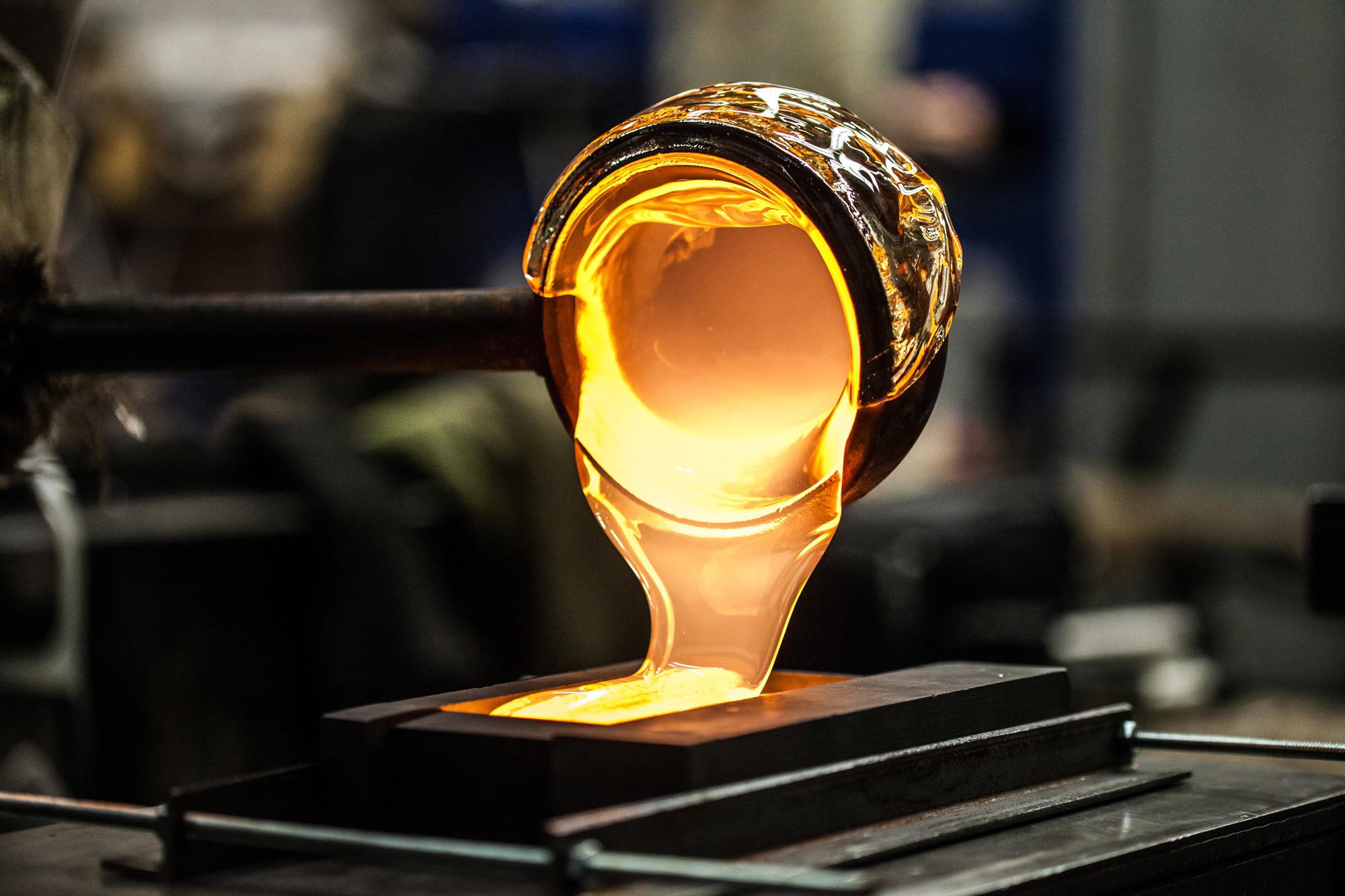
Researchers can now rewrite glass chemistry while it is still molten, unlocking properties that extreme heat once made impossible.
A team from TU Dortmund University, Paderborn University, the University of Duisburg-Essen, and the University of Oxford developed the method for glasses made from metal-organic frameworks, commonly called MOFs. Reported in Nature Materials, the technique uses an organic molecule to lower the melting temperature while reorganizing the bonds around metal atoms.
That dual action solves a persistent manufacturing problem. Some promising materials break down before they melt, leaving behind impurities that can interfere with their useful properties. Processing them more gently could help scientists create specialized glasses for gas storage, batteries, optics, catalysis, sensors, and optoelectronics.
Rewriting Glass While It Melts
“We have found a way to chemically modify the structure of glasses derived from so-called metal-organic framework compounds—or MOFs for short—right during the manufacturing process,” explains Prof. Dr. Sebastian Henke from TU Dortmund University, who led the study. The key ingredient is 1,10-phenanthroline, an organic molecule that changes how the metal atoms are connected as the material melts.
“Normally, glass is formed when a molten liquid cools rapidly. The solid structure then sets without the atoms arranging themselves in a regular pattern. Until now, researchers often had to accept the chemistry of these glasses as dictated by the starting material,” explains Prof. Henke. Unlike crystals, which contain repeating atomic arrangements, glasses trap atoms in a disordered structure. That disorder gives glass many of its distinctive properties, but it also makes its internal chemistry harder to design and study.
MOFs begin as networks of metal centers joined by organic compounds. When phenanthroline is introduced in the liquid state, it does more than occupy empty space. “The crucial point is that the molecule does not simply remain as a filler,” Prof. Henke continues. “It enters into a reaction. So we are altering the chemistry at precisely the moment when the material is still liquid.”
One Molecule, Two Functions
The scientists mixed phenanthroline with the starting ingredients before heating them. “As a flux, the substance lowers the temperature at which the material melts; as a chemical agent, the molecule binds directly to the metal atoms and partially displaces old bonds. In the molten state, the molecule interferes with what is known as the coordination environment. This term describes how many neighbors surround a single atom. Because the new molecule binds more strongly to the metal centers, the number of neighbors increases,” explains Prof. Henke.
This interaction restructures the wider glass network. By varying the amount of phenanthroline, the researchers can adjust how extensively the bonds are reorganized. That gives them a direct way to tune properties such as magnetism and light emission instead of accepting whatever structure the original ingredients produce.
The lower melting temperature is equally important. Without it, several of the materials examined would decompose before they could form glass. “Thanks to this molecular trick, the material melts at significantly lower temperatures and remains stable. Studies on cobalt-containing glasses have shown that this gentler process prevents the formation of harmful decomposition products,” explains Prof. Dr. Matthias Bauer from Paderborn University. Eliminating those impurities allowed the team to observe the glass’s intrinsic magnetic behavior, which contamination could otherwise obscure.
Confirming the Atomic Transformation
Proving that the atoms had been rearranged required methods capable of examining a material without a repeating crystal structure. “Instead, we used X-ray absorption spectroscopy, among other techniques. This method enabled us to investigate the immediate surroundings of the cobalt atoms,” Prof. Bauer explains.
The measurements showed that the cobalt atoms remained in the same chemical state (oxidation state), even as their local surroundings changed substantially. In other words, the process did not alter the atoms’ oxidation state. It changed which neighboring molecules were attached to them and how those bonds were arranged.
The team also demonstrated that the technique works beyond a single material family by applying it successfully to so-called carboxylate-based scaffold structures. This broader compatibility suggests that melt chemistry could become a versatile strategy for designing organometallic glasses with tailored behavior.
Turning the Melt Into a Design Tool
Prof. Henke summarizes the significance for the future: “The melt is no longer a rigid intermediate state. It becomes a reaction space in which we can program the structure.” Instead of treating melting as merely the step between solid ingredients and finished glass, scientists could use it as an opportunity to build new chemical arrangements.
That control may eventually lead to glasses engineered for specific roles in catalysis, chemical sensing, and optoelectronics. By manipulating the environment around individual metal centers, researchers could develop components that regulate light, magnetism, or chemical reactions with far greater precision.
Reference: “Flux-mediated ligand exchange restructures metal–organic framework glasses” by Jan-Benedikt Weiß, Lorena Fritsch, Michele Tricarico, Anke Schoch, Soma Salamon, Wen-Long Xue, Chinmoy Das, Pascal Kolodzeiski, Heiko Wende, Jin-Chong Tan, Matthias Bauer and Sebastian Henke, 24 August 2026, Nature Materials.
DOI: 10.1038/s41563-026-02712-5
Never miss a breakthrough: Join the SciTechDaily newsletter.
Follow us on Google and Google News.
1 Comment
Started is here now