
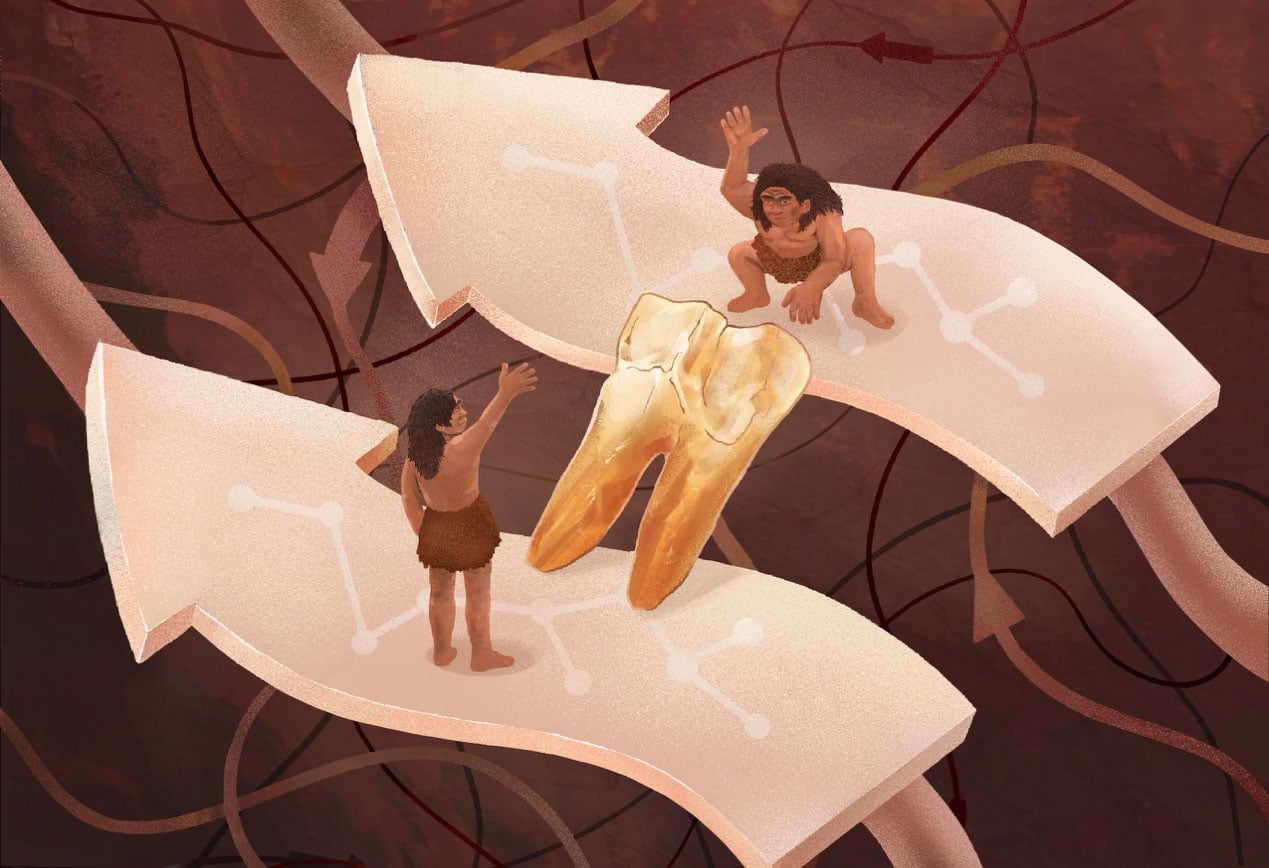
Enamel proteins from Homo erectus teeth suggest genetic links to Denisovans while offering a less destructive way to study ancient human fossils.
A handful of ancient teeth may preserve clues to a relationship that has remained difficult to trace through fossils alone.
Researchers from the Institute of Vertebrate Paleontology and Paleoanthropology (IVPP) of the Chinese Academy of Sciences have recovered molecular evidence suggesting a possible connection between Homo erectus and modern humans, while developing less invasive paleoproteomics methods for studying rare fossils.
Homo erectus, or H. erectus, was the first species in the genus Homo known to have migrated out of Africa and occupies an important place in human evolutionary history. Yet the scarcity of molecular evidence has left major questions unresolved, including the species’ genetic characteristics, population diversity, and possible relationships with modern humans. Its role in human evolution therefore remains a major subject of debate.
One reason for this uncertainty is that ancient hominin fossils are both irreplaceable scientific specimens and valuable cultural heritage. Molecular techniques that require destructive sampling are often unacceptable, severely limiting what researchers can learn from H. erectus remains.
Proteins bypass a major fossil barrier
To work around that problem, a multi-institutional team led by Qiaomei Fu of IVPP used a micro-destructive acid etching technique to recover molecular information from six Homo erectus teeth while preserving their overall morphology.
The findings were published in Nature.
A commentary published alongside the research in Nature emphasized how enamel proteins recovered from the six Chinese H. erectus teeth provided “new insights into how ancient genetic material was eventually introduced into modern human populations.”
Two mutations connect ancient human lineages
The researchers detected two mutations in teeth from fossils at least 400,000 years old, recovered from three sites: Zhoukoudian (Peking Man), Hexian, and Sunjiadong. The variants point to possible genetic connections between East Asian H. erectus and Denisovans, an archaic human group that also contributed genetic material to modern populations.
One mutation, AMBN-A253G, had not previously been identified. The researchers propose it as a potential molecular marker for these H. erectus populations, providing the first evidence that specimens from all three sites belonged to the same evolutionary population.
The second variant, AMBN-M273V, had previously been considered specific to Denisovans. The new results indicate that it was not unique to Denisovans and was also present in these H. erectus populations.
According to the researchers, AMBN-M273V may have entered the Denisovan lineage through admixture and later reached some modern human populations (in Southeast Asia and Oceania) through Denisovan introgression. The finding offers the first molecular clues to a possible relationship between East Asian H. erectus (such as those from Zhoukoudian) and Denisovans, as well as potentially deeper genetic connections with some present-day humans.
New methods could preserve more fossils
The work also introduces a set of experimental and computational methods for future paleoproteomics research.
These include a technique for determining the sex of ancient hominins using the male-specific enamel protein AMELY, a cross-validation strategy combining tandem mass spectrometry with multiple data analysis pipelines, and DNA analysis approaches tied to specific amino acid variants. Together, the methods provide a framework for extracting molecular information from ancient fossils while reducing damage to valuable specimens.
Reference: “Enamel proteins from six Homo erectus specimens across China” by Qiaomei Fu, Zhongyou Wu, E. Andrew Bennett, Song Xing, Qiang Ji, Zhe Dong, Huiyun Rao, Xuejun Gu, Yizhao Dang, Jun Xing, Kai Zhou and Xiaotian Feng, 13 May 2026, Nature.
DOI: 10.1038/s41586-026-10478-8
This work was supported by the National Natural Science Foundation of China (L2424324), the Chinese Academy of Sciences (CAS) (YSBR-019), the Archaeological Talent Promotion Program of China (2024-278) and the New Cornerstone Science Foundation.
Never miss a breakthrough: Join the SciTechDaily newsletter.
Follow us on Google and Google News.
3 Comments
Since H sapiens came into being between 300 000- 360 000 years ago, to judge from work in Morocco, one could surmise that interbreeding between H sapiens and any human precursor was possible. H erectus seems to have been around in Java just a short 100 000 years ago and Java is not far from both the Australia and Papua New Guinea. Teeth would survive a tropical climate as they live in the human mouth. There are plenty of caves in PNG and caves (sorry; sacred sites) in Australia. Not to mention teeth in the now lost-to-science Mungo Man and his lady, plus the Cow Creek skulls.
Odd how comments get removed.
Do ancient teeth show decay cuz I read that your teeth actually have protective covering and I’m wondering if we take it off of it with all those toothbrushing when we’re Young