
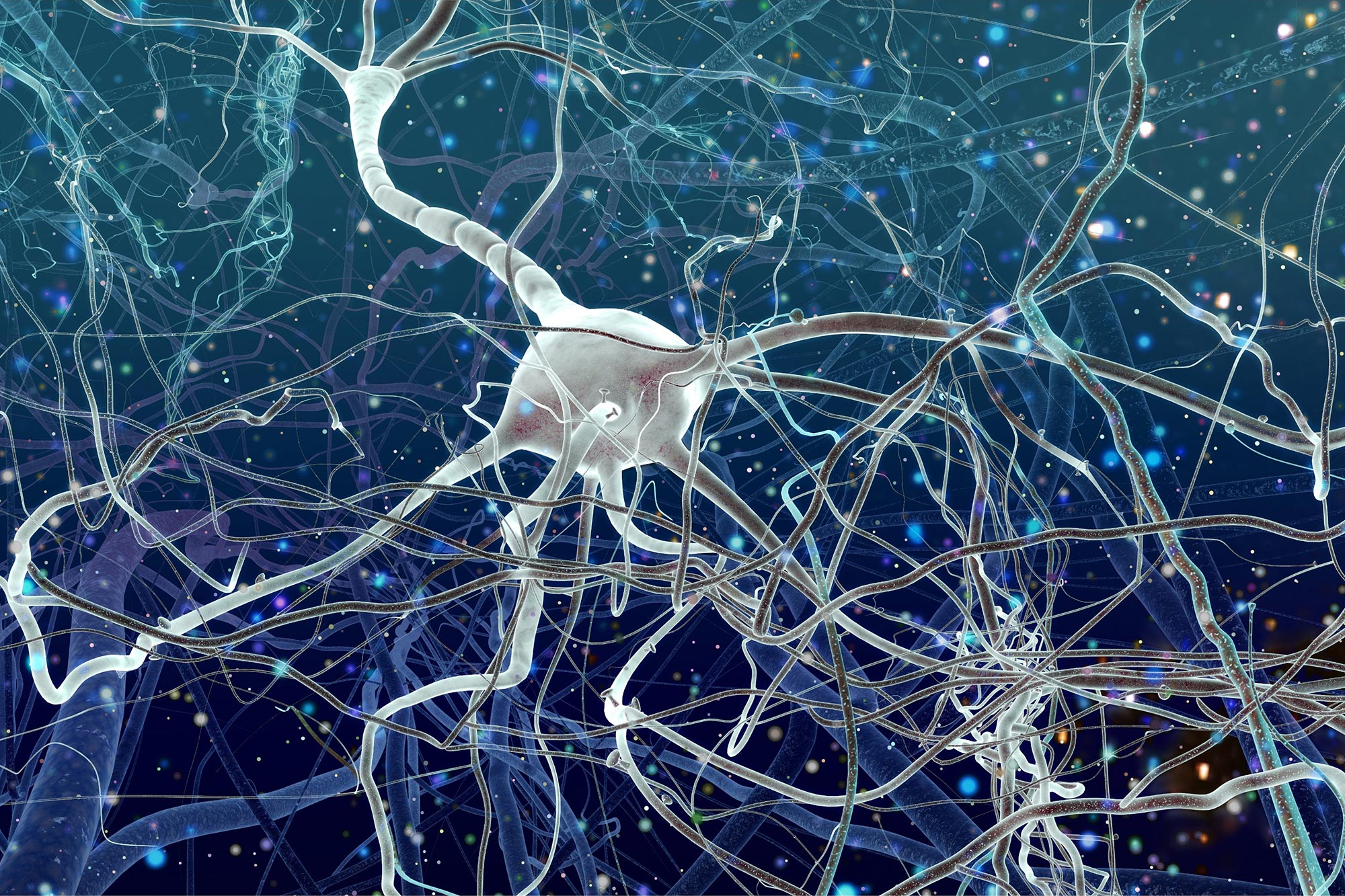
Salk Institute scientists found that immune cells in the central nervous system identify and kill specific nerve cells in the spinal cords of mice with late-stage ALS, worsening the disease. The findings could help inform new approaches to cancer and autoimmune therapies.
In amyotrophic lateral sclerosis (ALS), the nerve cells that control movement gradually die, breaking the connection between the brain and the muscles. Salk Institute researchers have now identified another contributor to that damage: immune cells in the central nervous system that can use a cellular cleanup system to target and consume living motor neurons in mice with ALS.
Those immune cells, called microglia, rely on TAM receptors, a family of proteins that helps the body recognize and remove dying cells. The new work shows that in the spinal cords of mice with ALS, this system can instead direct microglia toward motor neurons that are still alive.
ALS currently affects around 35,000 Americans, according to the CDC, with another 5,000 diagnosed each year. The risk increases with age, existing treatments can only slow the disease, and there is no cure.
The study was published in Nature Communications.
Immune cells emerge as ALS drivers
ALS progressively destroys motor neurons, the nerve cells that carry signals from the brain to the muscles. As those neurons fail and disappear, symptoms can advance from tremors and poor coordination to the loss of the ability to walk, talk, eat, and eventually breathe.
Because motor neurons are so central to the disease, they have long dominated ALS research. But scientists have also found that microglia, immune cells found specifically in the brain and spinal cord, become highly active in people with ALS. What remained unclear was what those activated cells were actually doing.
One clue came from TAM receptors, which can be used to identify active microglia. Senior author Greg Lemke, PhD, distinguished professor emeritus at Salk, discovered this family of proteins more than three decades ago. TAM receptors form an important link between the immune system and the rest of the body by helping immune cells recognize material that needs to be cleared away.
“Cells that are dying throw an ‘eat me’ sign out on their surface, and the TAM system recognizes that sign,” explains Lemke, distinguished professor emeritus at Salk. “It’s an essential system that clears billions upon billions of dead and dying cells from the body daily. We wondered whether microglia were corrupting this TAM system to kill living neurons in ALS.”
TAM receptors target living neurons
To test that possibility, the researchers turned to SOD1 mice, the most widely used mouse model of ALS. These animals produce a mutant form of the SOD1 protein that causes ALS in people.
Inside the spinal cords of these mice, the researchers found evidence that many motor neurons had already been consumed. TAM proteins were also present at elevated levels, particularly Axl and Mer.
Closer examination revealed another important clue. Motor neurons were displaying phosphatidylserine, small molecules that function as the “eat me” signals normally associated with dying cells, even when they should not have been present. Those signals activated the TAM system, directing microglia toward living neurons.
Removing TAM proteins preserved motor neurons
The natural next question in the lab, Lemke shares, is “what happens when we eliminate Axl and Mer?” Removing those two TAM proteins produced an unexpected result: the mice became sick more quickly, yet survived longer. “This was very weird to see,” continues Lemke. “Since the TAM system is so important throughout the body, you would assume that removing them would be devastating.”
“But it somehow was not devastating,” says first author Youtong Huang, PhD, a former graduate student researcher in Lemke’s lab. “When we looked at how many motor neurons mice without Axl and Mer had, compared to mice with Axl and Mer, we found losing the TAM proteins meant preserving muscle controls.”

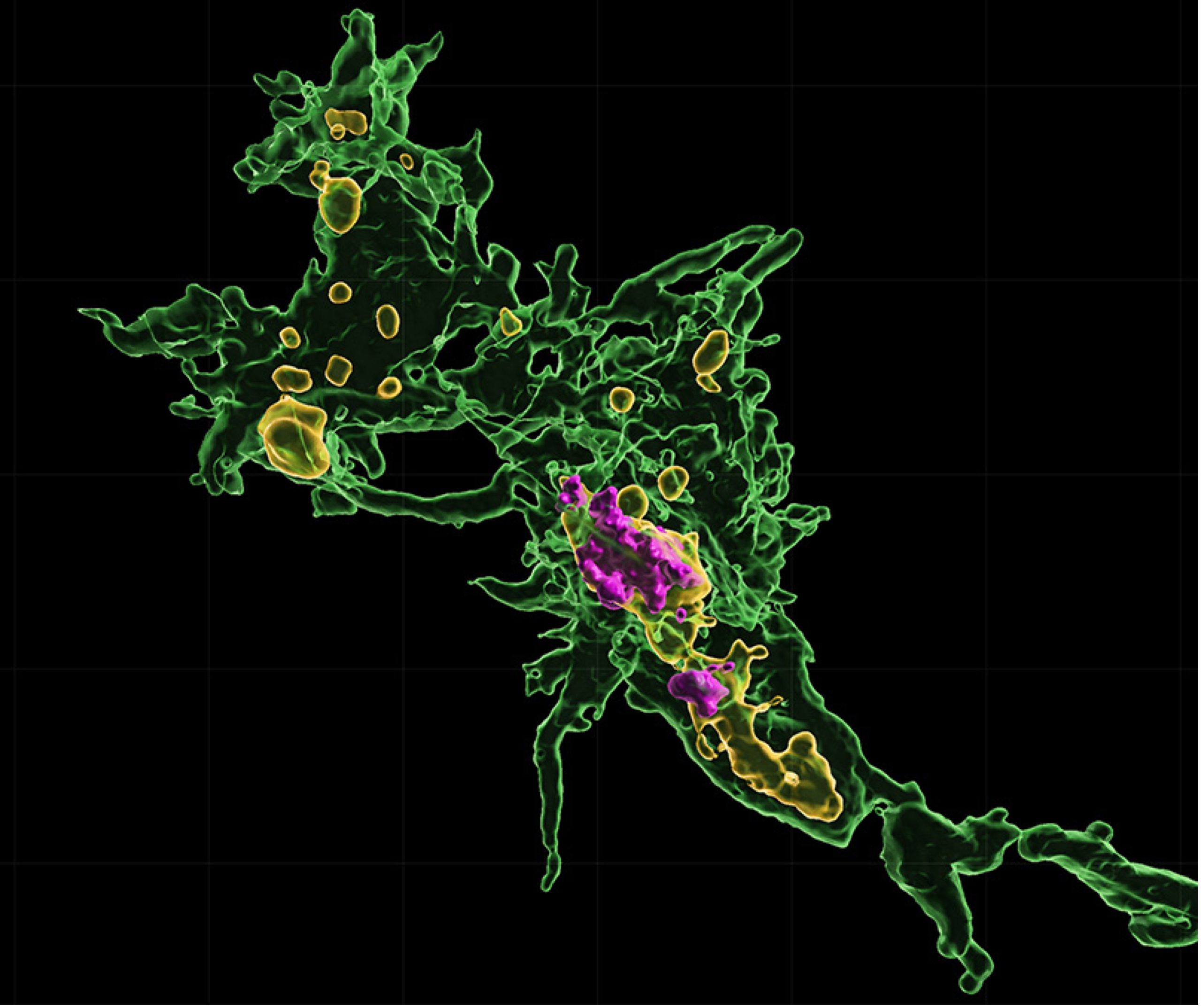
The difference was also visible inside the spinal cord. Microglia in SOD1 mice contained large numbers of consumed neurons, but this accumulation dropped sharply when the TAM system was disabled.
“The bottom line is, microglia are using the TAM system to eat cells that aren’t dead,” says Lemke. This is the first time the TAM system has been shown to target living cells—a finding that likely has repercussions in other parts of the body beyond the central nervous system.
The results provide a new mechanism that may help explain why microglial activation is associated with ALS and how those cells can contribute to the disease’s progression and lethality.
But Huang cautions against interpreting the findings as a simple argument for eliminating TAM activity altogether.
“But it’s important to note that, while these findings may suggest we start designing therapies that remove the TAM system, there are so many more variables at play, and we really don’t see that as the best option,” says Huang. “Rather, therapies that target the TAM system must also target the underlying mechanisms of ALS—or other neurodegenerative diseases like Alzheimer’s or Parkinson’s—to be truly effective.”
The finding extends beyond ALS
The findings also broaden what researchers know about the biology of microglia, neurons, and the TAM system beyond ALS. Other neurodegenerative diseases share some of the same molecular features. Elevated Axl, for example, is a hallmark of Alzheimer’s.
The discovery that TAM receptors can help destroy living cells also opened another possibility: deliberately directing the system against cells that researchers want removed. Groups in Japan and Korea have since developed ways to activate TAM proteins so they can tag selected living cells and recruit immune cells to consume them.
“Jun Suzuki’s research group in Kyoto engineered a TAM-based protein that was able to induce ‘eating’ of live B cells to alleviate autoimmunity in mice with lupus, then engineered another TAM-based protein that enabled ‘eating’ of live cancer cells and reduced tumor growth in mice with melanoma,” shares Huang.
“There is enormous potential for this in clinical translation,” says Lemke. “Rather than engineering entire cells as immunotherapies—a process that is far more complicated, time-consuming, and invasive—we could simply design TAM-based proteins that target any cell you’d like. I’m really excited to see where this discovery goes and how it changes immunotherapy opportunities.”
Reference: “Microglia deploy TAM receptors to kill motor neurons in a mouse model of amyotrophic lateral sclerosis” by Youtong Huang, Ananya Mavinkurve, Bristy Sabikunnahar, Beth Stevens and Greg Lemke, 15 August 2026, Nature Communications.
DOI: 10.1038/s41467-026-76728-5
The work was supported by the National Institutes of Health (RF1 AG060748, R01 AI101400, RF1 NS092578), Harvard Medical School, Salk Women in Science Award, UC San Diego, Marguerite Vogt, and H. A. and Mary K. Chapman Charitable Trust.
Never miss a breakthrough: Join the SciTechDaily newsletter.
Follow us on Google and Google News.