
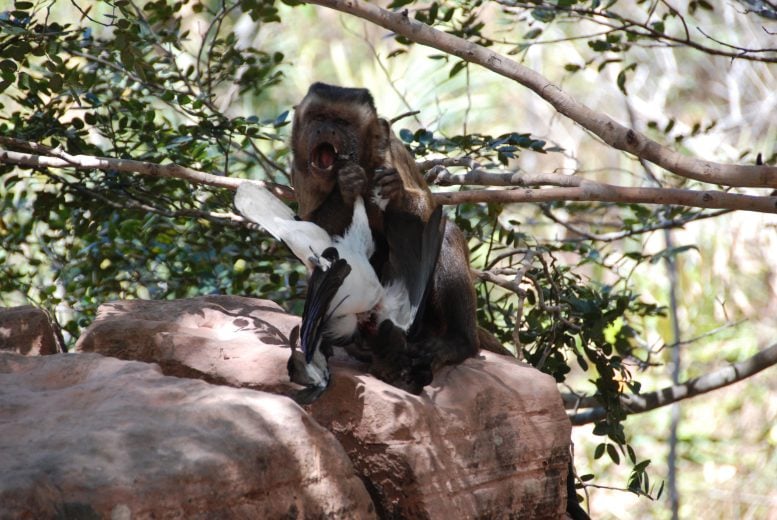
When fruit disappears, bearded capuchins switch from foraging to hunting, targeting everything from lizards and rodents to snakes, iguanas, and young birds.
Bearded capuchin monkeys hunt more small vertebrates when fruit is scarce, according to a long-term field study in Brazil. The behavior may offer clues to how early human ancestors obtained nutrient-rich food during shortages before hunting large animals became common.
Humans are the only living primates that regularly pursue animals as large as or larger than themselves. That behavior, often called the human predatory pattern, has been linked to larger brains, cooperation, and increasingly sophisticated tools. Yet the path to big game may have begun with far smaller prey that required less energy and technology to capture.
Thousands of Hours Reveal a Hidden Diet
To explore what drives primates to hunt, Susana Carvalho (Gorongosa National Park, Mozambique), Noemi Spagnoletti (Sapienza University of Rome, Italy), and their colleagues followed two groups of wild bearded capuchins at Fazenda Boa Vista in northeastern Brazil. Their findings were published in the open-access journal PLOS ONE.
Vertebrate consumption. (a) A young capuchin eating a vertebrate; (b) Capuchin feeding on a lizard. Credit: This video is taken from the documentary “The bearded capuchin monkeys of Fazenda Boa Vista” (https://www.youtube.com/watch?v=7ojU43JgpYo) by Elisabetta Visalberghi and Alessandro Albani. The footage was not recorded during this study, but it illustrates what the authors reported, and extracts of it were included in the supplementary information of the Carvalho et al. (PLOS One, 2026) study under the CC-BY 4.0.
Across 45 months from 2006 to 2010, the researchers accumulated more than 5,000 hours of observations and documented 446 occasions when capuchins consumed vertebrates. Lizards accounted for 43% of the prey and rodents for 28%. The study also recorded these monkeys eating opossums, iguanas, and bird nestlings for the first time.
Their prey also included animals that were difficult or dangerous to catch. The capuchins caught geckos, snakes, bats, birds, and other small animals, showing that vertebrate meat was not merely an occasional accident in their diet. It was a recurring food source shaped by changing conditions.
Fruit Scarcity Turns Capuchins Into Hunters
Hunting increased as fruit availability declined, supporting the idea that vertebrates become worth the effort when preferred foods are harder to find. One group received supplemental nuts, corn, and water during the dry season. Members of the group without this extra food hunted at nearly twice the rate, strengthening the connection between scarcity and predation.
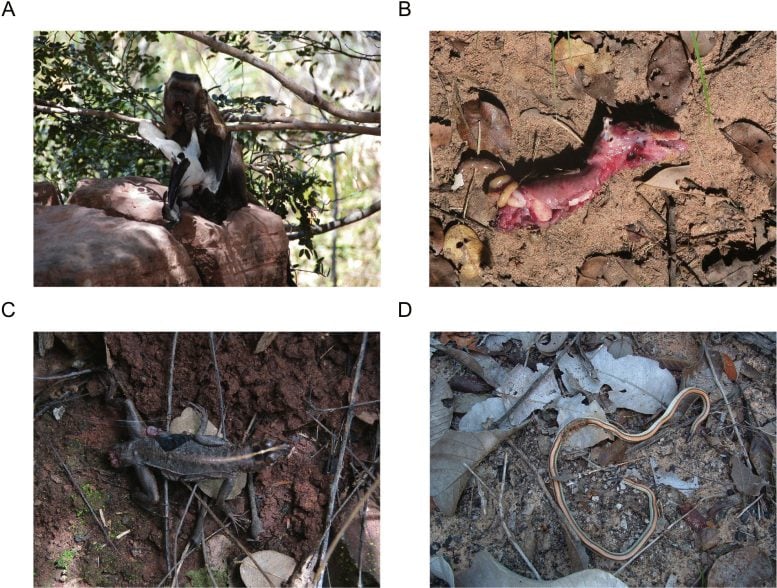
Males consumed vertebrates about 1.4 times as often as females and were more likely to pursue dangerous prey. Only males were observed eating snakes. Their larger bodies may require more energy, while the physical risk and skill involved in capturing mobile prey may also help explain the imbalance.
Experience appeared to matter as well. Infants consumed vertebrates at only one-fifth the adult rate, while juveniles did not differ significantly from adults. The finding suggests that effective hunting may develop as capuchins gain strength, coordination, and familiarity with prey.
Brains and Organs Offer a Nutritional Prize
The monkeys often began with the brain or internal organs rather than ordinary muscle. These tissues can provide concentrated fat and other valuable nutrients, making them especially useful when calories from fruit are scarce. Depending on the animal, the capuchins also ate eyes, skin, tails, paws, and other body parts.
This selective feeding may be relevant to human evolution. Fossil sites dating back roughly 2 million years indicate that early members of the human lineage exploited small animals before large prey became a major resource. Small vertebrates would have been easier to catch than big game and could have supplied energy-rich tissues without advanced weapons or coordinated group hunts.
Capuchins are not direct stand-ins for human ancestors, but they offer a living example of how an intelligent, adaptable primate can shift toward hunting when familiar foods disappear. Their behavior suggests that nutritional need, body size, experience, and opportunity may all have influenced the earliest stages of predation.
A hunting event of Type II (collective). Four young capuchins hidden in a bush attack an Iguana (Iguana iguana) passing nearby. One grasps and detaches the far end of the iguana’s tail. Meat transfer should have occurred while the capuchins were in the bush. However, it is important to note that sooner or later we observed all four of them eating parts of the iguana. Credit: This video is taken from the documentary “The bearded capuchin monkeys of Fazenda Boa Vista” (https://www.youtube.com/watch?v=7ojU43JgpYo) by Elisabetta Visalberghi and Alessandro Albani. The footage was not recorded during this study, but it illustrates what the authors reported, and extracts of it were included in the supplementary information of the Carvalho et al. (PLOS One, 2026) study under the CC-BY 4.0 license
Rethinking the Fossil Evidence
The researchers propose taking a fresh look at small animal remains from early human sites. Evidence of butchery, broken skulls, or selective access to brains and organs could reveal a form of hunting that is easy to overlook when research focuses mainly on the bones of large mammals.
Carvalho, director of science at Gorongosa National Park and one of the study’s lead authors, said, “This study highlights the critical need of long-term observational fieldwork to reliably understand the behavior of long-lived and highly flexible primate species.”
“When we look at 45 months of data, we see small vertebrates like lizards, rodents, and snakes as a key source of food when less fruit is available – and a preferential target for prey brains and viscera. Hunting small prey could have been an important source of nutrition for human ancestors during periods of food scarcity, providing a stepping stone to the exploitation of larger prey – the fossil record now needs re-analyzing to look at evidence of small vertebrate predation.”
Reference: “Small vertebrate consumption by capuchin monkeys (Sapajus libidinosus): Insights into the human predatory pattern” by Susana Carvalho, Noemi Spagnoletti, João d’Oliveira Coelho, Megan Beardmore-Herd, Olívia Mendonça-Furtado, Michele Verderane, Joana Prieto, Dominique I. Cavallaro, Patrícia Izar and Elisabetta Visalberghi, 26 August 2026, PLOS ONE.
DOI: 10.1371/journal.pone.0355204
This work was financially supported by a Scholarship for postgraduate study abroad (Law 398/89, Rector’s Decree of 25/01/2006) given to Noemi Spagnoletti by the University La Sapienza of Rome; EU FP6 NEST Programme ANALOGY (NS: 029088, Elisabetta Visalberghi PI for the ISTC-CNR Unit); FAPESP PhD scholarships (MPV: 06/51578-9; OMF: 08/52293-3) and FAPESP to Patrícia Izar PI (06/51577-2 and 08/55684-3), CNPq research grant # 307731/2096-5 to Patrícia Izar PI, CAPES (NS: 017/2012) to Noemi Spagnoletti PI, CNR Short-term Mobility Program to Elisabetta Visalberghi, and Funding from Ethoikos srl to Elisabetta Visalberghi PI.
Never miss a breakthrough: Join the SciTechDaily newsletter.
Follow us on Google and Google News.