
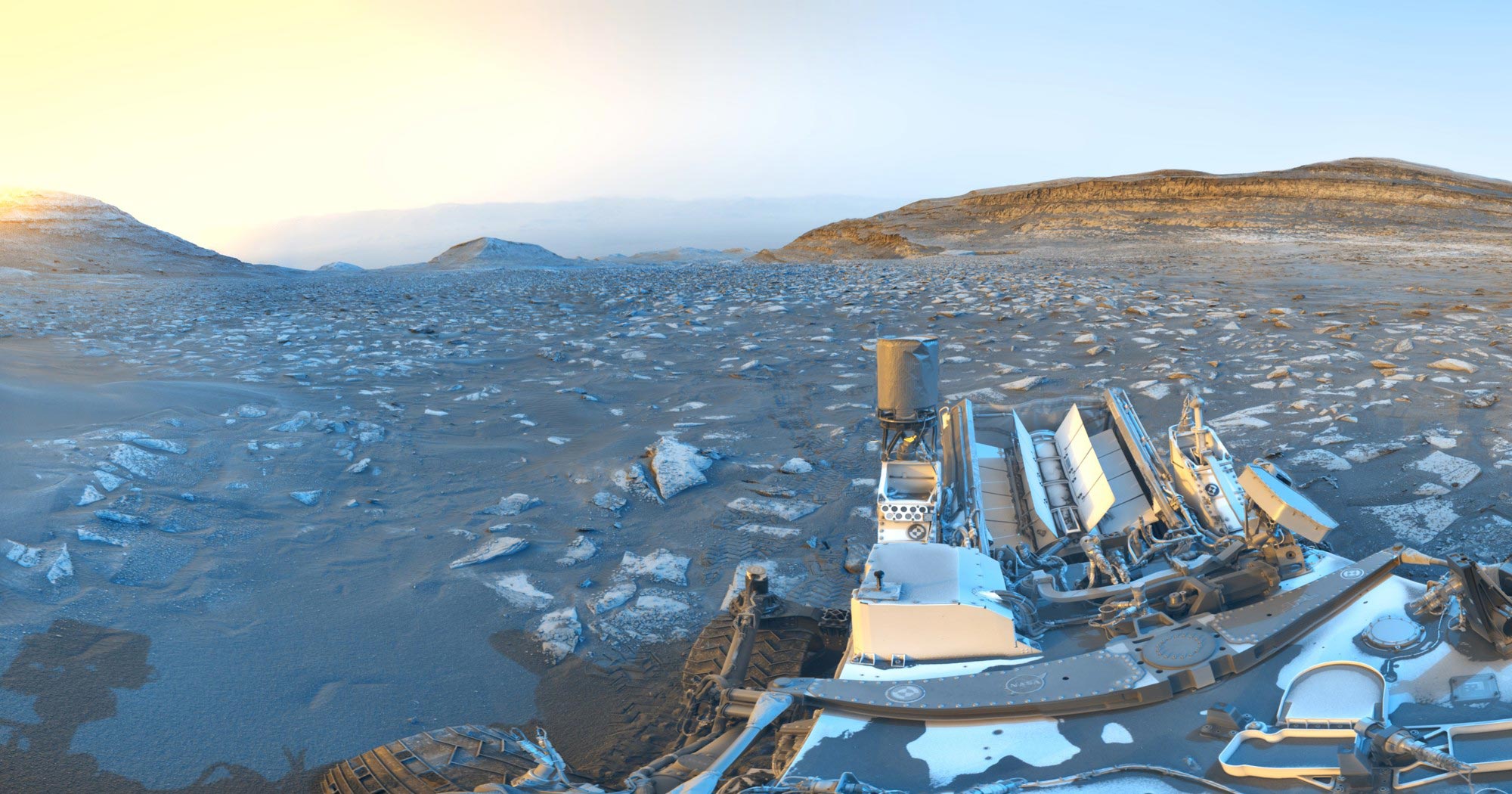
Curiosity marked 5,000 days on Mars with a vivid new postcard showing its tracks across Gale Crater.
NASA’s Curiosity Mars rover has captured a striking new view of the Red Planet while stopped at a sandy ridge nicknamed “Chocolatal.” Using its black-and-white navigation cameras, the rover photographed the surrounding landscape at two different times of day.
The first panorama was recorded on August 30, 2026, at 9:56 a.m. local Mars time, which marked Curiosity’s 5,000th Martian day, or sol, on the planet. A second panorama followed on September 2, 2026, at 5:39 p.m. local Mars time, during the mission’s 5,003rd sol.
Morning and Afternoon on Mars
Once the images reached Earth, they were combined into a single scene. Color was then added as an artistic interpretation, with blue used for the morning view and yellow for the afternoon panorama.
The finished image creates a postcard-like look that NASA has used with Curiosity imagery before, including a similar scene taken in November 2021.
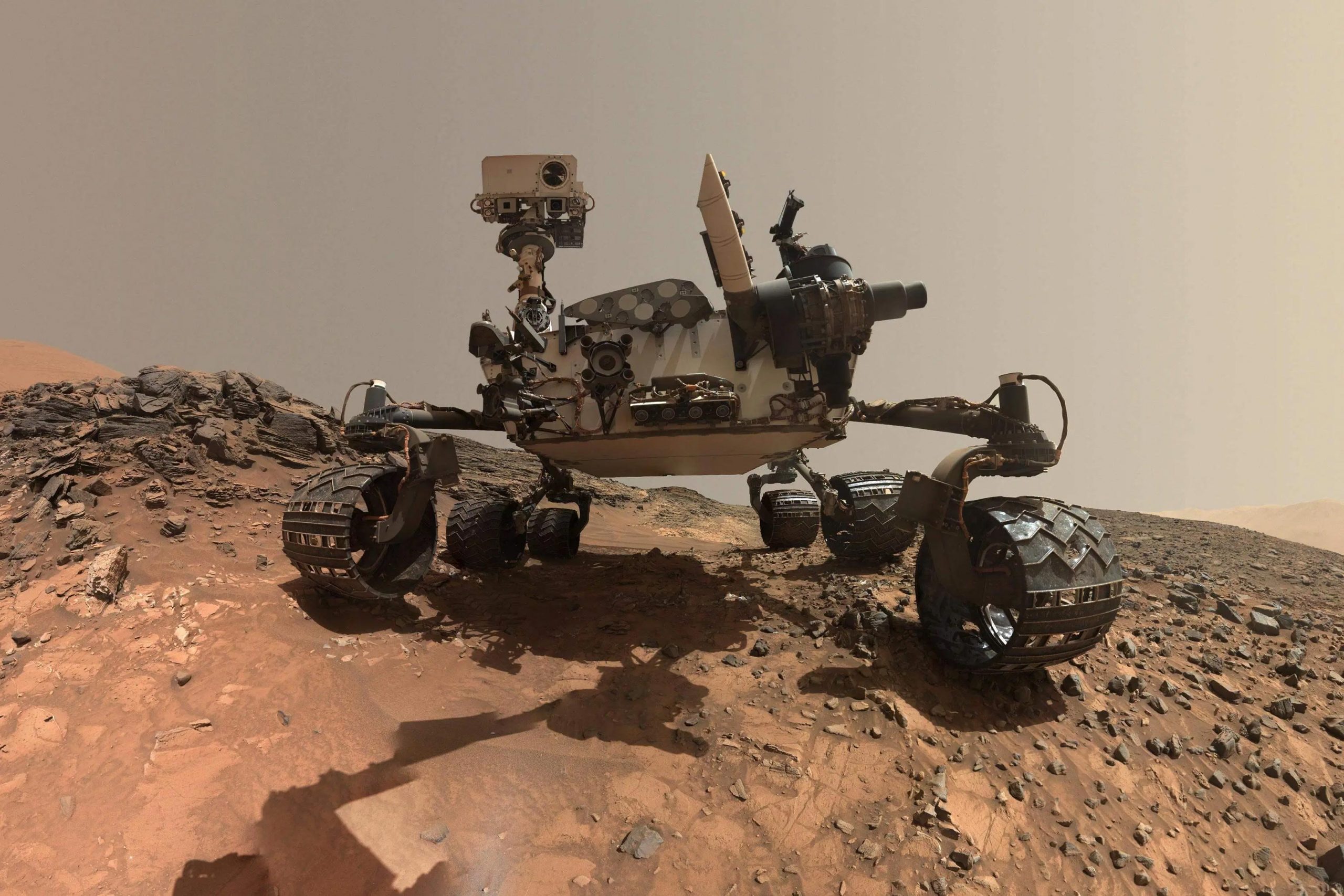
Curiosity and Its Tracks in View
Curiosity’s deck fills the foreground of the panorama. Visible equipment includes the rover’s can-shaped UHF antenna, which allows it to transmit data to spacecraft orbiting Mars.
Also visible at the rear is Curiosity’s finned Multi-Mission Radioisotope Thermoelectric Generator (MMRTG), the nuclear power source that supplies the rover with energy. Behind Curiosity, its tracks extend across the Martian terrain and fade into the distance.
Looking Across Gale Crater
The rover is currently exploring the lower foothills of Mount Sharp, a 3-mile-tall (5-kilometer-tall) mountain located inside Gale Crater. From Curiosity’s position, the panorama looks downward toward the crater floor. The distant rim of Gale Crater is only faintly visible along the horizon.
Curiosity was built by NASA’s Jet Propulsion Laboratory, which is managed by Caltech in Pasadena, California. JPL operates the mission for NASA’s Science Mission Directorate in Washington as part of NASA’s Mars Exploration Program portfolio.
Never miss a breakthrough: Join the SciTechDaily newsletter.
Follow us on Google and Google News.